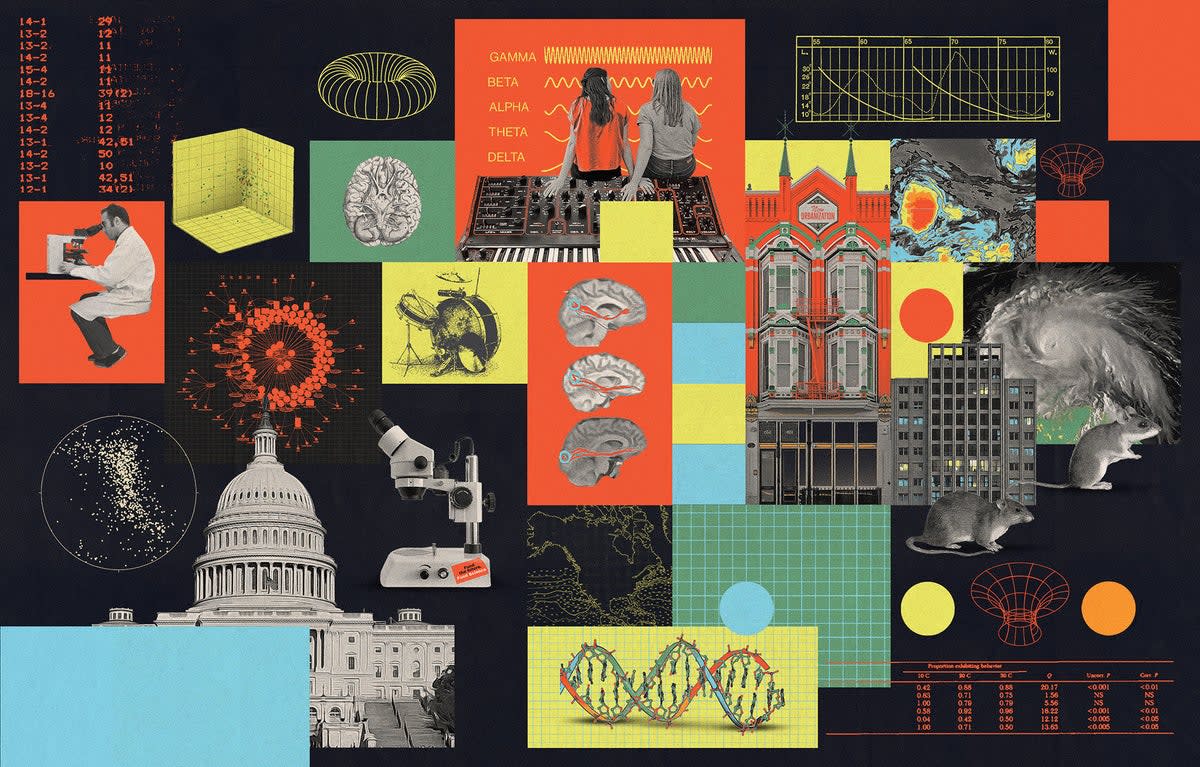
5 Young Scientists Changing Medicine, Climate, and Democracy
Five rising researchers are using music to heal mental health, teaching cells to fight blindness, and showing students how science can strengthen democracy. Their work proves groundbreaking research happens everywhere, not just at elite labs with massive budgets.
A physician who studies how music syncs our brains is helping us understand why a great song can bring strangers together. At Yale, Dr. Aza Allsop discovered that when people hear pleasing music face-to-face, their brains light up in areas linked to social connection.
Allsop combines his work as a neuroscientist, doctor, and musician to explore how sound might improve mental health. He also runs the Center for Collective Healing at Howard University, where neuroscience meets sociology to promote wellness and peace across communities.
Across the country at San Francisco State, Robert Boria is tracking how squirrels, mice, and other small mammals adapt to our warming, expanding cities. His team blends natural history with population genetics to predict how animals will respond to the changes ahead.
What makes Boria's work special? He's doing cutting-edge research at a commuter school without Ph.D. students, proving that important science doesn't require Ivy League resources.
Meanwhile, graduate student Colette Delawalla is mobilizing young scientists to protect research funding and evidence-based policy. Through her organization Stand Up for Science, she's organized protests against science cuts and worked within government to preserve the role of research in policymaking.
At Mount Sinai, Daniel Clarke writes the computer programs that help scientists make sense of massive genomics datasets. Despite lacking a traditional Ph.D., his tools have enabled multiple breakthrough publications. Colleagues call him the most creative member of their lab, yet programmers like Clarke rarely get recognition for the essential work they do.
Xing Chen at the University of Pittsburgh is working toward restoring sight for people blinded by accidents or glaucoma. She's using electrodes to stimulate visual brain regions, creating signals the brain interprets as shapes and letters without actual eyesight involved.
The Ripple Effect
These five scientists represent a shift in how research happens. They're working at teaching universities, blending art with science, and building tools instead of just using them. They're showing students that scientific discovery isn't locked behind elite institution gates.
Their work also crosses traditional boundaries. Music becomes medicine. Computer science unlocks cell biology. Political organizing protects labs nationwide.
Each researcher is opening doors for the scientists who'll come after them, proving that innovation thrives wherever curious minds ask better questions.
More Images


Based on reporting by Scientific American
This story was written by BrightWire based on verified news reports.
Spread the positivity!
Share this good news with someone who needs it