50-Year-Old Equation Shows Simple Math Can Explain Nature
A groundbreaking 1976 paper proved that the messy, unpredictable patterns in nature follow beautifully simple mathematical rules. Half a century later, Robert May's chaos theory work continues inspiring everything from literature to financial systems.
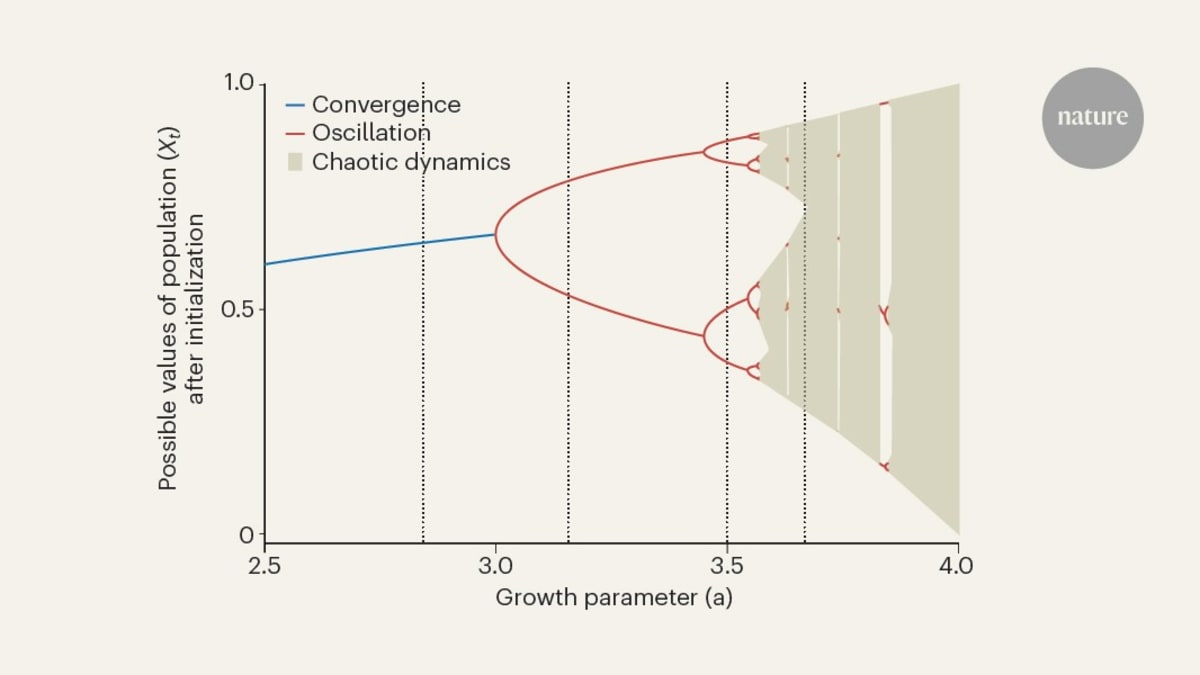
What if the seemingly random chaos of nature could be explained by an equation simple enough to fit on a napkin? That's exactly what ecologist Robert May proved 50 years ago, changing science forever.
In 1976, May published a paper in Nature that would become the foundation of chaos theory. He showed that wildly complex, unpredictable behavior in biological systems like animal populations could be described using surprisingly simple mathematical models.
The discovery was revolutionary. Scientists had long assumed that complicated outcomes required complicated causes. May flipped that assumption on its head.
His work revealed that tiny changes in starting conditions could lead to dramatically different outcomes, even when following the same mathematical rules. Think of it like predicting where a leaf will land after falling from a tree. The path seems random, but physics governs every twist and turn.
The paper's influence stretched far beyond biology labs. Playwright Tom Stoppard consulted with May while writing "Arcadia," his 1993 play exploring chaos theory and human nature. The mathematical concepts became art.
The Ripple Effect
Today, May's insights shape fields he never originally studied. Researchers apply chaos theory to understand heart rhythms and improve medical diagnoses. Cybersecurity experts use it to create stronger encryption systems.
Financial regulators now recognize that simple interactions in banking systems can cascade into economic crises. May himself later co-authored influential work on preventing financial crashes, drawing direct lines from ecology to economics.
The equation's legacy lives in our daily lives too. Weather forecasting, secure online shopping, and even understanding how diseases spread all rely on principles May helped establish.
What made May's work so powerful was its accessibility. Complex doesn't mean incomprehensible. The same mathematical beauty that governs how rabbit populations boom and bust also explains why predicting next week's weather remains challenging.
May passed away in 2020, but his paper remains one of the most cited works in mathematical biology. New applications continue emerging, from artificial intelligence to climate modeling.
The lesson resonates beyond science: sometimes the most profound truths come in the simplest packages.
More Images



Based on reporting by Nature News
This story was written by BrightWire based on verified news reports.
Spread the positivity!
Share this good news with someone who needs it