Scientists Find Brain Switch That Assigns Bees Their Jobs
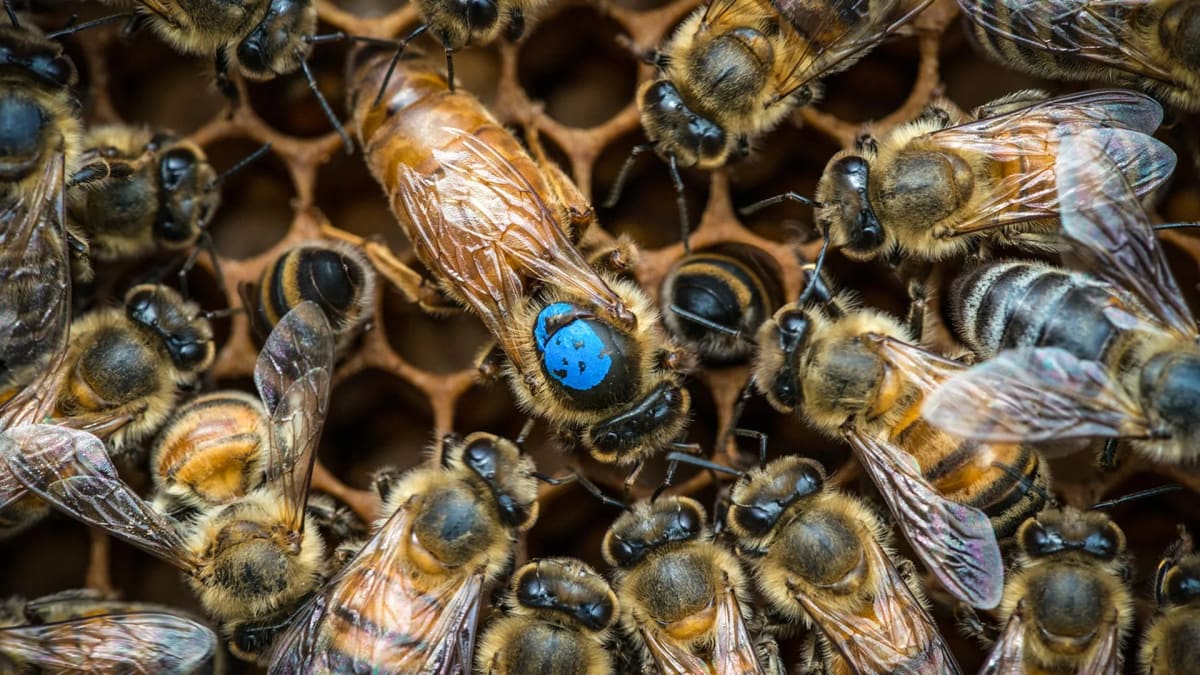
Researchers discovered specific brain circuits that determine whether a bee nurses the queen, guards the hive, or searches for food. By switching off these circuits, they made older worker bees return to caring for the queen like young bees do.
Scientists just unlocked one of nature's most fascinating mysteries: how a bee colony organizes thousands of workers without anyone giving orders.
Researchers at Heinrich Heine University Düsseldorf discovered that specific brain circuits act like neural switches, determining which jobs worker bees perform as they age. Young bees typically nurse the queen and larvae, middle-aged bees build and defend the hive, and only the oldest bees leave to search for food.
The breakthrough came when scientists studied a gene called doublesex. When they deactivated this gene in older worker bees, something remarkable happened: the experienced foragers abandoned their normal duties and returned to caring for the queen, a job typically reserved for the youngest workers.
Lead researcher Dr. Jana Seiler and her team took the experiment further. They selectively turned off specific neural circuits connected to the doublesex gene by feeding bees a substance that suppressed activity only in targeted brain areas. Every time those circuits were inhibited, older bees resumed nursing the queen instead of performing their age-appropriate tasks.
The discovery reveals that bee colonies don't need a central planner because the organization exists inside each bee's brain. Different neural circuits activate at different life stages, automatically shifting workers from one role to another as the colony needs.
Why This Inspires
This research shows us that cooperation doesn't always require complex planning or leadership. Sometimes the blueprint for working together is already wired into our biology, waiting to guide us toward the right role at the right time.
Professor Martin Beye, who led the research team, sees bigger possibilities ahead. Understanding how bees coordinate without instructions could help scientists explore how many animals cooperate so efficiently in nature.
The findings offer a window into one of evolution's clever solutions: building teamwork directly into the brain, one neural circuit at a time.
Based on reporting by Google News - Scientists Discover
This story was written by BrightWire based on verified news reports.
Spread the positivity!
Share this good news with someone who needs it