6 Teens Win Up to $100K for Breakthrough Science Projects
Six Indian American students just earned up to $100,000 each for tackling some of science's toughest challenges, from predicting airplane turbulence to saving Florida's citrus farms. Their innovations could change millions of lives.
Eighteen-year-old Aditya Sengupta knows the fear of sudden airplane turbulence firsthand, and now he's done something about it. The Washington teen just won $100,000 for creating ForeCAT, a machine learning system that predicts invisible clear air turbulence far better than current aviation tools.
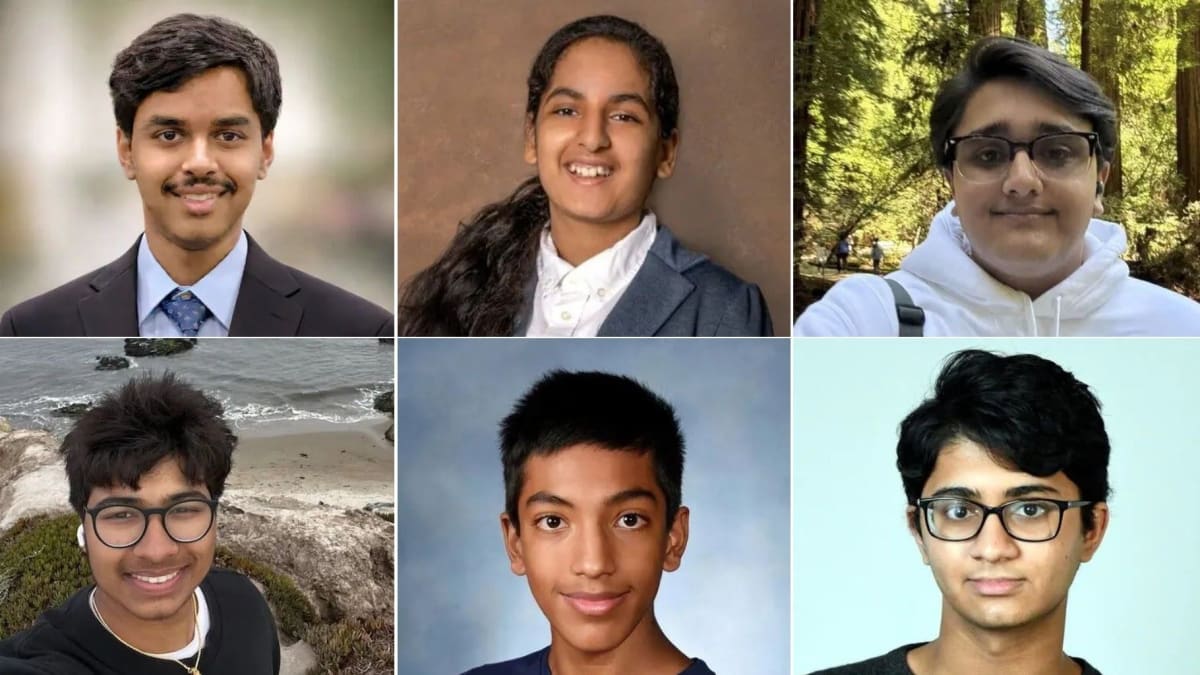
Sengupta is the top winner among six Indian American students honored with 2026 Davidson Fellows Scholarships, which recognize young people 18 and under for extraordinary work in science, technology, math, and other fields. The Davidson Institute awarded a total of $375,000 to these six young innovators.
For Tanishka Aglave, 17, the problem hit closer to home. Watching citrus greening disease devastate her father's Florida groves and threaten farming families across the state, she spent over 300 hours developing a solution. Her treatment combines a bactericide made from curry leaf extract with thermal therapy and a smartphone app that lets growers diagnose disease severity from leaf photos.
When commercial injection systems damaged young trees, Aglave designed and 3D-printed her own smaller infusion tool. Her findings earned publication in a major plant disease journal and a $50,000 scholarship.
Hitaishi Chillara, 17, looked billions of miles outward instead. The Texas teen built a framework combining telescope data and artificial intelligence to investigate whether galaxy colors can reveal the mass of supermassive black holes at their centers. His work could help scientists better use the massive amounts of data from sky surveys like the Vera C. Rubin Observatory's upcoming project.
Praadhyumn Indaana tackled nuclear safety from his home in New Jersey. The 17-year-old developed a physics-guided neural network that predicts dangerous heat thresholds in nuclear reactors with 5.5 percent error, down from the 63 percent error rate of conventional formulas. He trained his system using data from over 10,000 experiments.
Rajarshi Mandal, 16, turned mathematics toward preventing malaria, creating models to optimize how limited supplies of insecticide-treated mosquito nets get distributed for maximum impact. Pavan Subramani earned a $25,000 scholarship for his scientific contributions.
The Ripple Effect
These young scientists aren't just winning awards. They're addressing real problems that affect millions of people right now. Aglave's citrus treatment offers hope to struggling Florida farmers. Sengupta's turbulence predictions could make air travel safer for everyone. Indaana's nuclear safety improvements could protect communities near power plants.
What started with curiosity about a toy robot dog for Chillara and scary flights for Sengupta turned into research that could reshape entire fields. Each student spent hundreds of hours testing, failing, redesigning, and trying again.
"Being named a Davidson Fellow gives me the opportunity to join a community of young people who are curious, ambitious, and passionate about using their ideas to improve lives," Sengupta said.
These teenagers prove that age doesn't limit the ability to solve problems that have stumped experts for years.
Based on reporting by Google News - Scholarship Awarded
This story was written by BrightWire based on verified news reports.
Spread the positivity!
Share this good news with someone who needs it