600-Year-Old Religious Manuscript Reunited After 50 Years
Six missing pages from a priceless Tudor-era manuscript have been discovered hiding in an English archive, revealing a fascinating piece of religious history. The pages belonged to a book owned by one of Henry VIII's closest advisors during England's dramatic religious transformation.
A medieval book that survived one of history's most turbulent religious upheavals just got a little more complete.
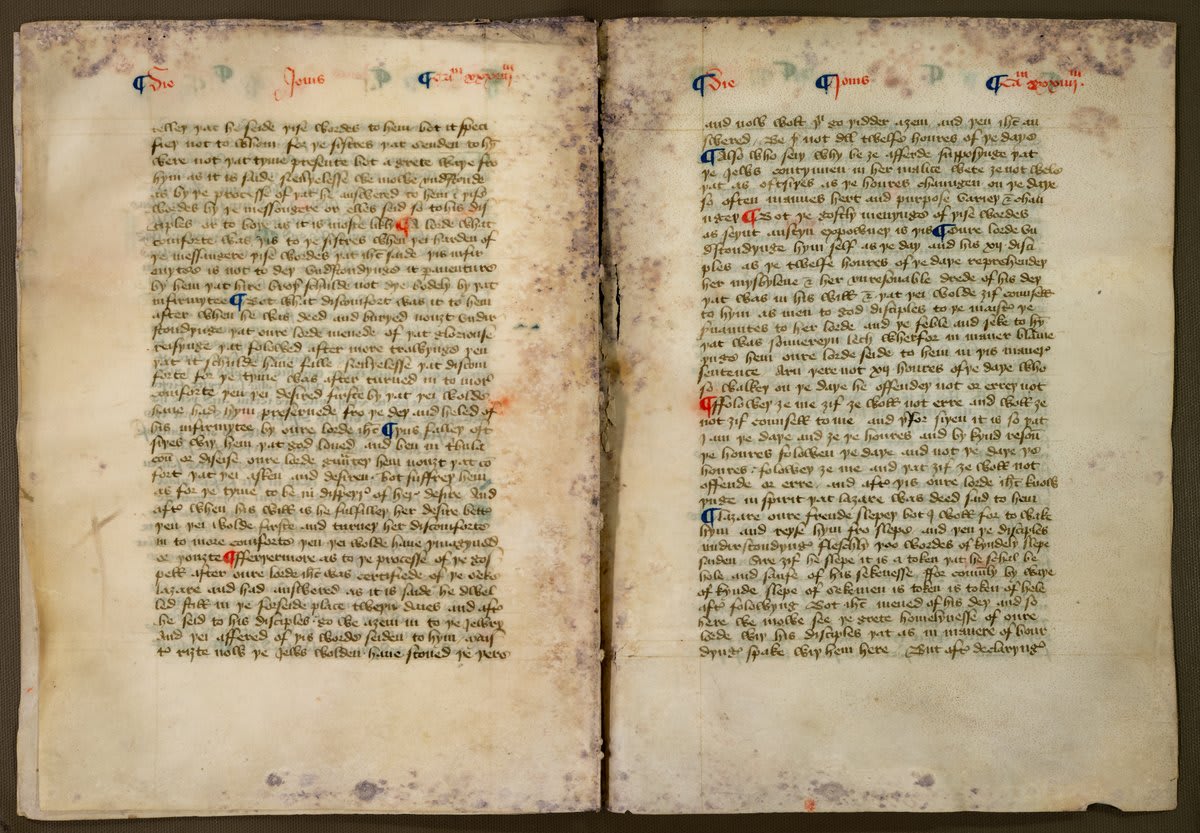
Researchers have found six missing pages from a 600-year-old manuscript that once belonged to John Gage, a personal attendant to King Henry VIII. The pages had been separated from the rest of the book for decades, tucked away in estate records at an archive in Brighton, England.
The book is a copy of "Mirror of the Blessed Life of Jesus Christ," a religious text that was wildly popular in medieval England. Owning a copy showed you were a devout Catholic, which makes the book's survival story even more remarkable.
Gage had an unusual job. He worked for Henry VIII during the dissolution of the monasteries, when the king was breaking from the Catholic Church and seizing church property. Gage's role was to catalog monastery possessions and either hand them to the Crown or destroy them.
But Gage himself was a faithful Catholic. When he found this copy of Mirror during his rounds, he couldn't bring himself to destroy it. Instead, he signed his name in the book and kept it for himself.
The manuscript stayed in Gage's family for centuries before being sold in 1976 to a Japanese book collector. It eventually made its way to Yale University's rare book library and was digitized, but scholars knew pages were missing.
The Ripple Effect
The discovery happened when researchers James Wade and Katie Walter noticed similarities between loose pages at the Keep archive in Brighton and the incomplete manuscript at Yale. They compared the paper dimensions, handwriting styles, and even the colors of the annotations.
Everything matched perfectly. The missing pages, which describe Jesus raising Lazarus from the dead, had simply been left out when someone repaired the book's binding long ago.
The find helps historians better understand the dangerous religious climate of Tudor England. People could be judged as heretics based on which books they owned, making Gage's decision to save this particular text a significant personal risk.
While the pages likely won't be physically reconnected to the rest of the book (both pieces are too valuable to move), scholars now know exactly where to find the complete text. Digital technology means anyone can study the reunited manuscript online.
A book that survived political intrigue, religious persecution, and 600 years of history is now whole again, at least in spirit.
More Images



Based on reporting by Scientific American
This story was written by BrightWire based on verified news reports.
Spread the positivity!
Share this good news with someone who needs it