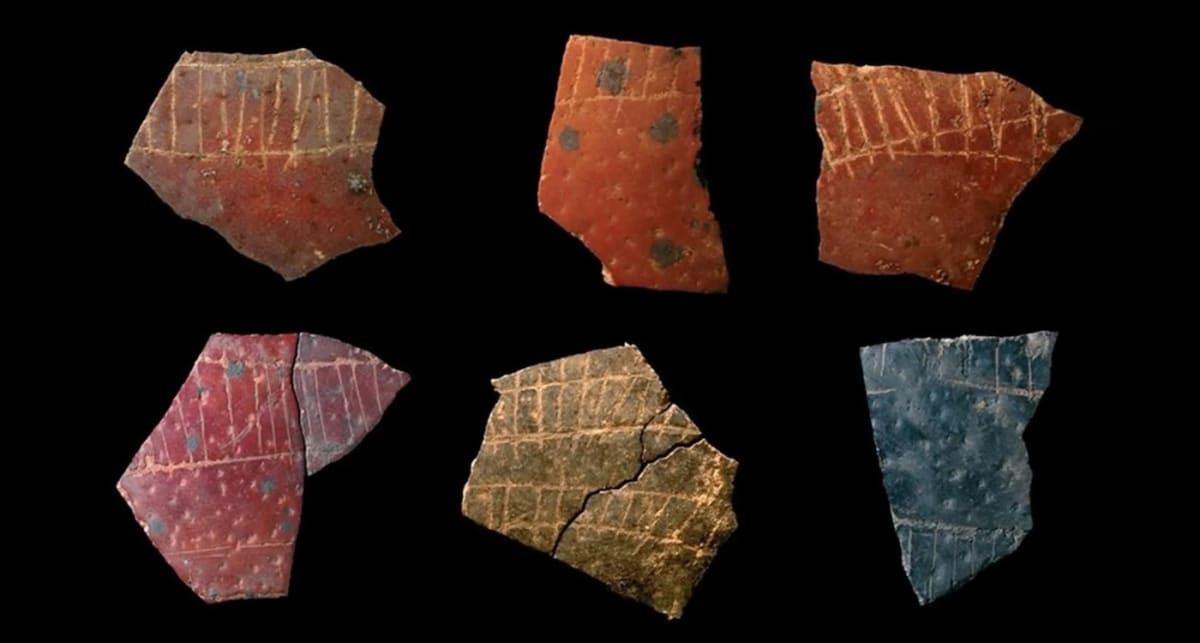
60,000-Year-Old Egg Carvings Show Human Abstract Thought
Ancient humans in southern Africa were creating intricate geometric patterns on ostrich eggshells 60,000 years ago, revealing surprisingly advanced abstract thinking. New analysis shows these weren't random doodles but carefully planned designs following consistent mathematical rules.
Imagine planning a complex geometric design in your mind before you ever pick up a tool. That's exactly what our ancestors were doing 60,000 years ago in southern Africa.
Researchers at the University of Bologna just cracked the code on hundreds of engraved ostrich eggshell fragments found across archaeological sites in South Africa and Namibia. These weren't simple scratches or random decorations. They were carefully planned geometric patterns following specific rules like parallelism, rotation, and systematic repetition.
"We are talking about people who did not simply draw lines, but organized them according to recurring principles," says Professor Silvia Ferrara, who led the study. The team analyzed 112 fragments from sites including Diepkloof, Klipdrift, and Apollo 11 using advanced geometric and statistical methods never before applied to these artifacts.
The results were stunning. More than 80% of the designs showed coherent spatial patterns, with repeated use of 90-degree angles and parallel lines. The most complex compositions included hatched bands, grids, and diamond shapes that required cognitive operations we consider distinctly human.
What makes this discovery remarkable isn't just the age of the artifacts. It's what they reveal about how our ancestors thought. These early humans weren't improvising. They held complete mental images of their designs before ever touching the eggshells, which researchers believe were used as water containers.
The patterns show skills like "embedding," where artists created hierarchical levels of designs within the same surface. Think of it as visual grammar in its earliest form. This ability to construct organized visual configurations according to specific rules marks a crucial step in human evolution: the emergence of abstract thought.
Why This Inspires
These ancient eggshells connect us across 60,000 years to ancestors who thought remarkably like us. They saw patterns, planned carefully, and created beauty with purpose. The same cognitive abilities that helped them organize geometric shapes eventually led to symbolic systems and writing itself.
Valentina Decembrini, the study's first author, captures it perfectly: "Transforming simple forms into complex systems by following defined rules is a deeply human trait that has characterized our history over millennia."
From water containers decorated with careful precision to the written word you're reading now, human innovation has always been about seeing possibility in pattern.
Based on reporting by Good News Network
This story was written by BrightWire based on verified news reports.
Spread the positivity!
Share this good news with someone who needs it