700 Wild Crested Ibises Now Thrive in China's Dongzhai Reserve
Once critically endangered, the "Oriental Gem" crested ibis has soared past 700 birds in central China's Henan Province. Wild-born chicks now exceed 100 annually for two consecutive years, signaling a conservation triumph nearly two decades in the making.
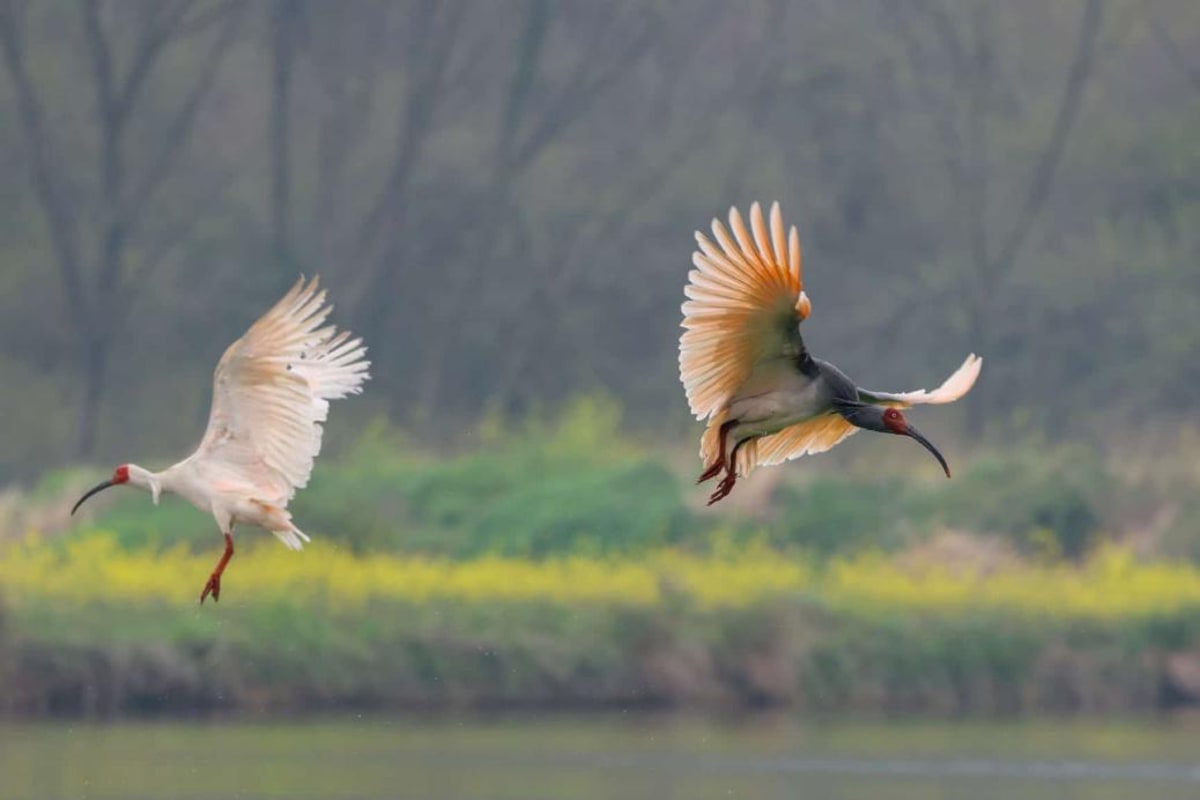
The distinctive red beaks of crested ibises now dot the skies over Henan Dongzhai National Nature Reserve, a sight that seemed impossible just 18 years ago. This spring, the critically endangered birds are thriving in numbers that conservationists once only dreamed of.
In 2007, just 17 crested ibises arrived at the reserve in Luoshan County as part of China's first reintroduction program for the species. Reserve staff fed them on strict schedules, tracked every behavior, and hoped the birds could survive in unfamiliar territory.
The gamble paid off spectacularly. Today, over 700 wild crested ibises call Dongzhai home, with breeding pairs naturally producing more than 100 chicks each year since 2024.
Cai Dejing, deputy director of the breeding station, patrols the reserve every morning during the busy January to June breeding season. This year brought especially good news: nesting started four days earlier than usual, typically a sign of higher breeding success.
The reserve's secret weapon is a 32-meter-tall circular aviary spanning 2,850 square meters. Inside, captive-raised birds practice flying, foraging, and dodging predators in an environment mimicking their natural habitat complete with ponds, wetlands, rice paddies, and streams.
Since 2013, seven release events have returned 133 trained birds to the wild. Each wears an identification ring and gets tracked through binoculars and satellites, allowing researchers to monitor the population's remarkable growth.
The Ripple Effect
The ibis comeback has transformed the local economy in unexpected ways. More than 30 professional bird guides now lead visitors through 69 designated watching sites, while 66 lodging and dining facilities serve over 30,000 annual birdwatchers.
This nature tourism generates over $7 million yearly and created 2,000 jobs, with workers earning an extra $2,900 annually on average. Local residents who once harvested forest resources now protect the "national treasures" and actively report nesting sites to reserve staff.
The reserve partners with Beijing Normal University, Beijing Forestry University, and the Chinese Academy of Sciences to study the birds' genetics, behavior, and health. This research continues strengthening conservation strategies while advancing scientific knowledge.
Director Li Yongqiang sees the thriving population as proof of Luoshan County's ecological health. Crested ibises are famously sensitive to environmental conditions, making their sustained growth a powerful indicator of habitat quality.
In December 2022, Luoshan County shared its conservation success story at the UN Convention on Biological Diversity conference. The achievement demonstrates how patient, science-based conservation can bring species back from the brink while enriching human communities.
Cai expects the wild population to reach 1,000 birds soon, a milestone that seemed unthinkable when those first 17 ibises arrived nearly two decades ago.
More Images




Based on reporting by Google News - Conservation Success
This story was written by BrightWire based on verified news reports.
Spread the positivity!
Share this good news with someone who needs it