AI Cracks 70-Year Math Puzzle Scientists Couldn't Solve
Artificial intelligence just solved one of mathematics' most stubborn problems, stunning researchers who thought the breakthrough was "too good to be true." The achievement opens doors for AI to become a true partner in scientific discovery.
A mathematical puzzle that stumped brilliant minds for seven decades just fell to artificial intelligence, and even the scientists involved can barely believe it happened.
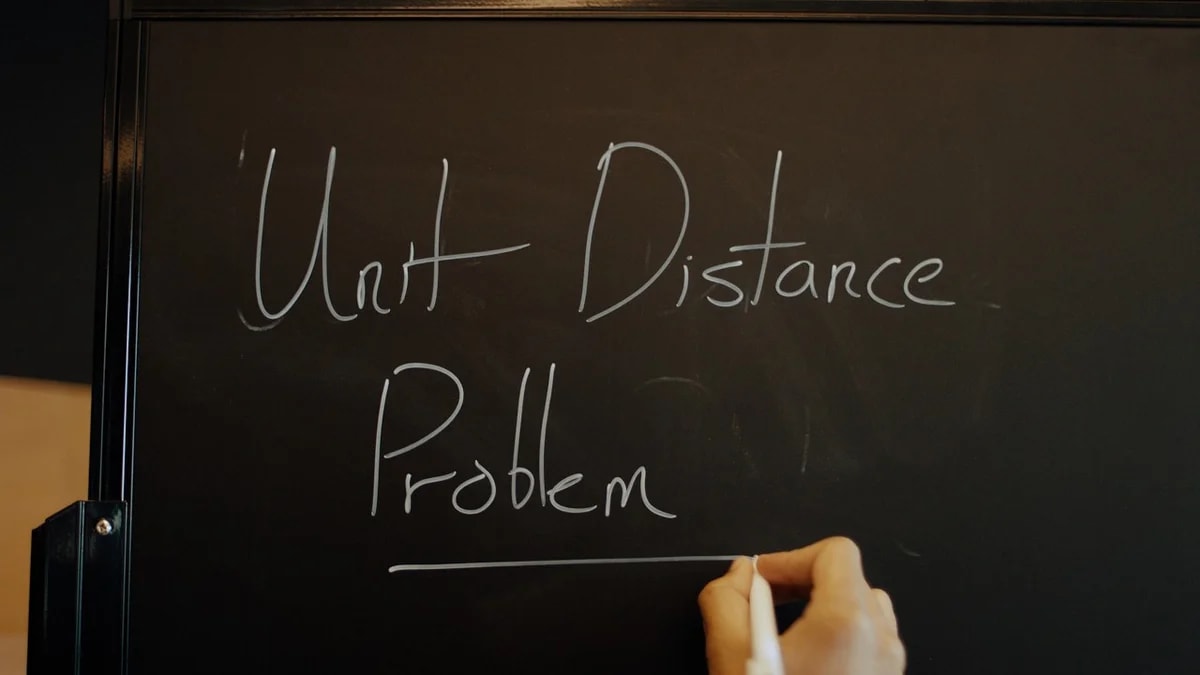
Researchers at OpenAI watched in amazement as their AI model cracked the Erdős Unit Distance Problem, a deceptively simple question about placing points on a plane. The problem asks: what's the maximum number of points you can arrange so each one sits exactly one unit apart from its neighbors?
Paul Erdős, one of history's most prolific mathematicians, called it one of geometry's most important unsolved problems. For generations, mathematicians tried intricate geometric constructions and advanced number theory, but the vast possibilities made definitive solutions nearly impossible to find.
Then AI changed everything. The model dove deep into algebraic number theory, exploring mathematical landscapes that might take human researchers lifetimes to traverse. It connected concepts and tested combinations far beyond what traditional approaches could handle.
"This sounds like too good to be true," said Sebastian Bubeck, an OpenAI researcher, describing the team's reaction. They spent months converting the AI's solution into a formal proof because the breakthrough seemed so unexpected.
Mark Sellke explained that previous human attempts were "too delicate to execute." The AI found a more robust path that mathematicians had never discovered, demonstrating its ability to think beyond established patterns.
Lijie Chen captured the speed of progress perfectly: "I was expecting AI to do something with this, but my timeline got shorter." What seemed years away happened in months.
Why This Inspires
This breakthrough reveals AI as more than a calculator or assistant. It's becoming a genuine partner in pushing human knowledge forward, capable of creative thinking in theoretical domains we thought required uniquely human insight.
The implications ripple across science. If AI can crack stubborn mathematical problems, it could accelerate discoveries in physics, engineering, biology, and medicine. Problems that seemed impossibly complex might yield to this new collaborative approach between human curiosity and artificial intelligence.
The solution doesn't replace human mathematicians. Instead, it shows how AI and human intellect can complement each other, with machines exploring vast possibility spaces while humans provide direction, verification, and interpretation.
Mathematics just entered a new era where decades-old puzzles can fall in months, opening pathways researchers never imagined existed.
More Images


Based on reporting by Google News - AI Breakthrough
This story was written by BrightWire based on verified news reports.
Spread the positivity!
Share this good news with someone who needs it