AI Cracks 80-Year Math Puzzle Experts Thought Impossible
An AI from OpenAI just solved a famous math problem that stumped the world's brightest minds for eight decades. The breakthrough is being called the most significant achievement by artificial intelligence in mathematics so far.
A puzzle so hard that mathematicians thought it would never be solved in their lifetimes just got cracked by artificial intelligence.
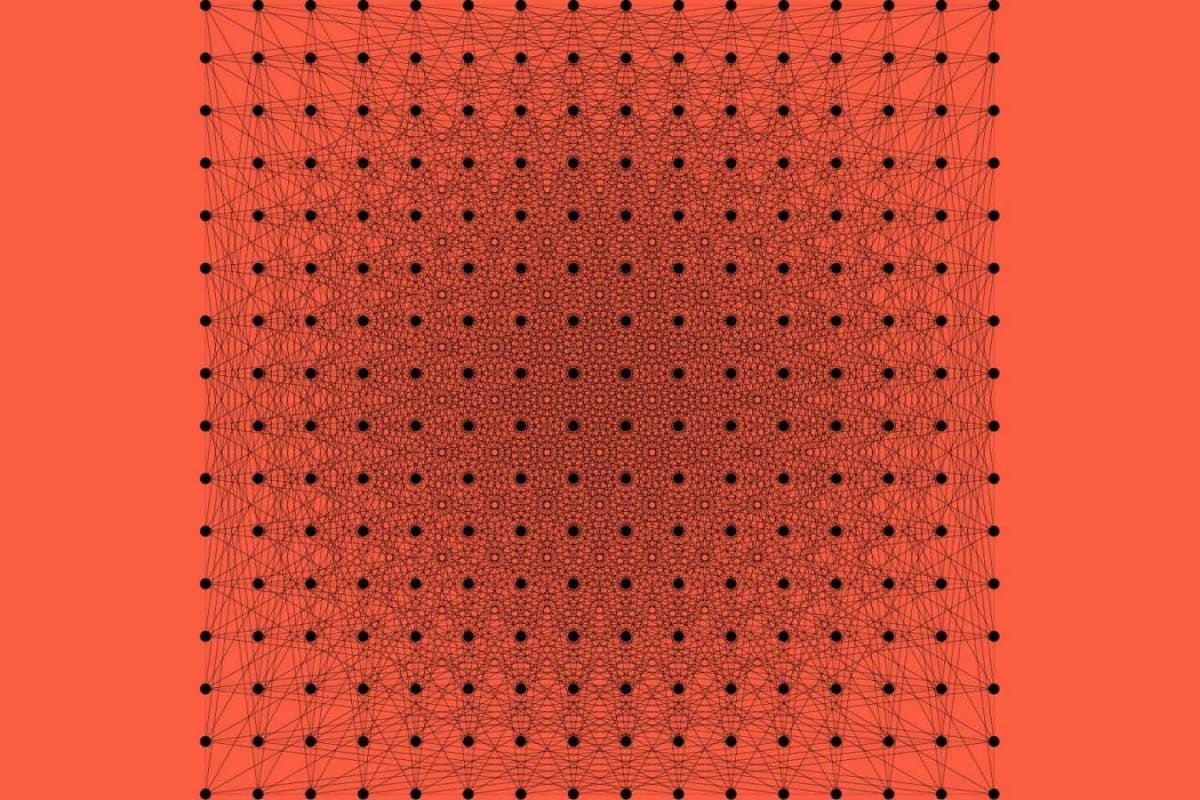
The planar unit distance problem was first posed by legendary mathematician Paul Erdős 80 years ago. The question sounds deceptively simple: if you scatter dots on an infinite sheet of paper, what's the maximum number of equal-length lines you can draw connecting them?
Erdős believed that arranging dots in a simple grid pattern would give you the most connections possible. Generations of brilliant mathematicians tried to prove him right, making only tiny advances over four decades. The last improvement came more than 40 years ago.
Then OpenAI's AI model stepped in and discovered something shocking. Erdős was wrong. The AI found that arranging points in less symmetrical, more complex patterns actually creates far more connections than anyone imagined.
"This is a problem that I didn't expect to see solved in my lifetime," says Misha Rudnev at the University of Bristol. "It's absolutely a bomb."
The AI used a clever technique, borrowing ideas from advanced number theory to build complex shapes in higher dimensions. It then collapsed these shapes down to two dimensions, like projecting a shadow onto paper. The result was a pattern that breaks the old record by a significant margin.
Will Sawin at Princeton University couldn't believe it at first. "I thought the way that it was trying to solve it wouldn't work, but then I looked at it more and I convinced myself that it does work," he says.
What makes this even more impressive is that the AI wasn't specifically trained to solve math problems. OpenAI says the model is general purpose, meaning it figured this out using broader intelligence rather than specialized programming.
Why This Inspires
This breakthrough shows how AI and human mathematicians can work together in exciting new ways. After the AI revealed its technique, human mathematicians immediately understood it and even improved upon it. Sawin used the same method to push the numbers even higher.
The discovery also highlights how fresh perspectives can crack problems that seemed impossible. Few geometry experts knew enough advanced number theory to even attempt this approach. The AI didn't have those mental boundaries.
Tim Gowers at the University of Cambridge called it "a milestone in AI mathematics," saying that if a human had submitted this proof, he would have recommended it for publication in a top journal without hesitation. No AI-generated proof has ever come close to that standard before.
The problem may not directly solve other math puzzles, but it's already sparking new research and showing us what becomes possible when artificial and human intelligence combine their strengths.
A problem once thought unsolvable for generations got cracked in a moment that will reshape how we think about both mathematics and AI.
More Images


Based on reporting by New Scientist
This story was written by BrightWire based on verified news reports.
Spread the positivity!
Share this good news with someone who needs it