AI Cuts Drug Discovery Time From 15 Years to 30 Months
Artificial intelligence is slashing scientific discovery timelines from decades to months, with one company bringing a drug from concept to clinical trials in just 30 months instead of the usual 15 years. The revolution is transforming everything from medicine to materials science.
Scientific breakthroughs that once took decades are now happening in months, thanks to artificial intelligence that can analyze billions of data points faster than any human team.
The transformation is already delivering real results across multiple fields. Insilico Medicine used AI to discover and advance a lung disease drug into Phase II clinical trials in just 30 months, a process that traditionally takes 10 to 15 years and costs over $2 billion.
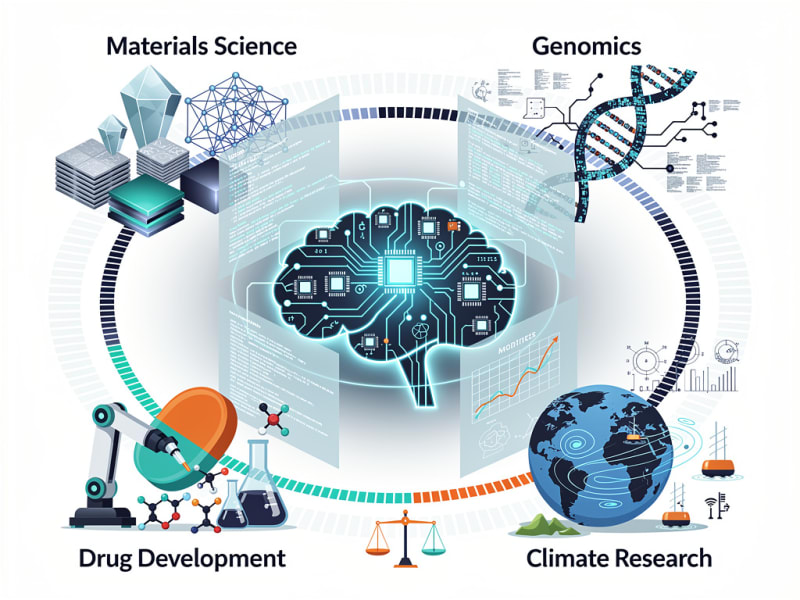
Drug development represents AI's most tangible impact on science. Companies like Recursion Pharmaceuticals and Alphabet's Isomorphic Labs are using machine learning to identify drug targets and predict how molecules will interact before researchers ever mix compounds in a lab.
The technology isn't replacing scientists but supercharging their work. AI systems can generate thousands of promising hypotheses in minutes, allowing human researchers to focus their time on designing experiments and interpreting results rather than sifting through mountains of data.
In materials science, the pace of discovery has become almost unbelievable. Google DeepMind's GNoME system predicted 2.2 million new crystal structures in 2023, equivalent to 800 years of traditional research. Of these, 380,000 showed potential for use in batteries, solar cells, and semiconductors.
Lawrence Berkeley National Laboratory then closed the loop by building robotic systems that can autonomously synthesize these AI-predicted materials. These "self-driving laboratories" represent the cutting edge of automated discovery, where machines handle everything from prediction to physical validation.
The Ripple Effect
The benefits extend far beyond faster timelines. In genomics, tools like DeepMind's AlphaMissense are helping doctors identify disease-causing genetic variants, potentially speeding up diagnoses for rare diseases and accelerating gene therapy development.
Climate researchers are using AI to process vast amounts of environmental data, finding patterns that human scientists might miss. The technology is helping teams understand everything from ocean currents to atmospheric changes with unprecedented speed and accuracy.
DeepMind's AlphaFold, which predicted the three-dimensional structures of virtually every known protein, has been cited in thousands of research papers since its release. The tool fundamentally changed structural biology by solving problems that would have taken human researchers lifetimes to complete.
The shift marks a fundamental change in how science works. The romantic image of the lone genius in a laboratory is giving way to interdisciplinary teams where computational scientists, domain experts, and AI systems collaborate as partners.
The bottleneck in research is no longer generating ideas but validating them through careful experimentation and human judgment. Scientists now face an abundance of hypotheses rather than a shortage, fundamentally changing the nature of scientific work.
What took centuries of methodical, painstaking human effort can now happen in months, opening possibilities for solving urgent challenges from disease to climate change faster than ever imagined.
More Images

Based on reporting by Google: scientific discovery
This story was written by BrightWire based on verified news reports.
Spread the positivity!
Share this good news with someone who needs it