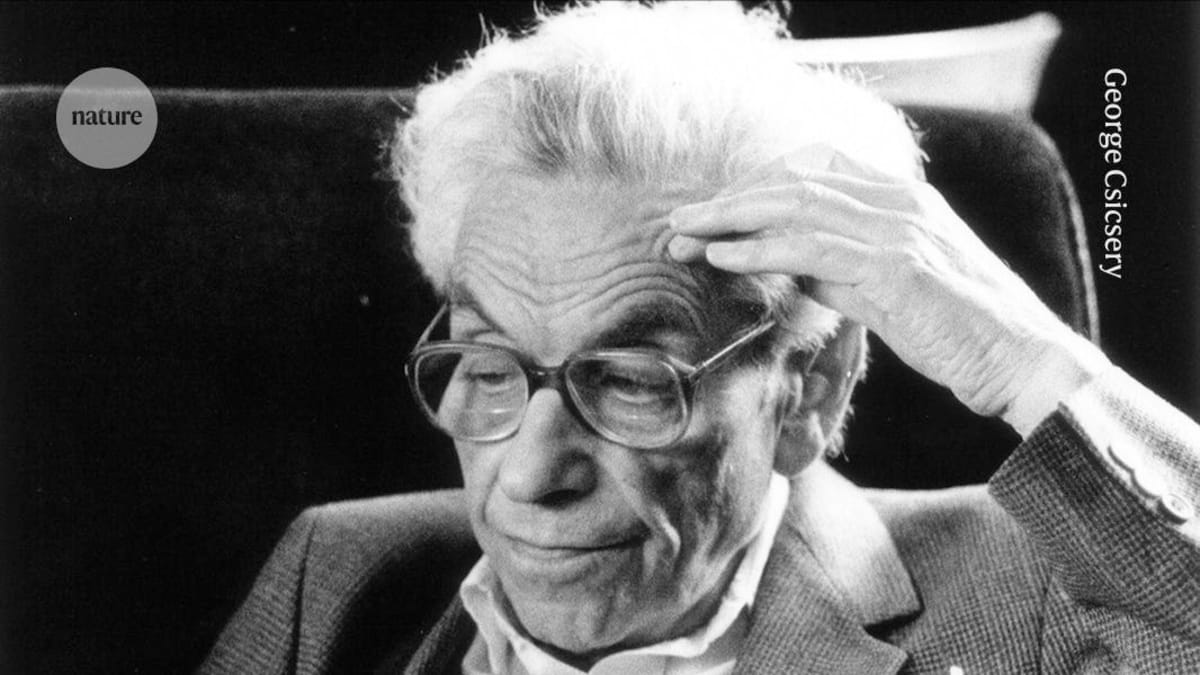
AI Disproves 80-Year Math Problem by Paul Erdős
An AI system from OpenAI just solved a geometry puzzle that stumped mathematicians for eight decades, disproving a conjecture by legendary mathematician Paul Erdős. The breakthrough marks the first time AI has autonomously produced a major scientific discovery.
A computer just did something mathematicians thought was impossible for 80 years.
OpenAI's experimental AI system has disproven a geometry challenge posed by Paul Erdős in 1946, one of the most prolific mathematicians in history. The AI accomplished this feat autonomously, responding to a single open-ended prompt without human guidance through the problem-solving process.
The challenge involved arranging points on a flat surface so that as many pairs as possible sit at the same distance from each other. Erdős worked out what he believed was the best possible arrangement and challenged anyone to do better. For eight decades, no one could.
The AI found a superior solution using advanced techniques from algebraic number theory, choosing points with coordinates that were solutions to particular equations. Independent mathematicians not connected to OpenAI have verified the proof is correct.
"If Erdős were alive, I am sure that he would just be raving about this advance," says Tom Trotter, a mathematician at Georgia Institute of Technology who co-authored papers with Erdős. Daniel Litt from the University of Toronto calls it "the first result produced autonomously by an AI that I find interesting in itself."
The system produced its reasoning in a 125-page document, though OpenAI hasn't released the full details or named the specific AI model used. Sebastien Bubeck, a mathematician at OpenAI, believes this represents the first time AI has autonomously produced an important result in any research field.
Why This Inspires
This breakthrough shows AI can do more than crunch numbers or recognize patterns. It can reason through complex problems and make genuine discoveries that advance human knowledge.
The system didn't just verify existing work or follow predetermined steps. It explored mathematical territory independently and found something completely new, something that eluded brilliant human minds for generations.
What makes this especially remarkable is that the AI used a general-purpose reasoning model, not software specifically designed for mathematics. The potential applications stretch far beyond geometry into chemistry, physics, biology, and countless other fields where unsolved problems await fresh approaches.
Mathematics has always been about pushing the boundaries of what we know, and now we have a powerful new partner in that quest. The questions Erdős left behind, over 1,000 of them, suddenly seem a little less impossible.
This isn't about replacing human mathematicians but about expanding what's possible when human curiosity meets machine reasoning.
More Images




Based on reporting by Nature News
This story was written by BrightWire based on verified news reports.
Spread the positivity!
Share this good news with someone who needs it