AI Lab Partners Speed Up LED Research by 400% in 5 Hours
Scientists at Sandia National Laboratories let three AI systems run their own experiments, and the results were stunning. What took years to develop was improved fourfold in just five hours, opening new doors for cheaper, more efficient technology.
A team of physicists just proved that artificial intelligence can be more than a calculator. It can be a true scientific partner.
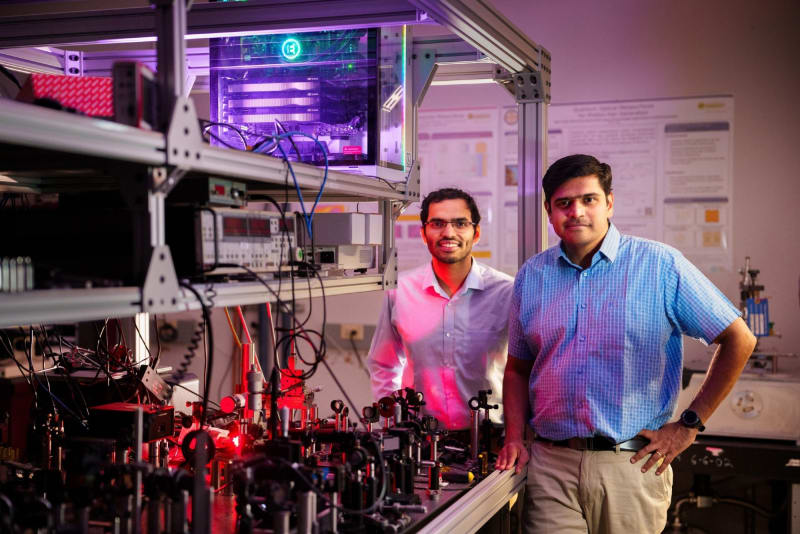
Researchers at Sandia National Laboratories in New Mexico handed over their lab equipment to three AI systems and watched something remarkable happen. The AI trio designed experiments, ran them, analyzed results, and then designed better experiments based on what it learned. In five hours, it improved the team's LED light-steering technique by four times what the scientists had achieved over years of painstaking work.
The breakthrough matters because better LED light control could replace expensive lasers in everything from grocery store scanners to self-driving cars. LEDs are cheaper, smaller, and use less energy. Back in 2023, the same Sandia team discovered a way to direct LED light more precisely, but they knew perfecting it would take years more research.
Then they decided to try something different. They gave their data to a generative AI that organized and streamlined the information. A second AI, called an active learning agent, received that cleaned-up data and got connected directly to the lab equipment. The third AI acted as a fact-checker, deriving mathematical equations to explain why experiments worked or failed.
By experiment number 300, the system had dramatically surpassed the human researchers' best results. Light-steering efficiency improved by an average of 2.2 times across a 74-degree angle, with some points reaching four times better performance. The AI even discovered a completely new approach the scientists hadn't considered.
The team didn't just celebrate the speed. They tackled one of AI's biggest problems: the black box effect. When AI spits out an answer, people often can't understand how it got there. That's useless for science, which requires explanations so other researchers can build on discoveries or challenge them.
"We are constraining ourselves to finding good experiments that will advance our understanding," explained postdoctoral researcher Saaketh Desai. The equation-learning AI ensured every result came with a mathematical explanation, not just a mystery answer.
Study author Prasad Iyer sees this as a turning point. "We are one of the leading examples of how a self-driving lab could be set up to aid and augment human knowledge," he said.
The Ripple Effect spreads beyond LED lights. This approach could accelerate discoveries across material science, chemistry, and physics. Instead of scientists spending years on trial and error, AI partners could explore thousands of possibilities in days while still producing results humans can understand and verify. The method creates a new model where human creativity guides AI speed and processing power.
The main limitation is cost. The system requires three high-end NVIDIA graphics cards and serious computing power, which means only well-funded institutions can currently access it.
Next, the Sandia team plans to apply their interpretable AI system to other material science challenges, potentially speeding up breakthroughs that could take human researchers decades to achieve.
More Images


Based on reporting by Google: scientific discovery
This story was written by BrightWire based on verified news reports.
Spread the positivity!
Share this good news with someone who needs it