AI Learns to Spot Cancer by Mimicking Human Pathologists
Researchers trained artificial intelligence to search for cancer the way human doctors do, scanning tissue slides with a dynamic approach rather than rigid patterns. The new method caught 100% of cancer cases in testing, offering a smarter way to help doctors find disease faster.
Cancer detection just got a major upgrade thanks to AI that thinks more like a human doctor than a machine.
Researchers at the University of Pennsylvania developed a new approach that teaches artificial intelligence to hunt for cancer cells the same way pathologists do. Instead of scanning tissue samples in fixed, robotic patterns, the AI now pans across slides, zooms in on suspicious areas, and lingers over regions that raise red flags.
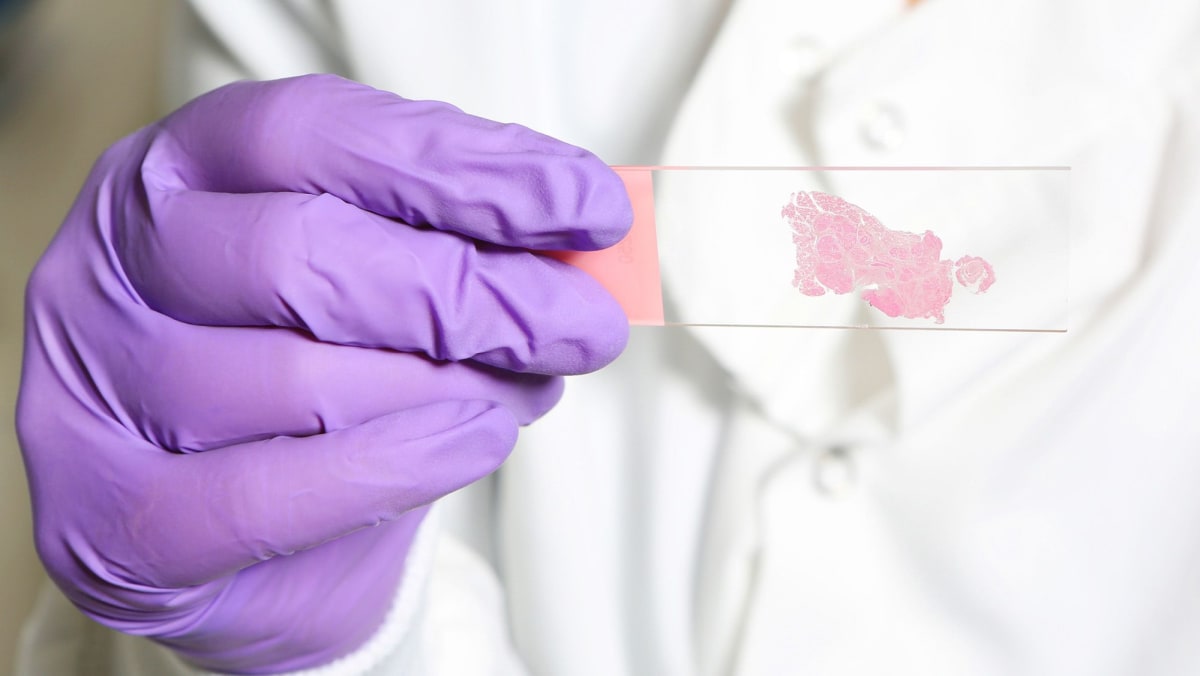
The challenge with detecting cancer on pathology slides is enormous. A single slide can contain billions of pixels, but the actual evidence of cancer might hide in just a tiny patch. Most AI systems tackle this by chopping slides into uniform squares or analyzing pre-selected regions, but that's not how human experts work.
Zhi Huang, an assistant professor who led the study, compared the traditional approach to a search-and-rescue helicopter inspecting one square meter of ground at a time. "You scan the landscape first and then swoop in for a closer look," he explained.
The team created software that recorded how eight pathologists actually moved around slides and adjusted magnification while searching for cancer. They filtered out random movements like drifting or fidgeting, focusing only on moments of deliberate attention. Then they used eye-tracking data to confirm the AI was capturing where doctors were genuinely looking.
This training method produced a tool called Pathology-o3. It starts by scanning a slide at low resolution, identifies regions worth examining more closely, then zooms in for detailed analysis.
When tested on lymph node tissue from colorectal cancer cases, Pathology-o3 correctly identified every single slide containing cancer. It did produce some false alarms, flagging 15.5% of negative slides as potentially positive, but that's actually by design. The researchers programmed it to err on the side of caution rather than potentially miss cancer.
By comparison, OpenAI's general-purpose o3 system caught cancer 87.5% of the time but had a much higher false alarm rate of 53.3%.
The Bright Side
The real win here isn't about replacing human pathologists. It's about giving them a smarter assistant that can quickly point them toward the most important areas of a slide.
Mohammad Asadi, a data scientist at Stanford University who wasn't involved in the research, noted that while the system isn't precise enough to diagnose patients independently, it excels at directing human experts to specific regions worth double-checking. That could save precious time and help doctors catch cancer earlier.
When the researchers tested Pathology-o3 on completely new slides it had never seen before, it still identified 97.6% of cancer cases. The AI proved it could adapt to unfamiliar territory, not just memorize patterns from its training data.
This breakthrough shows that sometimes the best way forward with artificial intelligence is teaching it to be a little more human.
More Images

Based on reporting by Live Science
This story was written by BrightWire based on verified news reports.
Spread the positivity!
Share this good news with someone who needs it