AI Models Learn Physics, Unlock Secrets Across Sciences
Scientists created AI models trained on real physics data that can solve problems across different fields, from exploding stars to bacteria movement. These foundation models are accelerating discoveries by applying knowledge learned in one science to completely different challenges.
Scientists just taught AI to think like a physicist, and it's already solving problems across wildly different fields.
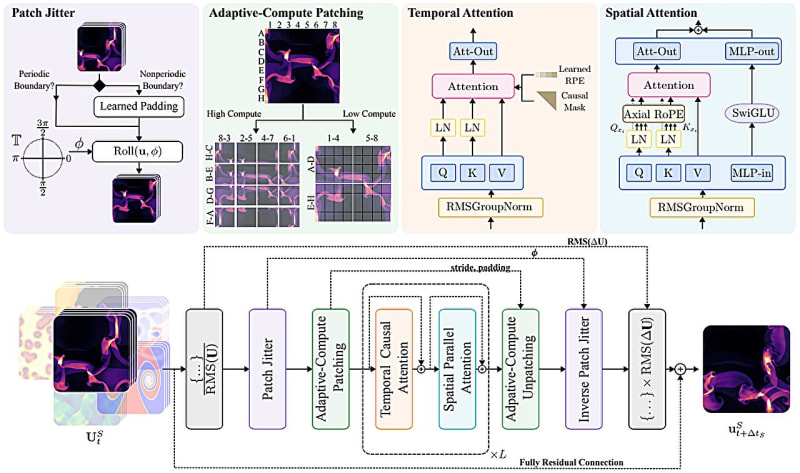
Researchers from the Polymathic AI collaboration, including scientists from Cambridge University, unveiled two breakthrough AI models that learned from real scientific data instead of text or images. The models, called Walrus and AION-1, can take knowledge from one area of physics and apply it to completely different scientific challenges.
Walrus tackles everything from exploding stars to WiFi signals to bacterial movement. AION-1 learned from 200 million observations of stars, quasars, and galaxies spanning 100 terabytes of data.
"I continue to be awed by the fact that a multi-disciplinary physics foundation model works at all, let alone at this level," said Dr. Miles Cranmer from Cambridge's Department of Applied Mathematics and Theoretical Physics.
The secret lies in how these "foundation models" learn. Unlike most scientific AI that focuses on specific problems, these models learned the universal physical processes that underlie different phenomena. Since the same physics governs many different systems, the AI can transfer its knowledge across fields.
Lead developer Michael McCabe explained the practical benefit. When researchers encounter new physics their field hasn't handled before, they might not have time to test every possible model. But Walrus might already understand similar physics from another discipline.
Walrus trained on the Well, a massive dataset covering 19 different scenarios in fluid dynamics, from merging neutron stars to acoustic waves to atmospheric layers. AION-1 studied data from astronomical surveys including the Sloan Digital Sky Survey and Gaia.
The Ripple Effect
These models offer scientists crucial advantages when working with limited data or budgets. When a researcher gets a low-resolution galaxy image, AION-1 can extract more information by drawing on physics learned from millions of other galaxies.
The team compared it to how our senses work together. Just as your brain learns associations between how things look, taste, and smell, these AI models connect patterns across different types of scientific observations.
Dr. Payel Mukhopadhyay from Cambridge's Institute of Astronomy sees massive potential ahead. "Walrus feels like a real step toward general-purpose AI for physical simulation—a single foundation model you can adapt across many scientific problems instead of retraining from scratch each time."
Both teams open-sourced their code and data, inviting the global scientific community to build on their work.
This breakthrough could transform how quickly scientists make discoveries, especially in fields where collecting data is expensive or time-consuming.
More Images
Based on reporting by Phys.org - Technology
This story was written by BrightWire based on verified news reports.
Spread the positivity!
Share this good news with someone who needs it