AI Predicts Complex Material Patterns 1,000x Faster
Scientists can now predict how tiny defects form in liquid crystals in milliseconds instead of hours, thanks to a new AI system. This breakthrough could speed up development of everything from holographic displays to smart windows.
The imperfections in materials might hold the key to tomorrow's smartest technologies.
Researchers at Chungnam National University in South Korea have developed an AI system that predicts how complex patterns form in liquid crystals 1,000 times faster than traditional methods. What once took hours of computer simulation now happens in milliseconds.
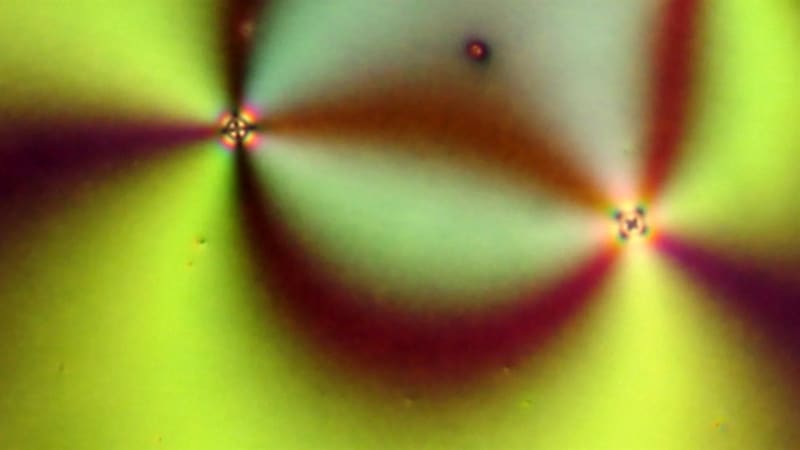
The breakthrough focuses on something called topological defects, tiny irregularities that appear when materials shift from disorder into organized patterns. These defects show up everywhere in nature, from the structure of galaxies to the liquid crystal displays in our phones.
Professor Jun-Hee Na and his team built their system using deep learning, a type of artificial intelligence that learns patterns from data. The AI doesn't need to solve complex physics equations step by step. Instead, it learns from previous simulations and predicts outcomes almost instantly.
The team trained their model on data from traditional simulations covering many different scenarios. Once trained, the AI accurately predicted entirely new configurations it had never seen before. Laboratory experiments confirmed the predictions matched real-world results.
Liquid crystals are particularly interesting because their molecules can spin freely while still pointing in roughly the same direction. This makes them perfect for studying how defects appear, merge, split apart, and reorganize themselves over time.
The Ripple Effect
This faster prediction method opens doors for designing advanced materials with precision-controlled structures. Scientists can now explore hundreds of design possibilities in the time it previously took to test just one.
The implications reach far beyond the laboratory. Smart materials designed with this technology could transform holographic displays, making them sharper and more realistic. Virtual and augmented reality systems could become more immersive and responsive.
Smart windows that automatically adjust their transparency based on sunlight might become more affordable and widespread. Adaptive optical systems could improve everything from cameras to telescopes.
Professor Na emphasizes that AI-driven design could drastically shorten the material development process. Instead of years of trial and error, researchers could rapidly prototype and test new materials tailored for specific applications.
The research, published in the journal Small, represents a shift in how scientists approach material design. By combining artificial intelligence with physics, they're creating tools that work alongside traditional methods rather than replacing them.
This breakthrough shows how AI can accelerate scientific discovery when paired with deep expertise in a field, turning what seemed impossibly complex into something manageable and fast.
Based on reporting by Science Daily - Technology
This story was written by BrightWire based on verified news reports.
Spread the positivity!
Share this good news with someone who needs it