AI Robots Now Run Drug Discovery Experiments 24/7
A new AI system translates scientists' ideas into complete drug discovery experiments, running them around the clock in the largest autonomous lab in the US. The breakthrough could slash research time from days to hours.
Drug discovery just got faster, thanks to robots that can think like scientists and work through the night without coffee breaks.
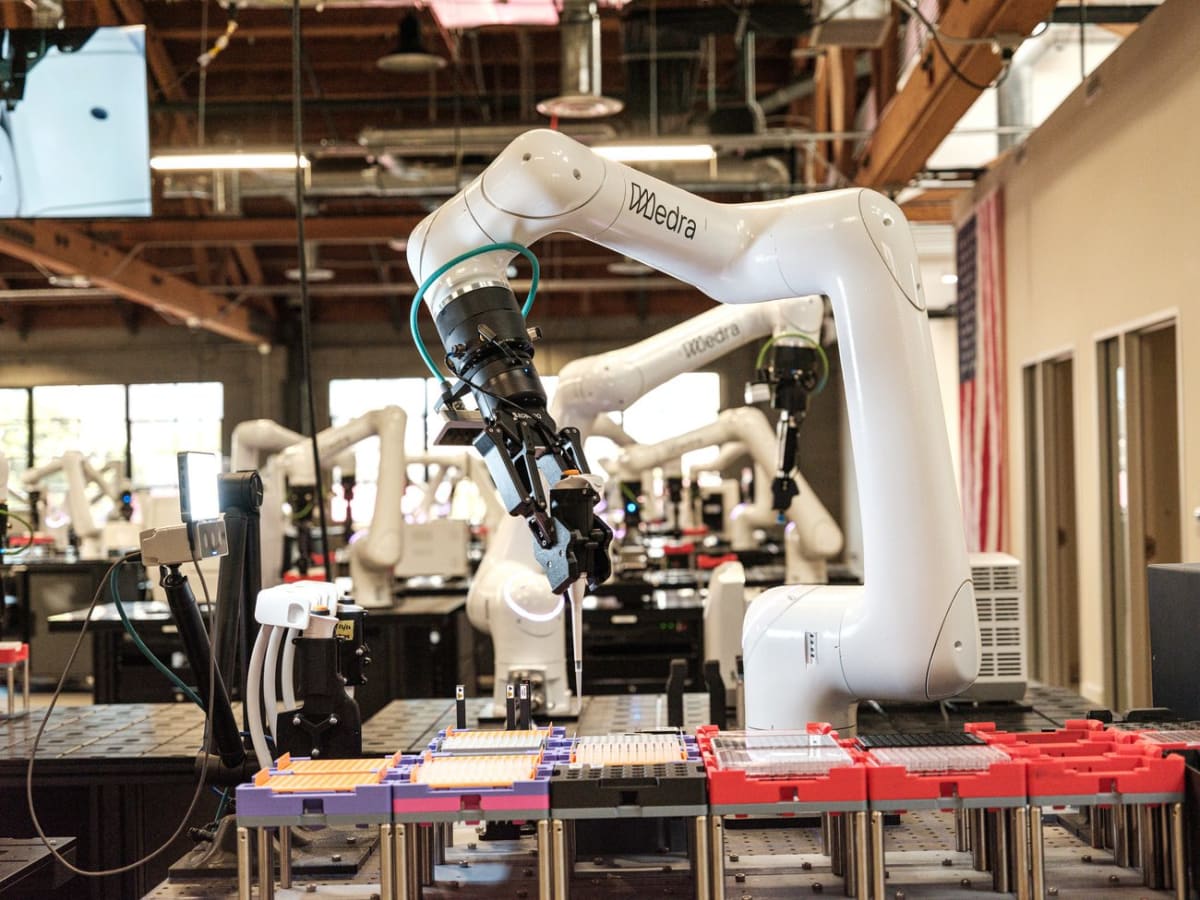
Medra, a biotech company, has launched AI Experimentalist, a system that turns research goals written in plain English into full experimental workflows. Scientists can simply type what they want to discover, and the AI designs the experiment, runs it in a robotic lab, analyzes the data, and refines the process for the next round.
The technology addresses a major bottleneck in medicine. While AI has become excellent at predicting which molecules might work as drugs, testing those predictions in real labs remains painfully slow. CEO Michelle Lee explains that building AI models capable of predicting and curing disease requires thousands of years worth of experimental data.
"This data problem is actually a robotics problem," Lee told industry publication GEN Edge. Her solution combines AI reasoning with physical robots that can pipette, mix, and test biological samples continuously.
The Ripple Effect
The impact reaches beyond speed. Medra's 38,000 square foot facility, dubbed ML001, operates as the largest autonomous lab in the United States. It runs experiments 24/7, compressing timelines that once took days into mere hours.
The system's intelligence handles the subtle artistry of science that often makes or breaks experiments. Variables like pipette angles and precise timing of mixing reagents matter more than most people realize. Physical AI equips standard lab robots with sensors and decision making capabilities, allowing them to adapt in real time.
In one example, when scientists requested an antibody assay for cancer research, AI Experimentalist suggested running tests in parallel and immediately feeding results into the next experiment. These small optimizations compound into massive time savings.
The platform works with a variety of cutting edge applications, from antibody discovery to gene editing and cell biology. Partners can access it either through robots installed at their own facilities or remotely through Medra's central lab.
The technology arrives through a collaboration with DARPA, the defense research agency known for funding breakthrough technologies. Its multi agent architecture allows Medra to plug in new biological AI models as they emerge, including tools from NVIDIA designed specifically for scientific research.
Lee sees integration and deployment, not technical capability, as the real challenge ahead. Her team designed AI Experimentalist to be flexible enough to incorporate future advances. Academic institutions, pharmaceutical companies, and government agencies are already using the platform to accelerate their research.
The promise extends beyond individual experiments to transforming entire drug discovery campaigns, bringing life saving treatments to patients faster than ever before.
More Images


Based on reporting by Google: scientific discovery
This story was written by BrightWire based on verified news reports.
Spread the positivity!
Share this good news with someone who needs it