AI Speeds Up Green Jet Fuel Production by 10-100x
Scientists just cracked a major bottleneck in creating sustainable jet fuel from plants, using robots and artificial intelligence to work up to 100 times faster than traditional methods. Two breakthrough studies show how automation could finally make flying green a reality.
Scientists at Lawrence Berkeley National Laboratory just solved one of aviation's biggest climate challenges in a fraction of the usual time.
For years, researchers have dreamed of teaching microbes to transform plant material into high-performance jet fuel. The problem? Designing these microscopic fuel factories through trial and error can take months or even years, with no guarantee of success.
Now, two teams at the Joint BioEnergy Institute have flipped that timeline on its head. Working in parallel, they developed complementary approaches that speed up the entire process by 10 to 100 times.
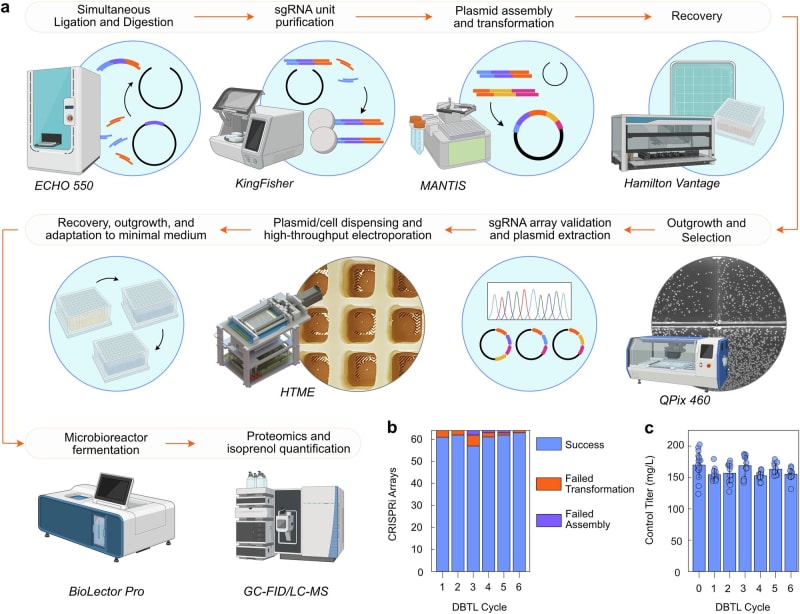
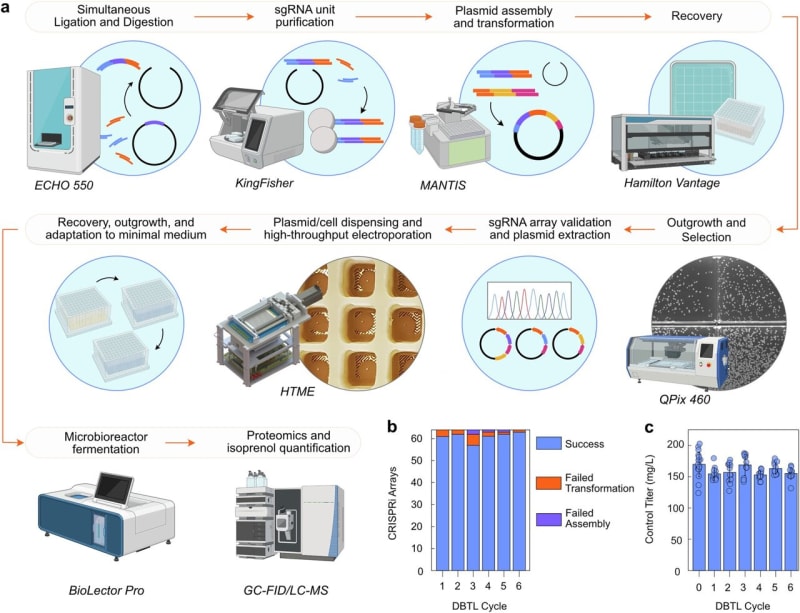
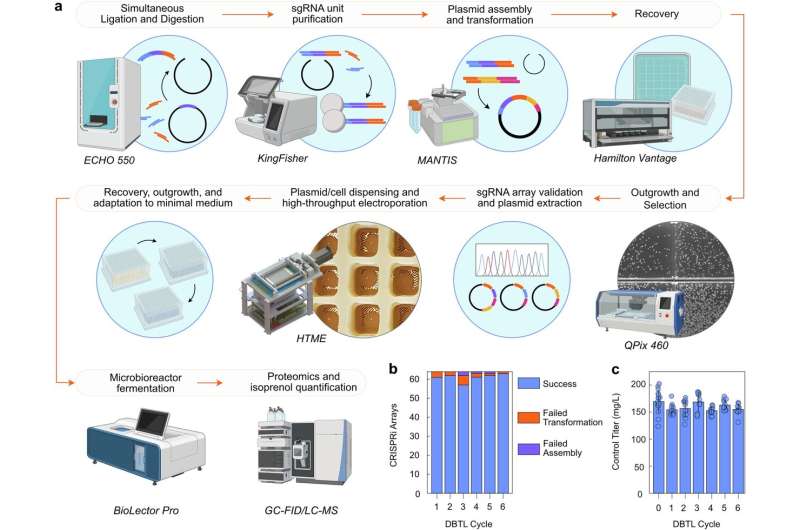
The first team built a robotic system that creates and tests hundreds of genetic designs simultaneously. After each round, machine learning algorithms analyze what worked and suggest the next batch of improvements. It's like having an AI coach that learns from every experiment.
"Standard metabolic engineering is slow because you're relying on human intuition and biological knowledge," said Héctor García Martín, who led the AI work. "Our goal was to make strain improvement systematic and fast."
The breakthrough includes a custom device that can insert genetic material into 384 bacterial strains in under a minute. That same task normally takes hours by hand.
The second team took a completely different angle. They discovered that bacteria naturally sense and respond to the fuel they're being forced to produce. Instead of fighting this response, the researchers rewired it into a powerful screening tool that identified strains producing up to 36 times more fuel.
Both teams focused on isoprenol, a clear alcohol that converts into DMCO, a next generation jet fuel with higher energy density than today's aviation fuel. The improved strains now produce five times more isoprenol than previous versions.
The Ripple Effect
This matters beyond the lab. Aviation accounts for a significant chunk of global emissions, and batteries can't yet deliver enough power for most flights. Sustainable jet fuel represents one of the few realistic paths to cleaner skies.
The automation breakthrough also changes how biological research happens. "We have been engineering these bacteria by hand for years, but biological experiments always come with small variations that are hard to control," said Taek Soon Lee, who led the metabolic engineering work. "Automation gives us the ability to generate the same high quality data every time."
The methods developed here could accelerate research across synthetic biology. From medicines to materials, any field that relies on engineering microbes could benefit from this faster, more systematic approach.
Thomas Eng, who led the biosensor study, emphasized how the strategies complement each other. "One is data driven optimization; the other is discovery. Together, they give us a way to move much faster than traditional trial and error."
The path from lab to airport fuel tank still has hurdles, but these teams just cleared one of the biggest in record time.
More Images

Based on reporting by Phys.org - Technology
This story was written by BrightWire based on verified news reports.
Spread the positivity!
Share this good news with someone who needs it