AI Tool Speeds Scientific Discoveries at Alabama Lab
University of Alabama scientists won federal funding to build an AI assistant that will help physicists analyze massive data floods in seconds instead of years. The breakthrough could revolutionize research across multiple scientific fields.
Scientists at the University of Alabama just got a powerful new partner in their quest to unlock nature's deepest secrets.
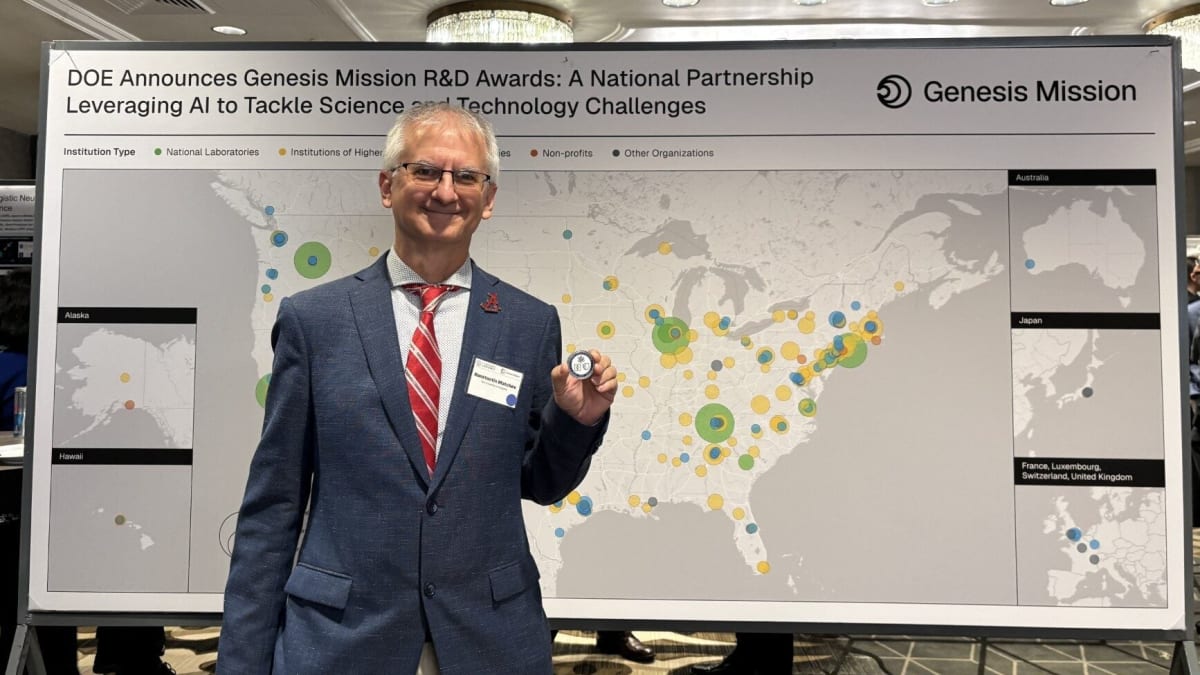
A research team led by Dr. Konstantin Matchev has won competitive federal funding to develop an AI tool that will dramatically speed up particle physics discoveries. The project was selected from over 5,000 proposals as part of the Department of Energy's Genesis Mission, which combines AI, supercomputing, and quantum systems to accelerate scientific breakthroughs.
The challenge is staggering. High-energy physics experiments at places like Switzerland's Large Hadron Collider generate one petabyte of data every second. That's enough information to keep thousands of scientists busy for years just processing it.
"This project is about giving scientists more time to do science," Matchev explained. By automating the complex software tasks that support physics analysis, researchers can move more quickly from massive datasets to meaningful discoveries.
Dr. Sergei Gleyzer, who works with the Compact Muon Solenoid experiment at CERN, knows this problem firsthand. His team currently needs years to manage and analyze the flood of data coming from particle detectors. The new AI assistant will handle the routine work, freeing scientists to focus on actual discovery.
The University of Alabama team already built a working prototype in 2025 using large language models. Now they'll expand it into a fully autonomous tool that can process data streams in real time.
The Ripple Effect
While the immediate goal is particle physics, the implications reach far beyond. The methods developed at Alabama will be scalable to any data-heavy discipline, from genomics to climate science to astronomy.
The project brings together an impressive coalition. Google and NVIDIA are providing support and collaboration. Fermilab, the renowned particle physics laboratory in Chicago, is partnering with Alabama researchers. The university's High-Performance Computing and Data Center will provide the computational muscle.
"This award reflects the kind of national research leadership our faculty bring to science's most ambitious questions," said Dr. Bryan Boudouris, UA's vice president for research. The university hosts one of the largest university-based Compact Muon Solenoid research groups in the Southeast.
The real winner is the pace of discovery itself. When AI handles the data deluge, human creativity gets unleashed to ask bigger questions and find faster answers.
More Images


Based on reporting by Google: scientific discovery
This story was written by BrightWire based on verified news reports.
Spread the positivity!
Share this good news with someone who needs it