Ancient Mega-Cliff Solves Grand Canyon's Billion-Year Mystery
Scientists discovered a massive ancient cliff system that may explain how the Grand Canyon's deepest rocks were exposed nearly a billion years before the Colorado River carved the iconic landscape. The finding also helps solve one of geology's greatest mysteries: where a billion years of rock disappeared to.
Scientists just solved a billion-year-old mystery hiding in plain sight at one of America's most visited natural wonders.
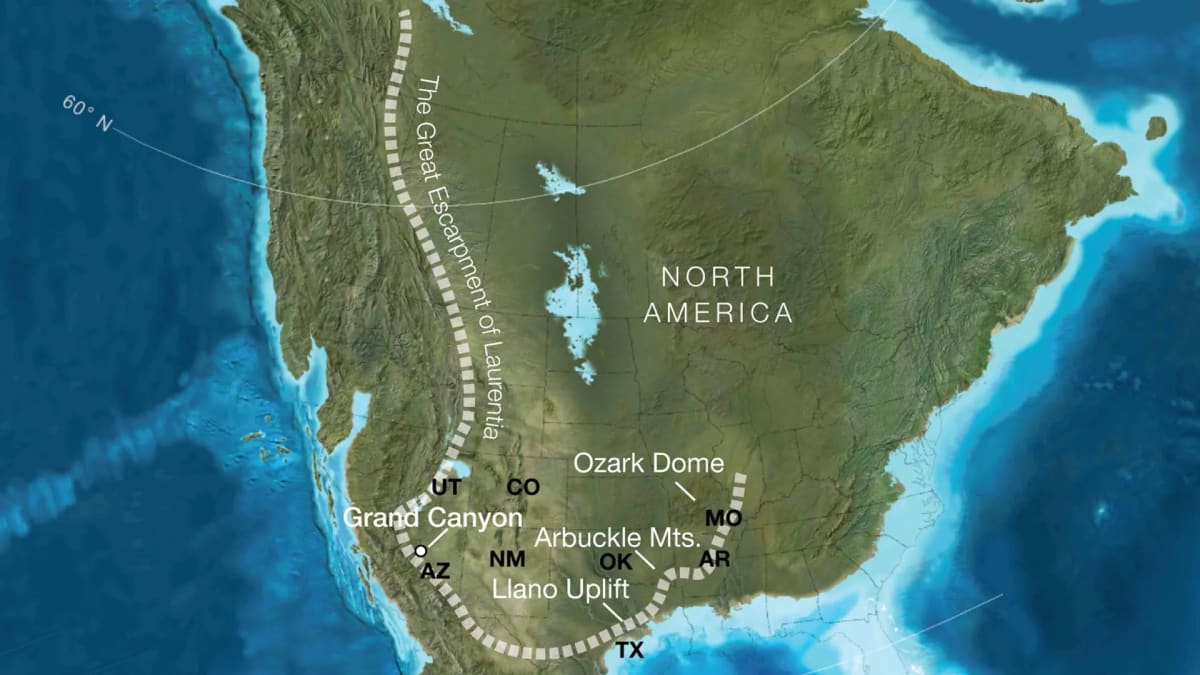
Researchers at the University of Southampton discovered that a colossal cliff system stretching thousands of kilometers across ancient North America exposed the Grand Canyon's deepest rocks nearly 800 million years before the Colorado River began its famous carving work. The towering cliffs reached roughly a kilometer high, comparable to modern skyscrapers stacked end to end.
The discovery helps explain the Great Unconformity, a puzzling gap in the Grand Canyon's geological record where more than a billion years of rock simply vanishes. Professor Thomas Gernon, who led the international research team, explained that half the canyon's two billion year history appears to be missing.
The mega-cliff formed when the ancient supercontinent Rodinia broke apart 800 million years ago. As the massive landmass fractured, it created what scientists call a "great escarpment" along western North America, stretching across areas that today include Arizona, Utah, Idaho, Wyoming, Colorado, Texas, Oklahoma, Arkansas, Missouri, and Illinois.
Over tens of millions of years, powerful erosion along this enormous rocky boundary stripped away up to eight kilometers of rock in some locations. That gradual wearing down progressively exposed the ancient crystalline basement rocks now visible in the Grand Canyon's depths.
The research team combined plate tectonic reconstructions with landscape evolution data to recreate what North America looked like hundreds of millions of years ago. Their computer models revealed that the future Grand Canyon sat in roughly the same position relative to the continental edge as major escarpments found today in South Africa and Brazil.
Why This Inspires
This discovery transforms how we understand the forces that shape our planet over deep time. By comparing the Grand Canyon's ancient history with active landscapes like the Great Escarpment of South Africa, scientists can now reinterpret similar geological mysteries worldwide.
The finding also demonstrates how continental breakup creates both steep slopes and high ground, providing the mountainous terrain that rivers and glaciers can readily erode. This enormous escarpment may have shaped river paths, determined where sediments collected, and influenced when rising seas spread across the continent before the Cambrian explosion, when complex life diversified rapidly.
The research, published in the journal Geology, involved scientists from universities in the UK, Germany, and the United States working together to piece together Earth's ancient puzzle.
Today's great escarpments in Africa, Brazil, India, and Antarctica now serve as windows into the forces that shape continents across hundreds of millions of years, helping us see familiar landmarks in entirely new light.
Based on reporting by Science Daily
This story was written by BrightWire based on verified news reports.
Spread the positivity!
Share this good news with someone who needs it