Assam's 150-Foot Hollong Trees Fight Floods for Centuries
Deep in Assam's rainforests, towering Hollong trees have spent centuries helping the land absorb monsoon rains and prevent soil erosion. Now classified as endangered after losing up to 70% of their population, protecting these natural giants could help communities build resilience against increasingly severe floods.
In the same week that floods swept through Assam's Sivasagar and Jorhat districts, forcing thousands from their homes, scientists pointed to an unlikely flood fighter that's been quietly doing its job for hundreds of years.
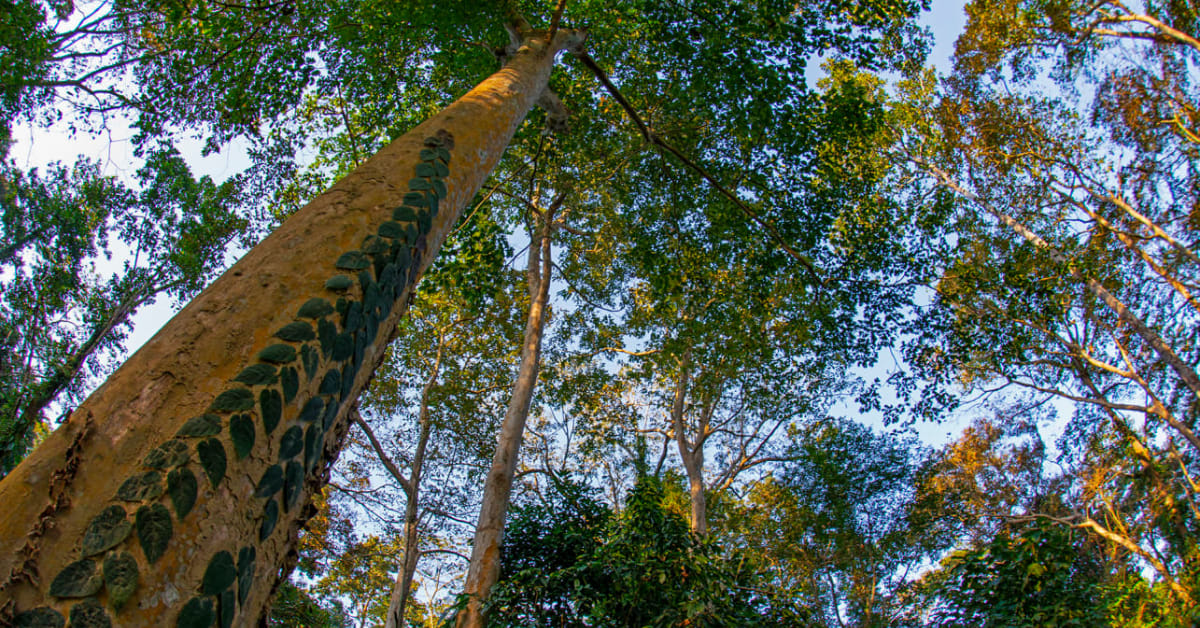
The Hollong tree, Assam's state tree, can grow as tall as a 15-story building. But its real superpower lies underground and in its canopy, where deep roots anchor waterlogged soil and massive leaves intercept rain before it hits the ground.
These rainforest giants evolved specifically for one of India's wettest climates, where annual rainfall can reach 3,000 millimeters. Their structure tells the story: deep root systems that stabilize soil during storms, large waxy leaves that shed water sheets during downpours, and winged seeds that disperse after monsoons to colonize new ground.
In forests like Hollongapar Gibbon Sanctuary and Dehing Patkai, Hollong trees create entire ecosystems beneath their canopies. They regulate microclimates, keeping forest floors cooler and more stable during extreme weather events.
The trees also serve as massive carbon storage units. Dipterocarp-dominated forests, the family to which Hollong belongs, are recognized globally as some of the planet's most important natural carbon sinks.
The Bright Side
Despite decades of logging and habitat loss that reduced Hollong populations by 50 to 70%, conservation efforts are gaining momentum. Communities across Upper Assam, Arunachal Pradesh and Nagaland are recognizing that protecting these native species offers benefits no concrete structure can replicate.
The trees can't stop floods entirely, but they perform crucial functions: intercepting rain, slowing water flow, anchoring soil, and helping landscapes absorb extreme rainfall. In a region where climate change is intensifying monsoon patterns, these natural systems are becoming more valuable than ever.
Recent afforestation projects in Tinsukia's Nalani Reserved Forest, though facing challenges, signal growing awareness of Hollong's importance. Local residents are now demanding accountability when saplings are destroyed, showing a shift in how communities value native forest restoration.
The International Union for Conservation of Nature lists Hollong as Endangered, but its story isn't over. Every protected forest, every replanted sapling, and every community that chooses native restoration over monoculture plantations gives these ancient flood fighters another chance to do what they've done for centuries: help Assam's landscape bend without breaking under the monsoon's weight.
More Images
%2Fenglish-betterindia%2Fmedia%2Fmedia_files%2F2026%2F08%2F04%2Fhollong-2026-08-04-13-31-13.png)
%2Ffilters%3Aformat(webp)%2Fenglish-betterindia%2Fmedia%2Fmedia_files%2F2026%2F08%2F04%2Fhollong-1-2026-08-04-13-34-09.png)
%2Ffilters%3Aformat(webp)%2Fenglish-betterindia%2Fmedia%2Fmedia_files%2F2026%2F08%2F04%2Fhollong-2-2026-08-04-13-38-14.png)
Based on reporting by The Better India
This story was written by BrightWire based on verified news reports.
Spread the positivity!
Share this good news with someone who needs it