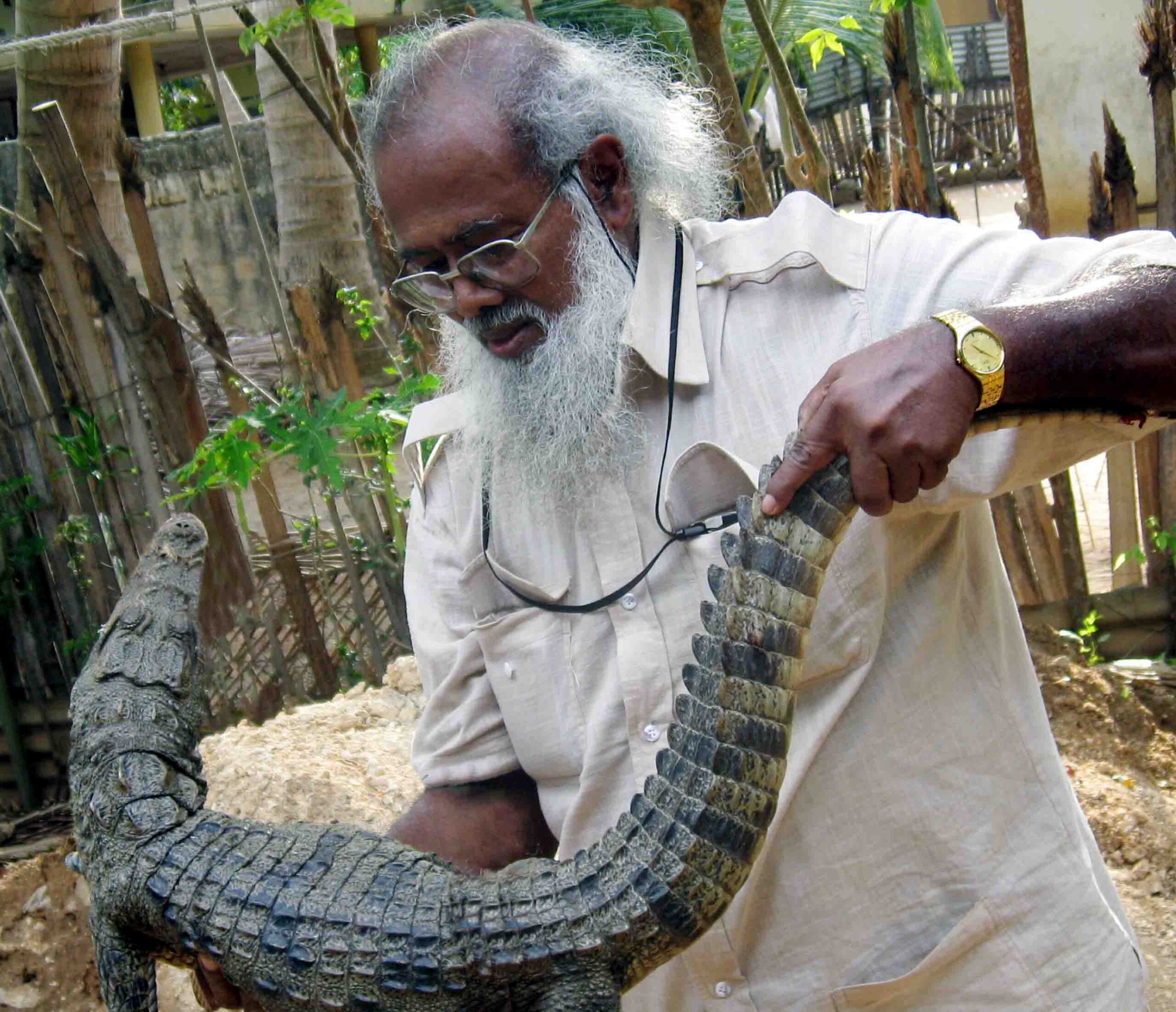
At 86, Sri Lankan Scientist Mentors Next Generation
Anslem de Silva has spent 60 years studying Sri Lanka's reptiles and amphibians, inspiring hundreds of young scientists along the way. Now at 86, he's hosting the world's first international conference dedicated entirely to snake conservation.
A 13-year-old boy in Sri Lanka opened his mailbox to find a scientific journal about reptiles, inscribed with a personal note from the country's leading herpetologist. That moment changed his life, just as it has for hundreds of other young scientists who received similar encouragement from Anslem de Silva.
At 86, de Silva has become something far greater than Sri Lanka's "father of modern herpetology." He's built an entire generation of conservationists who now protect the island's rich diversity of reptiles and amphibians.
His journey started in the 1960s when only a handful of researchers studied Sri Lanka's reptiles. De Silva has since authored more than 350 scientific papers and 25 books, documenting species that might otherwise have gone unnoticed.
But his real magic lies in mentorship. Born in 1940 in coastal Matara, de Silva fell in love with snakes after rescuing a rat snake from bullies as a child. Before becoming a scientist, he won Sri Lanka's title of Best Magician in 1965, skills he says taught him how to communicate conservation to everyday people.
"Communicating the value of conservation to the public is an art, a matter of good storytelling," de Silva explains. "I believe my experience as a magician helped me to reveal the true magicians of nature."
He launched Sri Lanka's first herpetology journal and organized the country's first reptile research conference. In 1990, he established the Amphibia and Reptile Research Organization of Sri Lanka, creating formal pathways for young scientists to enter the field.
The Ripple Effect
Ruchira Somaweera, now a conservation biologist, remembers receiving that inscribed journal at age 13. "Most of the herpetologists of my generation were groomed by de Silva," Somaweera says. "Hundreds, if not thousands, of students have been inspired by him, just like I was."
De Silva's work extends beyond mentorship into public education. He works to counter fear about snakes, teaching communities that only five of Sri Lanka's 100-plus snake species can deliver fatal bites. That knowledge saves both human lives and snakes from needless killing.
In October, de Silva will host the first World Congress on Snakes in Kandy, bringing together international researchers for the first gathering dedicated specifically to snake conservation. The IUCN recognized his lifetime achievements with the Sir Peter Scott Award of Conservation Merit in 2019.
For de Silva, the true measure of success isn't the species he's documented or the papers he's published. "I am especially happy to see the growth of herpetology in Sri Lanka and the younger generations who are now continuing this work," he says, knowing his legacy walks on two legs, not four.
More Images


Based on reporting by Mongabay
Turn Today’s Good News Into Action
Generate a simple, meaningful 2-minute act of kindness you can do today and log your ripple effect.
Share This Good News Story
Send a dose of constructive journalism to someone who needs it today.
More Good News