Berkeley Lab Teaches AI to "See" Atoms Like Scientists Do
Scientists just gave artificial intelligence a superpower it desperately needed: the ability to understand the invisible forces that hold matter together. This breakthrough could speed up the discovery of everything from better batteries to life-saving materials.
Imagine asking someone to fix a car engine by only reading a parts list, never seeing how the pieces fit together. That's been the frustrating reality for scientists trying to use AI tools like ChatGPT to solve complex materials problems.
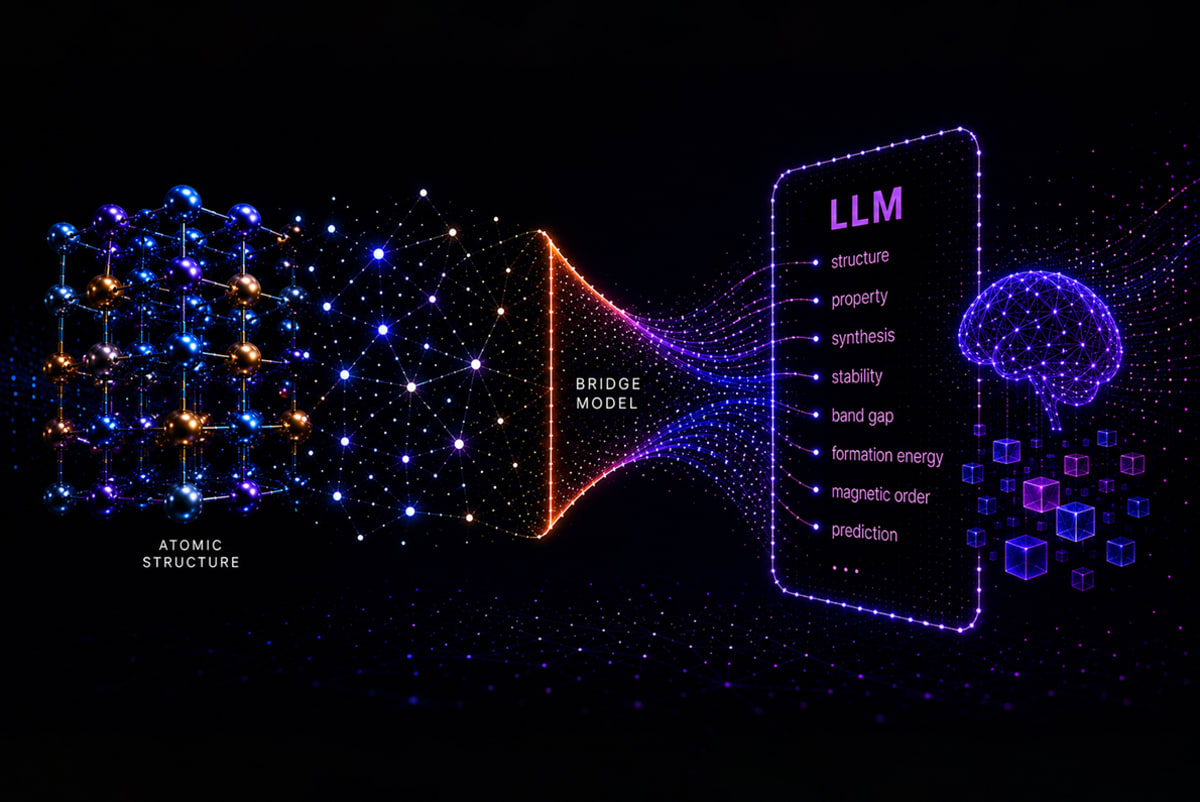
Now researchers at Lawrence Berkeley National Laboratory have solved this puzzle with MatterChat, an AI system that can finally "see" the atomic world the way scientists do. The breakthrough connects the conversational smarts of language models with physics-based AI that understands how atoms actually behave.
Traditional AI excels at words but stumbles when facing the three-dimensional reality of atoms arranged in crystals or molecules. Scientists had to feed these tools raw data files as simple text, losing all the spatial information that makes materials work the way they do.
The Berkeley Lab team took inspiration from AI that translates between images and text, then adapted it for the physical sciences. They created a "bridge model" trained on nearly 143,000 atomic structures that translates between an AI's understanding of language and its understanding of physics.
The results speak for themselves. MatterChat significantly outperformed general-purpose tools like GPT-4 at predicting material properties, especially critical measurements like bandgaps that determine whether a material works in electronics or energy storage.
What makes this especially clever is its efficiency. Instead of building a massive AI system from scratch, the team connected two existing powerful models with a lightweight bridge between them. Lead author Yingheng Tang, a postdoctoral researcher at Berkeley Lab, explains it gives language models the "structural vision" they need to tackle real-world materials challenges.
The system can now predict thermal stability, analyze electronic properties, and even generate step-by-step instructions for creating new materials. It's like giving a brilliant research assistant both encyclopedia knowledge and the ability to visualize molecular structures.
The Ripple Effect
This isn't just about making AI smarter. Discovering new materials traditionally requires expensive, time-consuming simulations and lab experiments. MatterChat could accelerate that process dramatically, helping researchers design better solar panels, stronger alloys, or more efficient computer chips in a fraction of the time.
The modular design means scientists can easily upgrade components or adapt the bridge to work with different physics models as technology advances. It's a foundation that grows stronger over time, not a one-off solution.
Published recently in Nature Machine Intelligence, this work represents a fundamental shift in how AI can serve scientific discovery. By teaching machines to truly understand the atomic world, researchers have unlocked a powerful new tool for solving humanity's materials challenges.
The future of scientific discovery just got a whole lot brighter, one atom at a time.
More Images
Based on reporting by Google: scientific discovery
This story was written by BrightWire based on verified news reports.
Spread the positivity!
Share this good news with someone who needs it