California Funds $3M Wind Turbine "Nervous System
Scientists just turned a floating wind turbine into a living, feeling structure that can detect problems before they happen and listen to whales swimming nearby. This breakthrough could unlock America's deepest ocean winds while protecting marine life.
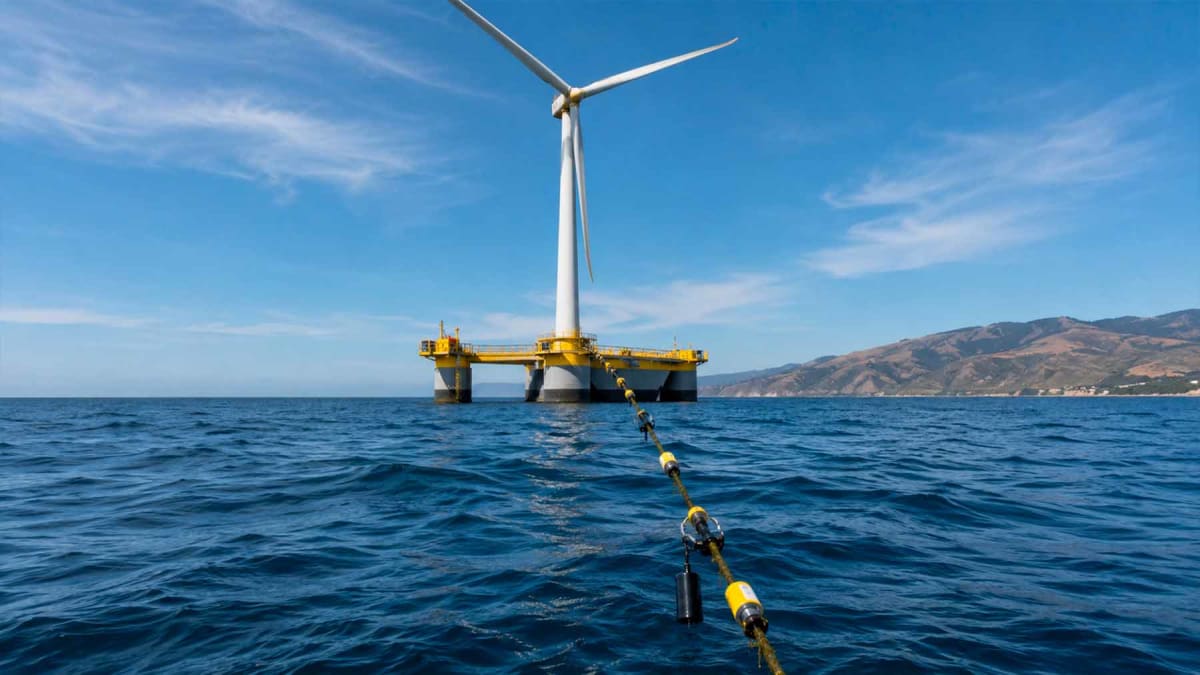
Floating wind turbines off California's coast are getting something remarkable: their own sense of touch and hearing.
Lawrence Berkeley National Laboratory just developed a fiber-optic "nervous system" for offshore wind platforms, funded by a $3 million grant from the California Energy Commission. Thin glass cables thread through the structure like biological nerves, constantly feeling for stress points, loose bolts, and temperature changes before they become dangerous failures.
The technology works by sending light pulses through glass fibers and recording how they reflect back in real time. Any tiny structural vibration or physical deformation gets detected immediately across the tower and gearboxes.
But here's where it gets even better. The same system doubles as underwater ears, using distributed acoustic sensing to track ocean sounds including whale vocalizations. Engineers can now monitor marine life behavior near turbines and adjust operations to protect migrating whales.
This innovation solves a critical problem as America races toward its 2050 net-zero emissions goal. The nation aims for 100% carbon-free power by 2035, and offshore wind is essential to reaching that target.
Traditional fixed-bottom turbines only work in waters up to 200 feet deep, and those shallow spots are filling up fast. California's Pacific coast drops into deep trenches just miles offshore, with some of the strongest, most consistent winds in the country. Floating platforms can access this untapped energy, but the harsh marine environment creates serious challenges.
Rip currents, unpredictable swells, and massive waves put constant mechanical strain on towers and mooring lines. Manual monitoring across these remote deep-water installations is expensive and difficult. Equipment failures in such extreme conditions could be catastrophic.
The new nervous system changes everything. UC Berkeley's Pacific Earthquake Engineering Research Center tested the technology under simulated harsh conditions, and sensors successfully caught minor problems early. Detecting a loose bolt now prevents a complete structural failure later.
The Ripple Effect
This breakthrough does more than protect individual turbines. It makes floating wind farms economically viable at scale, unlocking vast clean energy resources that were previously too risky and expensive to maintain.
The dual capability to monitor both structural health and marine ecosystems addresses two major barriers to offshore wind expansion. Environmental groups and fishing communities have raised concerns about ocean impacts, and this technology provides real data to guide responsible development.
Commercial field tests are already planned for upcoming deep-water Pacific platforms over the next decade. If successful across California's coast, the technology could roll out to floating wind projects nationwide.
America's deepest ocean winds are about to become our newest clean energy source, with turbines that can feel danger coming and listen to the whales swimming below.
Based on reporting by Google News - Wind Energy
This story was written by BrightWire based on verified news reports.
Spread the positivity!
Share this good news with someone who needs it