Car-Sized Sponge Found Off Hawaii May Be 2,300 Years Old
Deep-sea explorers discovered the world's largest sea sponge one mile down in Hawaiian waters, a creamy-white giant the size of a car that may have been filtering ocean water for thousands of years. The discovery highlights why protecting our ocean sanctuaries matters.
📺 Watch the full story above
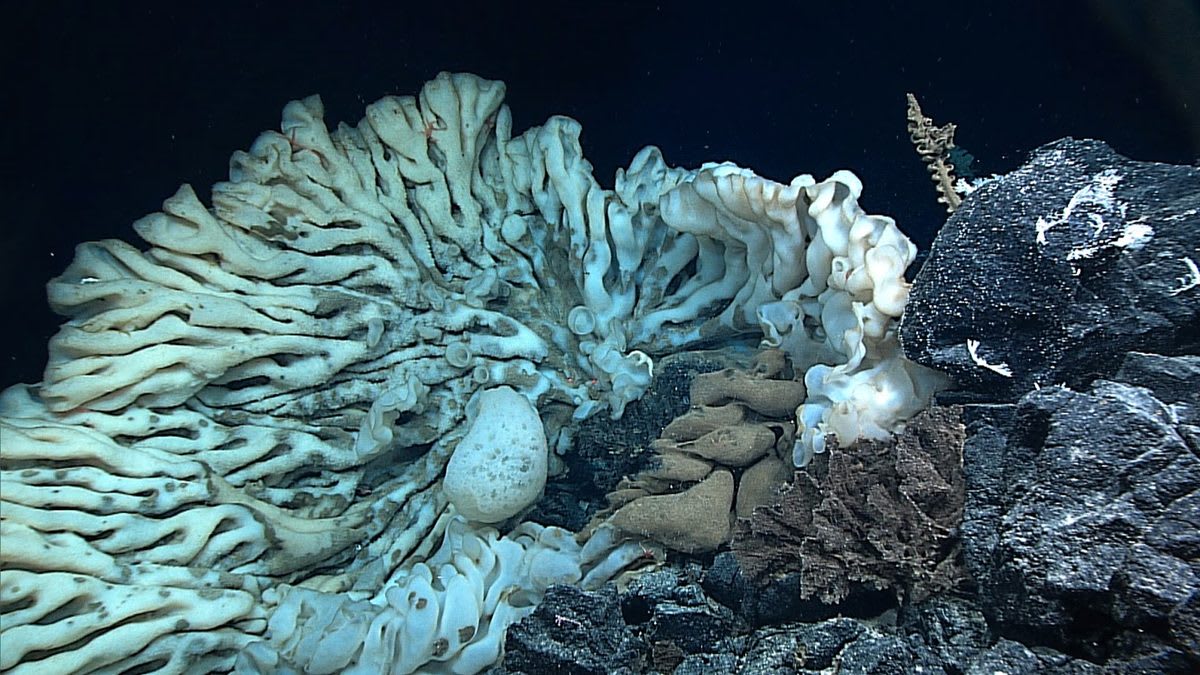
When scientists sent their underwater robot more than a mile deep off the coast of Hawaii in 2015, they weren't expecting to find a creature the size of a minivan quietly living on the seafloor. But there it was: the world's largest sea sponge, measuring 3.5 meters long, 2 meters high, and 1.5 meters wide.
"Oh my goodness! Where did this guy come from?" exclaimed one researcher as their remotely operated vehicle revealed the massive organism. "Holy guacamole here – look at this thing!"
The discovery happened during an expedition in Papahānaumokuākea Marine National Monument, a protected area in the Pacific Ocean. Scientists from NOAA's Office of Ocean Exploration and Research were exploring the seabed at 2,117 meters deep when they encountered the record-breaking giant.
This wasn't just any sponge. It's a type of glass sponge, with a creamy-white body full of pleats that look like an awkward pile of laundry bursting from the rocky ocean floor.
Measuring something a mile underwater isn't easy. The team used parallel laser beams projected onto the sponge as a reference point, then compared photos to calculate its true dimensions. The measurements confirmed it officially beat the previous record holder, a cloud sponge found in shallow Canadian waters that measured just 3.4 meters long.
Why This Inspires
This gentle giant has been quietly doing important work for possibly thousands of years. Sea sponges filter enormous amounts of water, capturing bacteria and debris while purifying everything that passes through them. Some can filter 20,000 times their own volume in just 24 hours.
Scientists estimate that massive sponges like this one can live for more than 2,300 years. That means this creature might have been growing on the seafloor long before most modern civilizations existed, patiently cleaning ocean water day after day.
The discovery reminds us how little we know about the ocean depths and how much is worth protecting. Because sponges can't swim away from danger, they're vulnerable to pollution and environmental changes. They're stuck in place, making them particularly sensitive to problems like chemical runoff and microplastic contamination.
The good news? This giant lives in one of the most protected marine areas on Earth. In 2025, Papahānaumokuākea was declared a marine sanctuary covering 582,570 square miles of ocean, giving creatures like this sponge the best chance at survival.
"The finding of such an enormous and presumably old sponge inside the Papahānaumokuākea Marine National Monument underscores the need to protect this area using the highest conservation measures available," the researchers wrote.
Sometimes the most inspiring discoveries are the quiet ones: ancient creatures peacefully doing their part to keep our oceans healthy, reminding us that protecting these hidden worlds means preserving thousands of years of natural history.
Based on reporting by Google News - World Record
This story was written by BrightWire based on verified news reports.
Spread the positivity!
Share this good news with someone who needs it