Cereal Box-Sized NASA Telescope Hunts Habitable Worlds
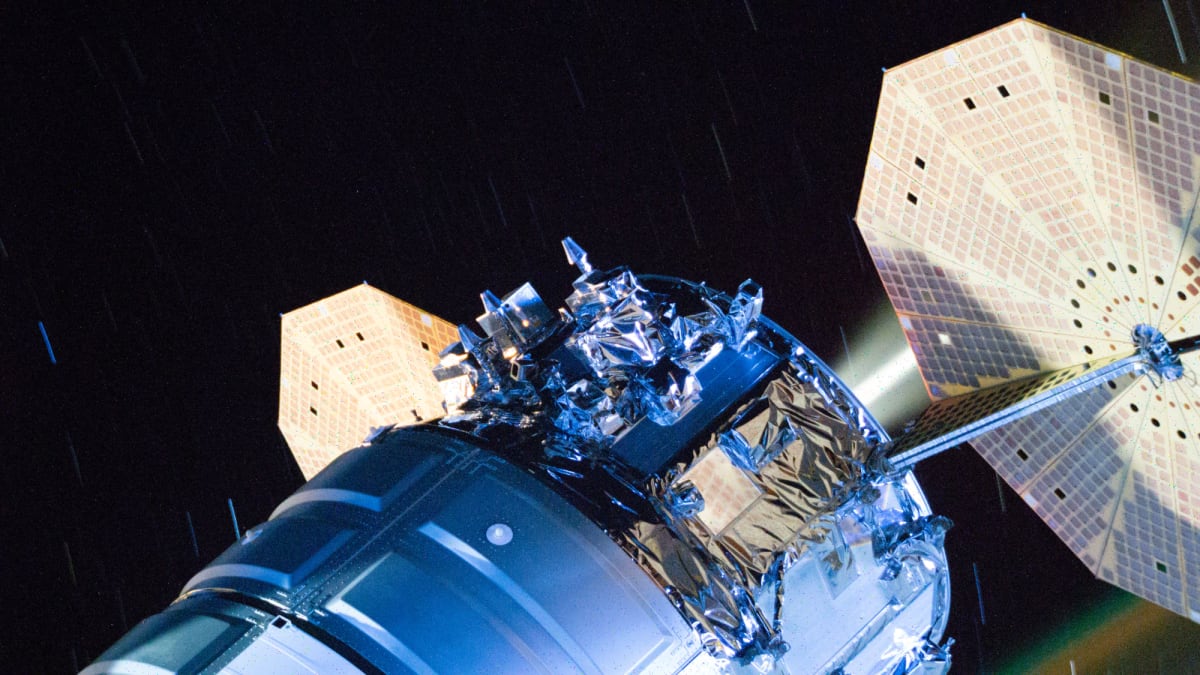
A tiny NASA spacecraft just sent back its first images from space, marking the start of a mission to discover which distant planets might support life. The breakthrough combines smartphone camera technology with quantum physics to study the most common stars in our galaxy.
A telescope the size of a cereal box just took a giant leap in the search for life beyond Earth.
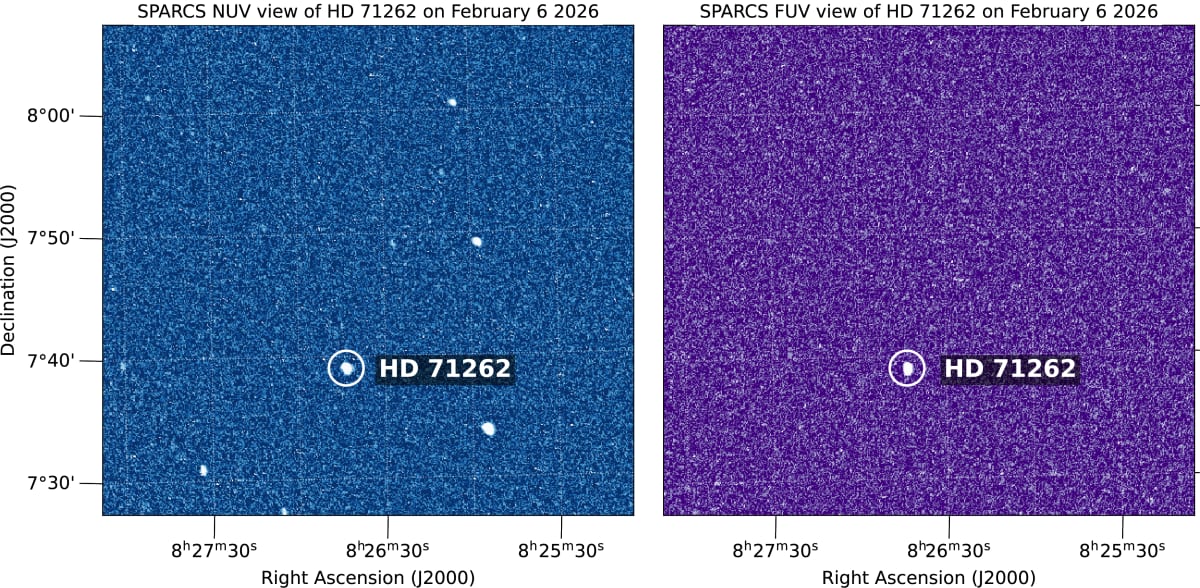
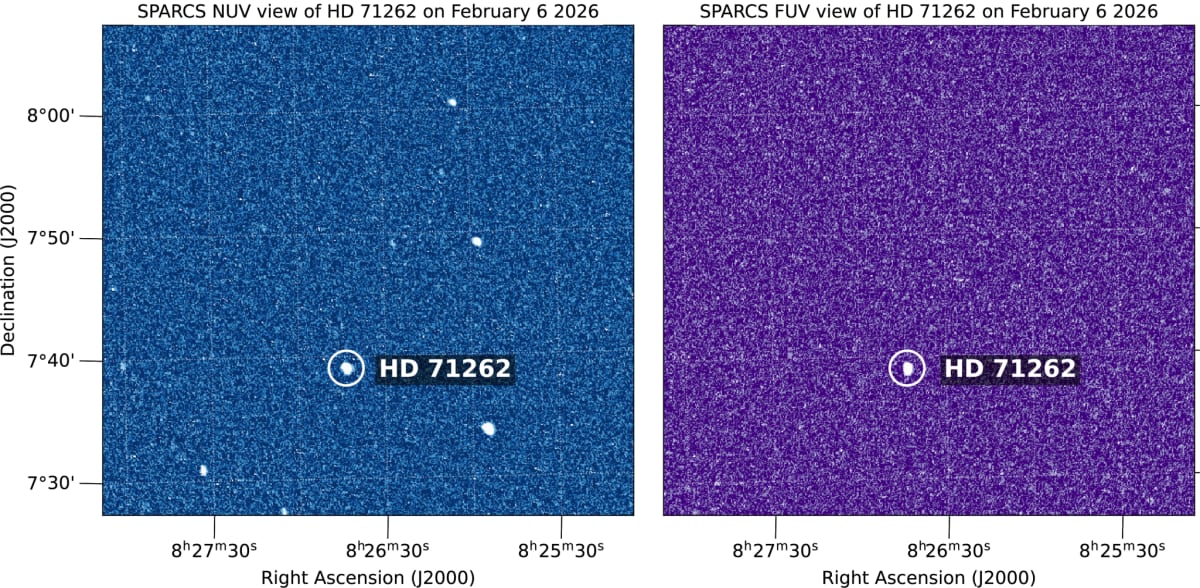
NASA's SPARCS spacecraft beamed down its first images in February after launching in January, proving its cutting-edge camera works perfectly in space. The tiny satellite will now spend the next year studying the galaxy's most common type of stars to help scientists figure out which distant worlds could harbor life.
The mission focuses on low-mass stars, which make up the majority of stars in the Milky Way. These small, cool stars host roughly 50 billion rocky planets in what scientists call the "habitable zone," where temperatures could allow liquid water to exist.
"Seeing SPARCS' first ultraviolet images from orbit is incredibly exciting," says Evgenya Shkolnik, the mission's lead investigator at Arizona State University. The images confirm the spacecraft is ready to begin the science it was built to do.
Here's why studying these particular stars matters. Low-mass stars flare far more frequently than our Sun, and those eruptions can dramatically affect the atmospheres of nearby planets. Understanding the star is key to understanding whether its planets could support life.
SPARCS will monitor about 20 stars continuously for five to 45 days each, tracking their flares and activity patterns in ultraviolet light. No other spacecraft has been dedicated to watching these stars this way for such extended periods.
Why This Inspires
The mission showcases ingenious engineering that makes big science possible in small packages. JPL scientists took the same silicon detector technology found in smartphone cameras and transformed it into one of the most sensitive ultraviolet imagers ever flown in space.
They achieved this by developing a technique to deposit special filters directly onto quantum-enhanced detectors, eliminating bulky separate components. The result is a powerful scientific instrument that fits in your hand.
The spacecraft even thinks for itself. An onboard computer can adjust observation settings in real time to better capture flare activity as it happens, maximizing every moment of its mission.
This technology blazes a trail for future planet-hunting missions. The techniques pioneered by SPARCS will help NASA's upcoming UVEX explorer and inform designs for the proposed Habitable Worlds Observatory, which could one day directly image Earth-like planets around other stars.
"By watching these stars in ultraviolet light in a way we've never done before, we're not just studying flares," says JPL scientist David Ardila. "These observations will sharpen our picture of stellar environments and help future missions interpret the habitability of distant worlds."
The first light images show multiple stars in near-ultraviolet wavelengths, with the hottest star also visible in far-ultraviolet light. These precise measurements are exactly what scientists need to understand how radiation from these stars affects the planets orbiting them.
SPARCS proves that the search for life beyond Earth doesn't require massive telescopes or billion-dollar budgets, just brilliant innovation and the determination to answer humanity's most profound question: Are we alone?
More Images



Based on reporting by Google News - Science
This story was written by BrightWire based on verified news reports.
Spread the positivity!
Share this good news with someone who needs it