China Beams 1,180 Watts of Power Wirelessly From 100 Meters
Chinese scientists just successfully transmitted over 1,000 watts of power through the air without wires, bringing us closer to solar farms in space that could beam clean energy to Earth 24/7. The breakthrough could one day end our dependence on weather and nighttime for solar power.
Imagine if solar panels could collect energy in space where the sun always shines, then beam that power down to Earth wirelessly. Chinese researchers just took a major step toward making that sci-fi vision real.
A team from Xidian University successfully transmitted 1,180 watts of electricity through the air over 100 meters with no wires or cables. That's enough power to run a laptop, charge multiple phones, or keep essential devices running during an emergency.
The achievement is part of China's Sun Chasing project, which launched in 2018 with an ambitious goal: build orbital solar power stations that collect sunlight in space and transmit it back to Earth. Unlike ground-based solar panels that stop working at night or during cloudy weather, space-based systems could provide continuous clean energy around the clock.
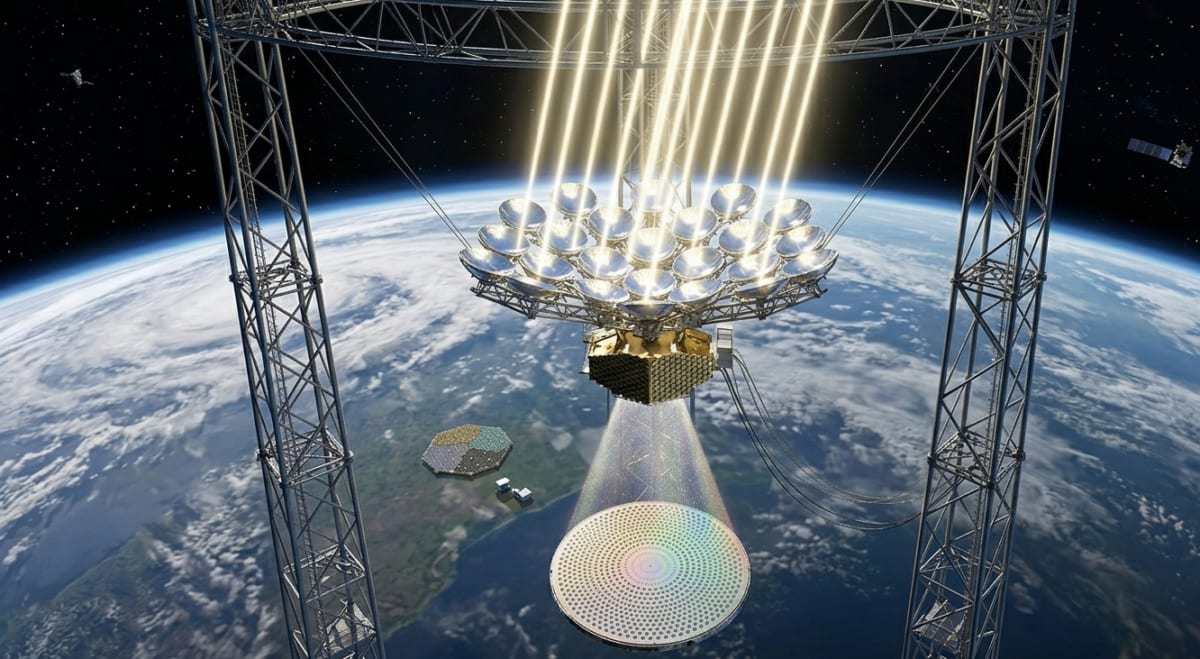
The technology works by collecting sunlight with special curved mirrors that concentrate the rays. That energy gets converted to electricity, then transformed into microwave beams that can travel through the atmosphere. A receiving antenna on the ground captures those microwaves and converts them back into usable power.
In recent tests, the system achieved 20.8% efficiency from start to finish over the 100-meter distance. The receiving antenna alone captured an impressive 87% of the transmitted microwave energy.
The team also tested the system on moving targets, successfully beaming 143 watts of stable power to a drone flying 30 kilometers per hour from 30 meters away. That demonstration solved a critical challenge: powering multiple moving objects from a single transmitter, meaning one future space station could supply electricity to several satellites or vehicles simultaneously.
Lead researcher Duan Baoyan highlighted the progress on making components smaller and lighter, which matters enormously for space applications where every gram counts. The team has also improved beam control precision to reduce energy waste and enhanced solar collection efficiency.
The Ripple Effect
Space-based solar power could transform how humanity generates energy. Remote communities without reliable electricity grids could receive power beamed directly from orbit. Disaster zones could get emergency power without waiting for fuel deliveries or infrastructure repairs.
The technology could also power spacecraft and satellites without heavy batteries, opening new possibilities for space exploration and communication. One orbital power station might serve multiple users across vast distances, making space operations more practical and sustainable.
The researchers acknowledge significant work remains before commercial viability. The next milestone involves conducting actual tests in orbit, where conditions differ dramatically from ground demonstrations. Scaling up from 100-meter tests to transmitting power from space to Earth represents an enormous engineering leap.
But the progress since 2018 shows steady advancement. The team completed full-system ground validation in 2022 and has consistently extended transmission distances while improving efficiency. Each breakthrough brings the vision closer to reality.
Clean, continuous, weather-independent energy from space isn't just a dream anymore—it's an engineering challenge being solved one test at a time.
More Images
Based on reporting by PV Magazine
This story was written by BrightWire based on verified news reports.
Spread the positivity!
Share this good news with someone who needs it