China Connects First Megawatt Airborne Turbine to Grid
A helium-powered wind turbine the size of a small building just floated 6,500 feet above China and successfully fed electricity into the grid. It's the first time a high-altitude floating wind system has worked at megawatt scale, opening new possibilities for clean energy.
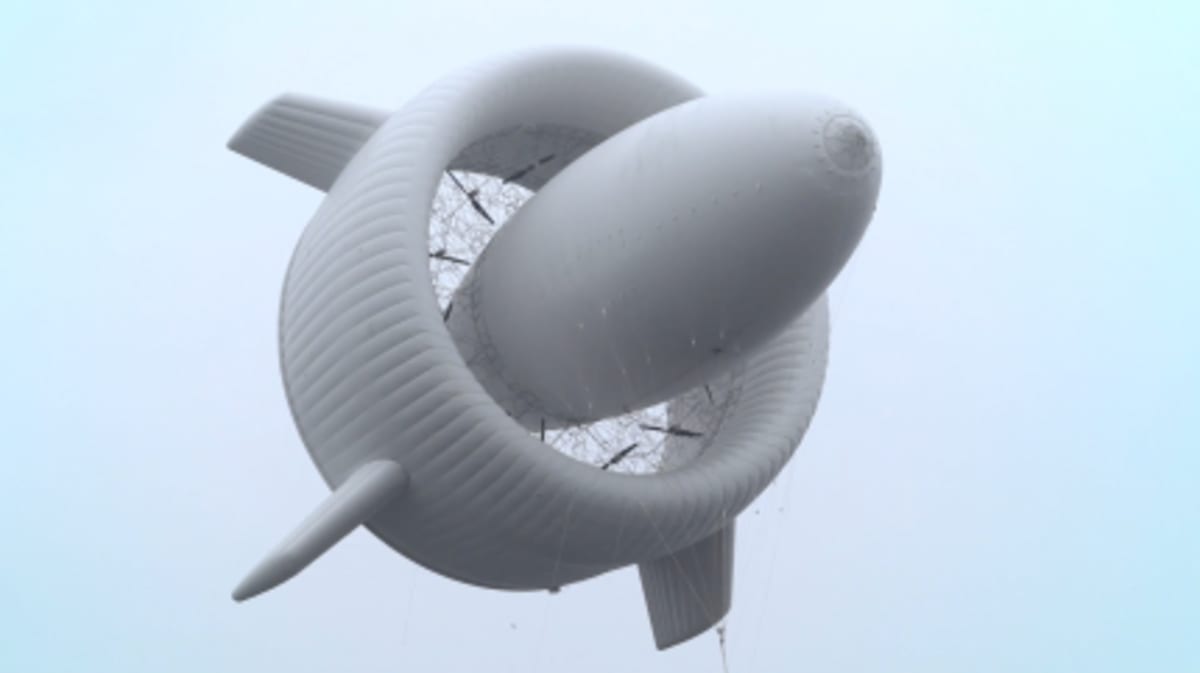
On January 5th, 2026, something extraordinary floated above the Chinese city of Yibin: a 197-foot-long wind turbine that rises on helium instead of standing on a tower.
The S2000 Stratosphere Airborne Wind Energy System climbed to 6,560 feet in just 30 minutes and generated 385 kilowatt-hours of electricity for the local power grid. It's the world's first megawatt-scale floating wind device to successfully connect to an electrical grid, marking a milestone that could unlock stronger, more consistent winds far above the ground.
Traditional wind turbines are stuck at ground level, where wind is weaker and less reliable. The S2000 SAWES solves this by floating like a massive blimp, lifting 12 separate turbines into high-altitude winds using helium. A cable both stabilizes the platform and transmits power back to earth.
The technology isn't entirely new. MIT researchers tested a similar design in 2014 with Altaeros Energies, and Google-backed Makani developed flying kites that generated 600 kilowatts. Both companies eventually closed or pivoted away from the technology, unable to prove they could make money.
What makes China's test different is the scale and the successful grid connection. Beijing-based Linyi Yunchuan Energy Technology built something 12 times larger than previous attempts and proved it can deliver usable electricity.
The engineering challenges are real. The team developed a special composite material woven with carbon fiber and Kevlar to prevent helium from leaking out. They also had to solve the complex problem of keeping something the size of a house stable at altitude while connected to the ground by cables.
The Bright Side
Smaller airborne wind companies are already succeeding with lighter designs. Kitepower and SkySails use fabric kites that fly at lower altitudes and cost far less to build and operate. Their success suggests the airborne wind industry is finding its footing, even if the path forward includes different approaches.
Chris Vermillion, an engineering professor at the University of Michigan, notes that while helium systems may seem simpler because they don't require constant motion, they face real challenges with material costs and weather dynamics. Helium prices could quadruple by 2026 due to supply chain issues, and leakage is inevitable over time.
Roland Schmehl, who co-founded Kitepower, points out that the S2000's massive scale means huge upfront costs without guaranteed success. Yet he also acknowledges that China's willingness to invest at this scale could answer questions that have held the entire industry back for years.
The test proved that floating wind turbines can work at utility scale, something that has never been demonstrated before.
More Images
Based on reporting by Google: wind energy success
This story was written by BrightWire based on verified news reports.
Spread the positivity!
Share this good news with someone who needs it