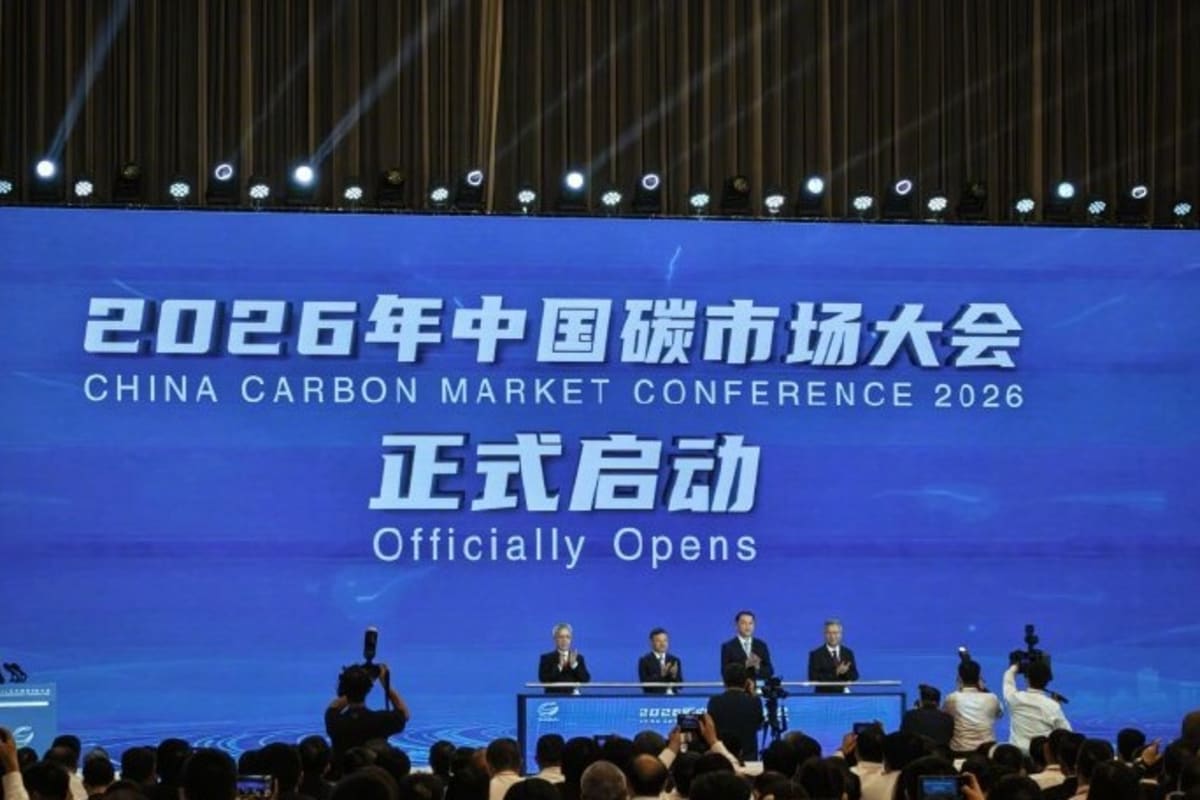
China's Carbon Market Hits $9.8B in Emission Trading
China's national carbon trading market has grown to nearly $10 billion since 2021, helping thousands of companies cut emissions while turning climate action into smart business. The system now covers 65% of the country's total carbon emissions across major industries.
China just proved that fighting climate change can work at massive scale, with its carbon trading market reaching almost $10 billion in total transactions.
Since launching in July 2021, the national carbon market has traded 961 million metric tons of carbon emission allowances through August 2026. That's roughly equivalent to taking millions of cars off the road for years.
The momentum is building fast. In 2025 alone, trading volume jumped 24% from the previous year to reach 235 million tons, the highest since the market began. The number of transactions, trading volume, and participating companies all broke records, with increases of 89%, 116%, and 77% respectively compared to the previous compliance cycle.
Here's how it works: Companies that emit carbon dioxide get allowances for how much they can emit. If they reduce emissions below their limit, they can sell extra allowances to companies that need more. This creates a financial incentive to go green.
The system now covers 3,680 major emitters across power generation, steel, cement, and aluminum industries. Together, these facilities produce more than 65% of China's total carbon emissions, making this one of the world's largest carbon markets.
The Ripple Effect
Carbon pricing has quietly transformed how Chinese companies think about pollution. Instead of viewing emission cuts as pure costs, businesses now see them as potential profit opportunities. The market has turned abstract environmental goals into concrete financial decisions that affect quarterly balance sheets.
The ripple extends beyond mandatory compliance too. China's voluntary carbon credit program has registered 41 projects that generated 24.2 million metric tons of certified emission reductions by August. This voluntary market, worth $243 million, shows companies are going beyond minimum requirements.
The government is preparing to expand the system to petrochemicals, chemicals, papermaking, and civil aviation sectors. That expansion will bring even more of China's industrial base into a system where reducing emissions makes business sense.
For context, China produces about 8.3 billion tons of carbon dioxide annually from just the industries currently covered. Each percentage point reduction translates to roughly 83 million tons of CO2, equivalent to the annual emissions of several small countries.
The stable growth of this market matters globally because China is the world's largest emitter. When the country's biggest polluters have financial reasons to innovate cleaner technology and processes, the benefits extend far beyond national borders through technology development, manufacturing improvements, and proof that market mechanisms can work at scale.
More Images
Based on reporting by Google News - Emissions Reduction
This story was written by BrightWire based on verified news reports.
Spread the positivity!
Share this good news with someone who needs it