China's Probe Captures First-Ever Photos of Quasi-Moon
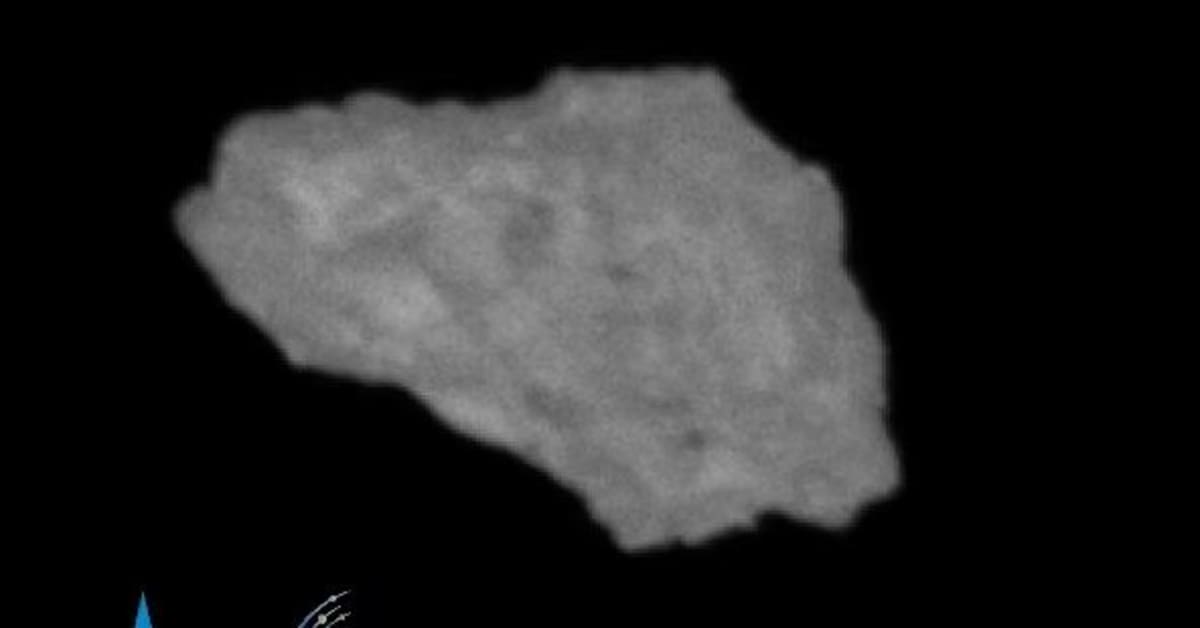
After a 400-day journey across a billion kilometers, China's Tianwen-2 spacecraft just sent back the first close-up images of Kamo'oalewa, a tiny asteroid that shadows Earth's orbit around the sun. If successful, this mission could unlock secrets about how our solar system formed billions of years ago.
A small spacecraft has just achieved something no probe has done before: photographing Earth's mysterious companion asteroid from just 12 miles away.
China's Tianwen-2 probe reached Kamo'oalewa on July 2, 2026, after traveling roughly 1 billion kilometers over 400 days. The spacecraft captured the first close-up images of this tiny space rock, which measures just 41 meters across (about half the length of a football field) and spins rapidly through space.
Kamo'oalewa isn't technically a moon because it orbits the sun, not Earth. But it follows a path nearly identical to our planet's orbit, making it what scientists call a quasi-satellite. It's been shadowing Earth for centuries, yet we knew almost nothing about it until now.
The real challenge starts now. Landing on a fast-spinning asteroid smaller than a city block requires incredible precision. Tianwen-2 will need to achieve stable contact within a narrow time window to collect samples from the surface.
If everything goes according to plan, the probe will scoop up pieces of this ancient rock and release them in a capsule during an Earth flyby in November 2027. Those samples could answer fundamental questions about our cosmic neighborhood.
The Bright Side
Scientists believe Kamo'oalewa might contain primordial material from the early solar system, offering clues about how planets formed billions of years ago. "It is highly likely to contain primordial information from the early days of the solar system's formation," explains Han Siyuan, spokesperson for the Tianwen-2 mission.
The asteroid's origins remain a scientific puzzle. Researchers initially thought Kamo'oalewa was a chunk of our moon, blasted into space by an asteroid impact millions of years ago. Its reflected light spectrum closely matched lunar silicate minerals, and computer simulations supported this theory.
But new research published in May challenges that idea. An international team, including scientists from the Chinese Academy of Sciences, found that the asteroid's light absorption patterns actually match a type of meteorite called LL chondrites. Their experiments simulating space weathering suggest Kamo'oalewa likely migrated from the Flora family, a group of asteroids in the main asteroid belt between Mars and Jupiter.
This mission joins an elite group of asteroid sample-return missions, following Japan's Hayabusa missions and NASA's OSIRIS-REx. Each successful sample return teaches us more about the building blocks that formed our solar system.
The samples Tianwen-2 hopes to bring home in 2027 will settle the debate about where this little wanderer truly came from and what stories it holds about our cosmic past.
More Images




Based on reporting by Wired
This story was written by BrightWire based on verified news reports.
Spread the positivity!
Share this good news with someone who needs it