Chinese Solar Breakthrough Hits Record 27% Efficiency
Scientists in China just shattered the world record for a new type of solar panel, reaching 27.17% efficiency and solving a puzzle that stumped researchers for years. The breakthrough could make solar power cheaper and easier to produce at scale.
Scientists in China just achieved something the solar industry has been chasing for years: a more efficient, easier-to-manufacture solar panel that could transform how we harness the sun's energy.
Researchers from Nankai University and Beijing Institute of Technology set a new world record with a perovskite solar cell reaching 27.17% efficiency. That means more than a quarter of the sunlight hitting the panel converts directly into electricity.
What makes this breakthrough special isn't just the number. The team cracked a longstanding mystery about why these "inverted" solar cells weren't performing as well as their counterparts.
The problem lived at the microscopic level, where electrons were getting trapped and energy was being wasted at the interface between materials. Previous researchers knew something was wrong but couldn't pinpoint exactly what.
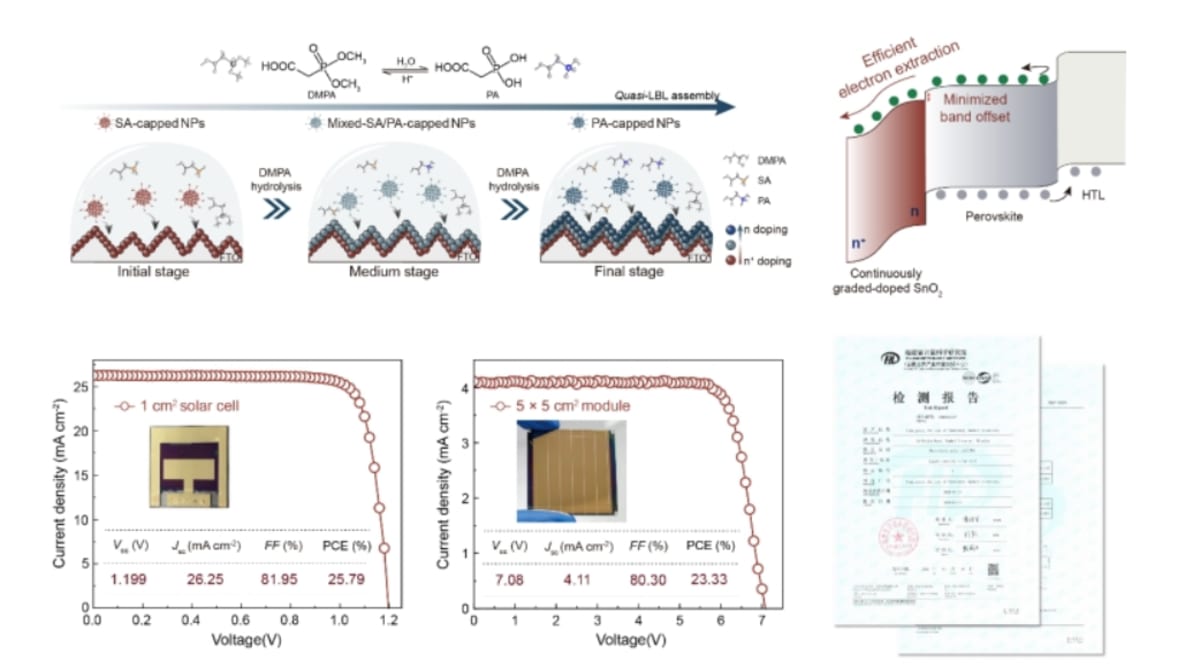
The Chinese team discovered that mismatched atomic structures and electron traffic jams were working together to sabotage efficiency. Armed with that knowledge, they redesigned the electron transport layer using tin oxide with a clever gradient structure that transitions from lightly doped to heavily doped regions.
This graded design solves both problems at once. It smooths out the energy mismatch and speeds up electron extraction, dramatically reducing wasted energy.
The results speak for themselves. Beyond the record-breaking small cell, the team achieved 25.79% efficiency on a larger laboratory-scale device and 23.33% on an even bigger module measuring over 16 square centimeters.
The Ripple Effect
This isn't just a laboratory curiosity. Inverted perovskite solar cells are easier and cheaper to manufacture than traditional designs, making them ideal for scaling up production.
The gradient doping strategy the team developed offers a universal approach that other researchers can adapt and improve. It's the kind of fundamental breakthrough that opens doors rather than closing them.
Solar power already provides clean energy to millions, but efficiency gains like this mean panels can generate more electricity from the same rooftop space. For homeowners and businesses, that translates to faster payback periods and greater savings.
Perhaps most exciting is what this means for developing regions where energy access remains limited. Cheaper, more efficient solar panels could accelerate electrification in communities that need it most.
The researchers published their findings in the journal Nature, sharing their discovery with the global scientific community. Their work provides what they call "technical support for the high stability and scalable production" of next-generation solar modules.
From laboratory bench to rooftop reality, solar power keeps getting better, one breakthrough at a time.
More Images

Based on reporting by Google News - Solar Power Record
This story was written by BrightWire based on verified news reports.
Spread the positivity!
Share this good news with someone who needs it