Chinese Solar Cells Hit Record 20% Efficiency Breakthrough
Scientists in China just cracked a major barrier in solar energy, pushing organic solar cells past 20% efficiency for the first time. Their surprisingly simple solution could make cleaner energy cheaper and easier to produce at scale.
Solar power just took a giant leap forward thanks to a team of Chinese researchers who achieved what many thought was years away.
Scientists from five Chinese universities developed organic solar cells that convert sunlight to electricity at 20.21% efficiency, setting a new world record. That might not sound dramatic, but in the solar world, every percentage point means significantly more clean energy from the same amount of material.
The breakthrough came from solving a stubborn problem that has plagued solar cell manufacturing for years. When scientists build these cells layer by layer, the solvents used in each new layer can damage the layers underneath, like accidentally smearing wet paint. This creates weak spots that waste energy and reduce performance.
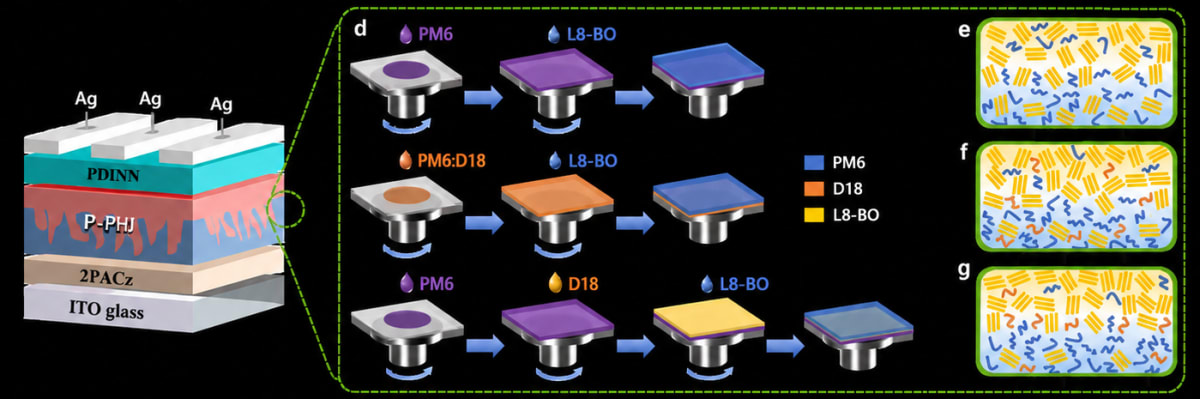
The research team's solution was elegantly simple. They inserted a protective buffer layer made from a crystalline polymer called D18 between the main energy-converting layers. Think of it like placing a waterproof sheet between floors during construction.
This thin protective layer prevented solvent damage while still allowing electricity to flow efficiently through the cell. The result was cleaner interfaces, better charge transport, and less energy lost to heat.
The team tested three different designs using combinations of materials with names like PM6, L8-BO, and BTP-eC9. Their buffered design outperformed conventional approaches, jumping from 18.53% efficiency to 19.80%, then reaching 20.21% with further refinements.
Why This Inspires
Organic solar cells matter because they promise something traditional silicon panels can't deliver as easily: lightweight, flexible solar power that could be printed onto buildings, vehicles, or even clothing. They use carbon-based materials instead of rare or toxic elements, making them potentially cheaper and more sustainable to produce.
The real beauty of this discovery is its simplicity. The researchers didn't invent exotic new materials or complex manufacturing processes. They found a straightforward way to protect existing materials during production, making high-performance solar cells more reliable and reproducible at factory scale.
This matters beyond just setting records. As efficiency climbs past 20%, organic solar technology moves closer to competing with traditional panels in real-world applications. That means more options for bringing clean energy to places where heavy silicon panels don't make sense.
The research appeared in the Chinese Journal of Polymer Science, with contributions from Jiangxi Normal University, Zhejiang University, Chinese University of Hong Kong, Changzhou University, and Gannan Normal University.
Clean energy just got a little brighter, and a lot more accessible.
More Images


Based on reporting by PV Magazine
This story was written by BrightWire based on verified news reports.
Spread the positivity!
Share this good news with someone who needs it