CMU Robots Playing Catch Could Transform Sports Training
Carnegie Mellon University just showed NFL legends robots that can throw footballs, assist surgeries, and adapt to human movement in real time. This isn't science fiction anymore—it's the future of sports training and recovery happening right now in Pittsburgh.
Imagine a training partner that never gets tired, can throw with perfect precision, and learns your unique movement patterns to prevent injuries. That future arrived in Pittsburgh this week when NFL Commissioner Roger Goodell and Steelers legend Jerome Bettis watched robots play catch at Carnegie Mellon University's Robotics Innovation Center.
More than 16 robotics startups showcased inventions that could revolutionize how athletes train, recover, and compete. The demonstrations ranged from surgical robots to "snakebots" that can crawl and swim into hard-to-reach places, but the sports applications stole the show.
Pittsburgh Mayor Corey O'Connor threw a football with a humanoid robot that's learning to catch, throw, and eventually tackle. Derek Ham, director of CMU's Entertainment Technology Center, says researchers can program the robot's arm strength and targets. "We're at the early eve where physical computing and AI start seeing bots as objects for entertainment, for games and play," he explained.
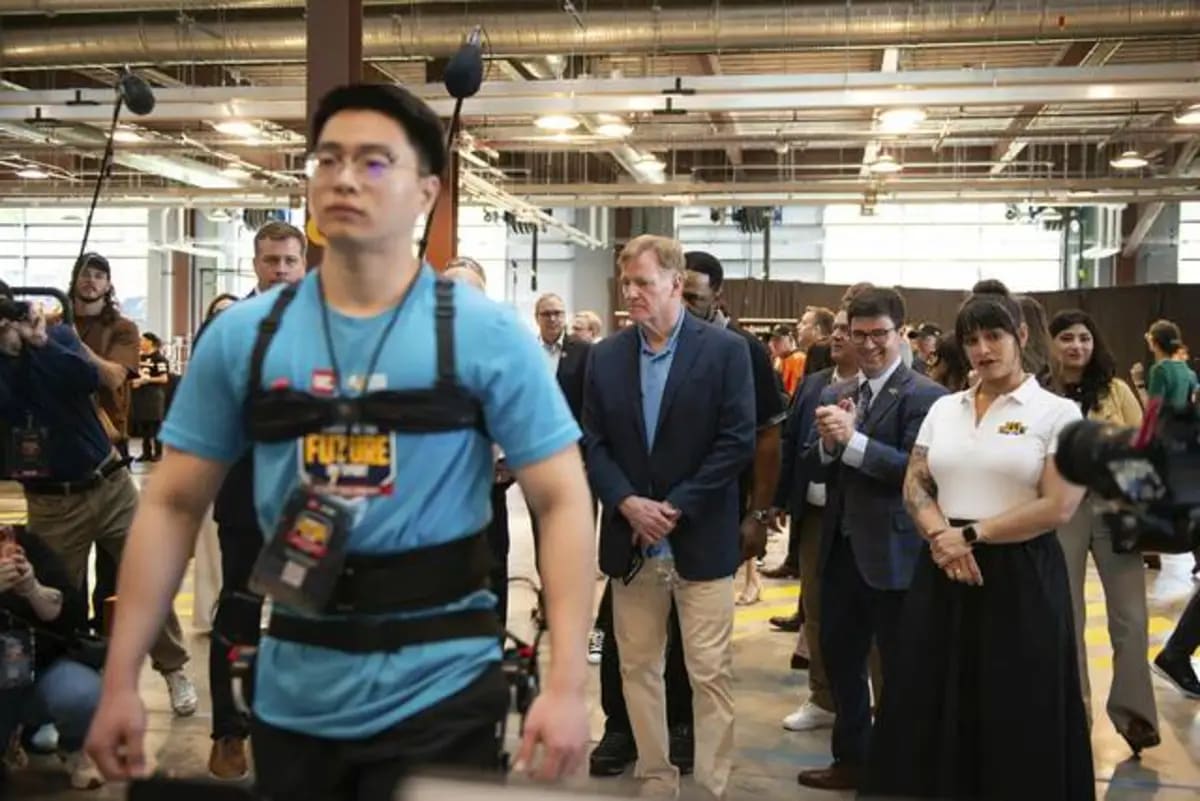
The technology goes far beyond entertainment. CMU's MetaMobility Lab presented an AI-powered exoskeleton that adapts to human motion in real time, supporting walking, stair climbing, and balance.
Inseung Kang, a mechanical engineering professor at CMU, explained how the system learns from each person. "The human body is all different, the way we move and behave is all different, so the controller needs to adapt to each individual," he said. The exoskeleton uses sensor data to create customized recovery solutions for injured athletes.
Jerome Bettis, who played for the Steelers from 1996 to 2005, watched the demonstrations thinking about his son Jerome Jr., who currently plays football for Notre Dame. "It's going to change the game that we love and know, it'll be a totally different game by the time he looks at the NFL," Bettis reflected.
The applications extend beyond football fields. FuturHand Robotics demonstrated surgical robots that can retrieve, hold, and use tools in operating rooms. Students showed how humanoid robots can coordinate dual arms, make decisions, and even deliver a Steelers Terrible Towel with precision.
The Ripple Effect
These innovations could democratize elite athletic training. Imagine high school teams in rural areas accessing the same robot-assisted conditioning as professional franchises. The exoskeleton technology could help weekend warriors recover from injuries faster, keeping people active throughout their lives.
Ham envisions entertainment possibilities that sound like science fiction. "It would not be far-fetched to see a five versus five bots on a field playing bot versus bot, or bots on human teams," he said.
The technology is still evolving, with the football-throwing robot in phase one of three development stages. But the progress happening in Pittsburgh's Hazelwood Green neighborhood shows how quickly AI and robotics are moving from laboratory experiments to practical tools that could benefit everyone from professional athletes to people recovering from injuries.
The future of sports isn't just coming—it's already throwing passes in Pittsburgh.
Based on reporting by Google: robotics innovation
This story was written by BrightWire based on verified news reports.
Spread the positivity!
Share this good news with someone who needs it


