College Students Keep 355 Girls in School During Periods
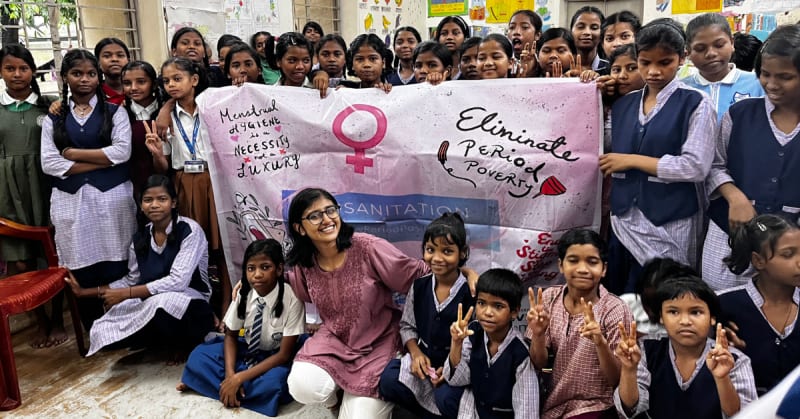
When Sristi Bose saw empty desks during menstruation week, she started asking questions. Now her student-led team brings menstrual health education to rural girls across seven Indian states.
Sristi Bose was just a teenager when she noticed something troubling during a school charity visit in Jamshedpur. Entire rows of desks sat empty because girls were menstruating.
"I was also going through puberty at the time," recalls Sristi, now 19. "That's when I realized how many women and girls in rural areas don't have basic knowledge about menstruation."
That moment stayed with her through graduation and into college. Eleven months ago, as a computer science student at Manipal Institute of Technology, she launched Project Ecosanitation to change what she'd witnessed.
Getting other students to join wasn't easy at first. But slowly, eleven classmates signed on, including two young men, united by a simple belief: menstrual health education should reach every girl.
The team now operates across seven states: Karnataka, Bihar, Jharkhand, Rajasthan, Telangana, Maharashtra, and West Bengal. They've reached 355 girls and women with interactive sessions on menstrual hygiene, body literacy, and when to seek medical help.
"We try to create spaces where girls feel safe asking questions," Sristi explains. "A lot of them have never had the chance to talk about this openly."
Each session includes free biodegradable sanitary pads because the team believes awareness without access feels incomplete. But they're thinking even bigger about sustainability.
India generates 113,000 tonnes of sanitary pad waste every year, polluting soil and water. Project Ecosanitation is developing hemp-based biodegradable pads using 70 percent hemp fiber and 30 percent cotton cellulose.
Hemp naturally prevents rashes, a common problem with conventional pads. The team aims to price their pads between 10 and 15 rupees, matching current market rates while staying accessible to rural communities.
They're planning small manufacturing units run by local women, creating both jobs and easier access. "We want these products available through schools and health centers," Sristi says. "In some tribal areas, women still use cloth or even leaves."
The Ripple Effect
What started as one teenager's uncomfortable realization is becoming a student movement. By having students conduct sessions in their home states, the project stays rooted in local culture rather than feeling like an outside intervention.
The team tracks their impact through feedback forms at every session, learning what questions girls ask and what barriers remain. They're not just distributing products or information. They're building trust in communities where menstruation has long been shrouded in shame and silence.
Mentor Hrishita Singh Charan, founder of the Udaipur-based Rahda Foundation, emphasizes what makes this campaign different: "What matters most is the order in which it happens."
For Project Ecosanitation, conversation comes first, then access, then sustainable solutions built by and for the communities they serve. Empty desks are filling up, one honest conversation at a time.
More Images
%2Fenglish-betterindia%2Fmedia%2Fmedia_files%2F2026%2F01%2F29%2Ffeatured-img-2026-01-29-09-00-13.png)
%2Ffilters%3Aformat(webp)%2Fenglish-betterindia%2Fmedia%2Fmedia_files%2F2026%2F01%2F29%2Ffeatured-img-2026-01-29-09-03-00.png)
%2Ffilters%3Aformat(webp)%2Fenglish-betterindia%2Fmedia%2Fmedia_files%2F2026%2F01%2F29%2Ffeatured-img-2026-01-29-09-06-10.png)
Based on reporting by The Better India
This story was written by BrightWire based on verified news reports.
Spread the positivity!
Share this good news with someone who needs it