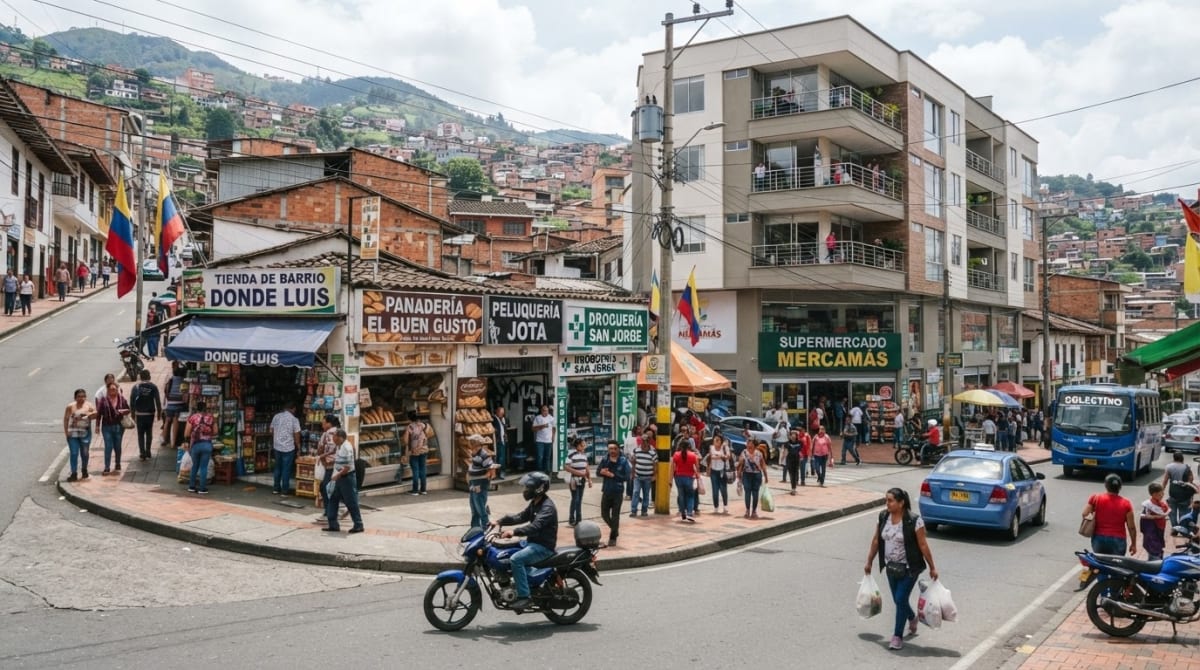
Colombia's Corner Stores Now Drive 60% of Food Sales
Small neighborhood shops and mid-sized cities are reshaping Colombia's economy, with local tiendas handling more than half the nation's food purchases. The shift marks a dramatic change from decades of growth centered in just three major capitals.
More than 260,000 corner stores across Colombia have quietly become the country's economic backbone, handling 60% of all food purchases and reaching 96% of lower and middle-income families.
The transformation shows up clearly in new census data. Colombia's registered businesses doubled from one million in 1990 to over two million in 2024, but the real story is where that growth happened.
Cities like Bucaramanga, Pereira, Santa Marta, and Villavicencio attracted most of the expansion. These mid-sized hubs now account for 69% of business establishments, up from 60% three decades ago, pulling economic momentum away from Bogota, Medellin, and Cali.
Small businesses power this shift. Neighborhood corner shops, hairdressers, bakeries, and auto repair garages have filled the gap left by declining manufacturing, which dropped from 9.5% to just 5.2% of Colombia's total business population since 1990.
Lower operating costs and better connectivity helped these intermediate cities thrive. Growing industries like tourism, healthcare, and agricultural processing created opportunities that didn't require heavy industrial infrastructure.
The Ripple Effect spreads beyond simple economics. These tiendas de barrio serve as community anchors, providing not just food and supplies but also jobs, social connections, and accessible services in neighborhoods across the country.
Economist Eduardo Freire analyzed the 2024 National Urban Economic Census and found something remarkable. The businesses transforming Colombia's economy aren't tech startups or multinational factories but ordinary shops owned by everyday entrepreneurs.
That accessibility matters. Small service businesses require less capital to launch than manufacturing plants, making them natural engines for growth in cities that never built the industrial base of larger capitals.
Fenalco, Colombia's national retailers federation, confirms these corner stores have become genuine economic heavyweights rather than small side businesses. Their reach into lower and middle-income households means they touch the daily lives of millions.
The data suggests Colombia's economic future looks different from its past. Service-oriented businesses steadily expanded to fill the space once dominated by industrial operations, creating a more distributed and locally rooted economic map.
Colombia's small shop owners are building tomorrow's economy one neighborhood at a time.
More Images
Based on reporting by Google News - Economic Growth
This story was written by BrightWire based on verified news reports.
Spread the positivity!
Share this good news with someone who needs it