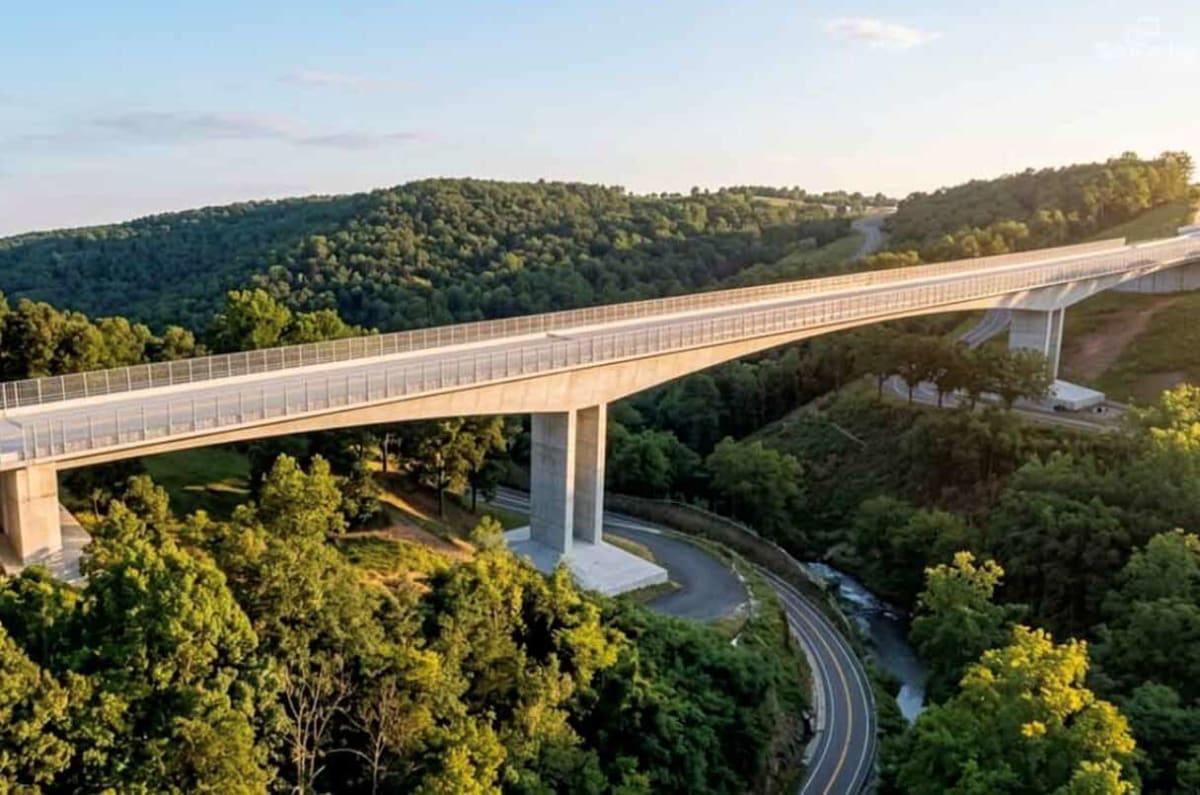
Costa Rica Builds Central America's Longest 4-Lane Bridge
A 1,010-foot bridge rising in Costa Rica will soon become one of Central America's longest four-lane spans, connecting mountain communities to economic opportunity. The massive structure is the centerpiece of a decades-long dream to link the country's heartland with its northern regions.
Deep in Costa Rica's mountainous terrain, construction crews are building a bridge that will stretch longer than three football fields and transform how nearly a million people travel.
The Cañuela Bridge will measure 1,010 feet when complete, making it one of Central America's longest four-lane bridges. It will soar across the steep valleys between Naranjo and San Ramón, connecting Costa Rica's Central Valley with its Northern Zone.
Building a structure this massive requires serious engineering. Crews are driving 94 concrete piles 82 feet into the ground, each nearly 4 feet wide, to create a foundation strong enough to support four lanes of traffic across one of the region's most challenging landscapes.
The bridge is the crown jewel of Punta Sur, a 5.1-mile stretch of entirely new highway designed for safer, faster travel. Construction company MECO is working on eight different sections simultaneously, building 13 major structures including bridges, overpasses, and viaducts.
This isn't just about concrete and steel. The project includes wildlife crossings so animals can safely navigate their habitats, plus design features to handle the intense rainfall that climate change is bringing to the region.
The $196 million project, funded by an Inter-American Development Bank loan, started construction in May 2025 and aims to finish by April 2028. Once a separate central section connects the remaining gap, drivers will have a complete modern corridor between San José and the Northern Zone.
The Ripple Effect
More than 848,000 people will directly benefit from this new route. Farmers in the Northern Zone will get their crops to market faster and fresher. Tourism operators will welcome more visitors who can now reach remote destinations safely. Families separated by mountains and winding roads will reconnect more easily.
Costa Rican governments have pursued this highway connection for decades, understanding that good roads build good communities. The new route will cut travel time, reduce accidents on dangerous mountain passes, and open economic doors for regions that have long felt isolated from the capital.
For a country known for protecting its rainforests and pioneering renewable energy, Costa Rica is now showing how infrastructure can connect people while respecting the environment. Every pile driven into the ground represents progress toward a future where geography doesn't limit opportunity.
When the first cars cross the Cañuela Bridge in 2028, they'll be driving over more than river water—they'll be traveling across a bridge to possibility.
More Images




Based on reporting by Tico Times Costa Rica
This story was written by BrightWire based on verified news reports.
Spread the positivity!
Share this good news with someone who needs it