Costa Rica Farms Team Up to Protect Peninsula Wildlife
Five private farms across Costa Rica's rugged Nicoya Peninsula are getting paid to protect their forests while scientists document the incredible wildlife thriving there. Camera traps are revealing what happens when conservation meets community collaboration.
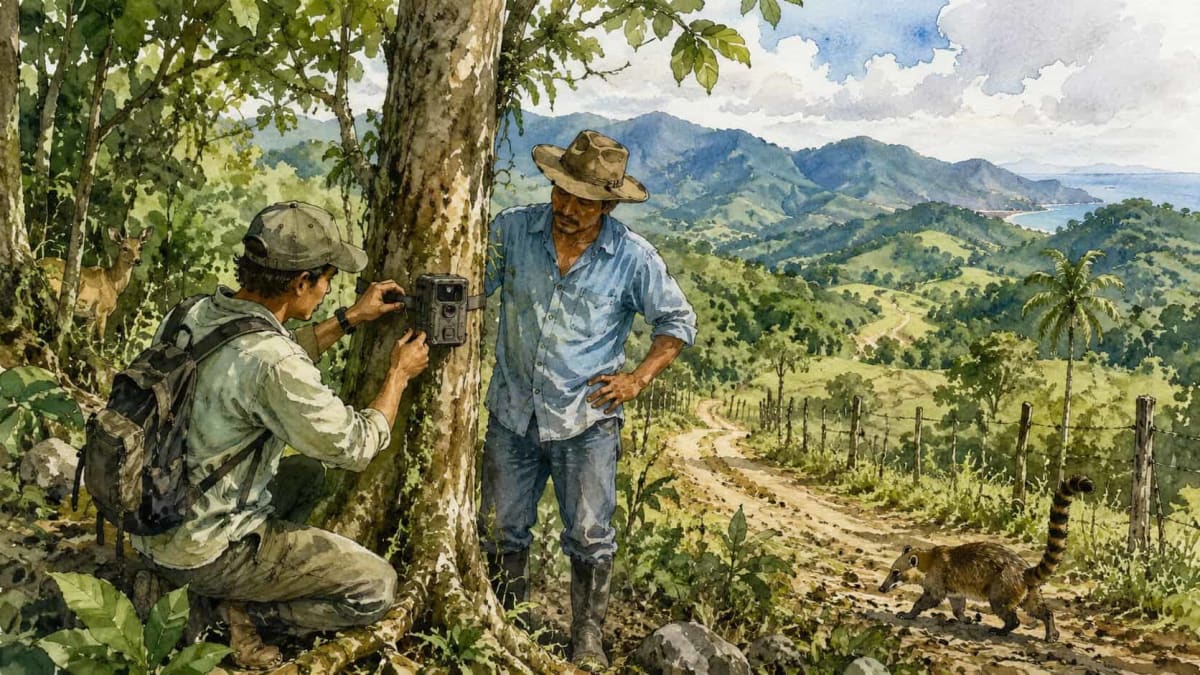
When biologist Vincent Losasso set out to place camera traps on five scattered farms in Costa Rica's Nicoya Peninsula, he didn't just find wildlife. He found proof that paying landowners to protect forests actually works.
The farms sit across Guanacaste's wild mountains, each one privately owned but connected through a special program. Landowners receive regular payments to keep their forested areas untouched, turning working farms into wildlife corridors.
Getting to these remote properties meant crossing at least ten streams, navigating cliff-edge roads, and dodging fallen trees. One wrong turn nearly left Losasso's truck wedged on a three-foot-wide walking bridge. But the rough journey revealed something beautiful: these protected patches of forest are teeming with life.
On one mountaintop farm, an elderly landowner hadn't visited part of his property in forty years. When he finally rode his horse back there with Losasso, they found prime habitat for camera trap monitoring. Another farmer guided the biologist to locations where wildlife clearly travels, sharing decades of knowledge about the land.
Three environmental consultants joined Losasso on the remaining farms, teaching him forest secrets along the way. The Espavel tree produces seeds that taste like candy. Certain spiky plants hide delicious hearts of palm at their centers, but only during specific weeks of the year.
The Ripple Effect
This isn't just about fifteen cameras on five farms. Costa Rica's payment-for-ecosystem-services program has been quietly transforming private land into protected habitat for decades. By compensating farmers for conservation instead of development, the country proves that environmental protection and rural livelihoods can support each other.
The camera traps will document jaguars, pumas, tapirs, and countless other species using these connected forest patches as highways through the landscape. That data helps scientists understand which conservation strategies work best and shows participating farmers the direct impact of their commitment.
The scattered farms create stepping stones of protected forest across a region that might otherwise be cleared. Wildlife that needs large territories can move safely between areas, maintaining genetic diversity and healthy populations.
Now in the easier second phase of the project, Losasso knows the routes and has friends waiting at each location. But those challenging first visits revealed the real story: when communities get supported for protecting nature, everyone wins.
The cameras are rolling, the forests are standing, and Costa Rica's wildlife has more room to roam.
More Images




Based on reporting by Tico Times Costa Rica
This story was written by BrightWire based on verified news reports.
Spread the positivity!
Share this good news with someone who needs it