CU Boulder Traps Light on Chip With Record Efficiency
Scientists at CU Boulder have created tiny glass racetracks that capture and amplify light with almost no energy loss, potentially revolutionizing sensors and quantum computers. The breakthrough uses highway-inspired curves and sub-nanometer precision to keep light circulating longer than ever before.
Imagine trapping light inside a microscopic racetrack so efficiently that it could power the next generation of sensors and quantum computers.
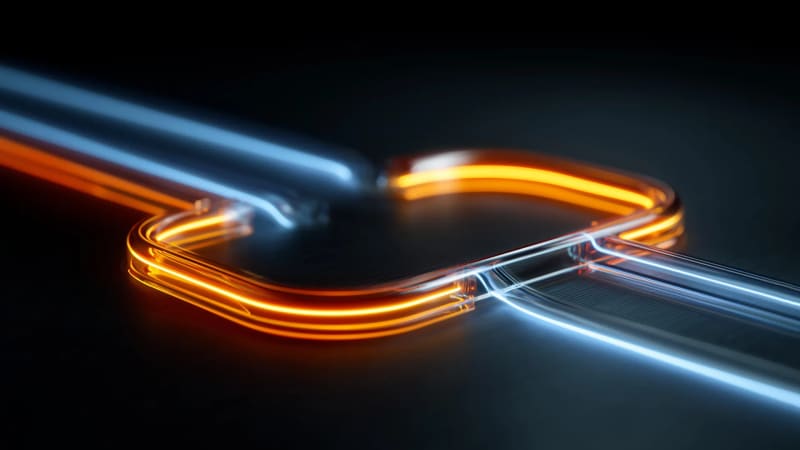
Researchers at the University of Colorado Boulder have done exactly that. They've engineered optical microresonators, tiny structures that confine light in loops smaller than the width of a human hair, achieving some of the lowest energy loss ever recorded.
The secret lies in their unconventional design approach. Instead of building traditional circular loops, the team created elongated racetrack shapes with specially engineered curves borrowed from highway design. These "Euler curves" guide light around bends as smoothly as interstate on-ramps guide cars, preventing the light from escaping.
"Just as vehicles cannot navigate sudden right angle turns at speed, light does not travel efficiently through sharp bends," said Won Park, professor of electrical engineering. By minimizing these sharp turns, photons circulate longer inside the device, building up the intensity needed for advanced sensing and computing applications.
The fabrication process pushed the boundaries of what's possible at microscopic scales. Fourth-year doctoral student Bright Lu led the work in a specialized clean room using electron beam lithography, which can create structures with sub-nanometer precision. That's thousands of times more precise than traditional methods.
"Clean rooms are just cool," Lu said. "You're working with these massive, precise machines, and then you get to see images of structures you made only microns wide." The team transformed thin films of specialized semiconductor glass into working optical circuits that rival anything created worldwide.
The choice of material proved equally important. The researchers used chalcogenide glass, a family of specialized semiconductors that allow intense light to pass through with minimal loss. These materials are notoriously difficult to work with, requiring careful balance during fabrication.
"Our work represents one of the best performing devices using chalcogenides, if not the best," Park said. Professor Juliet Gopinath, who has collaborated on the project for over a decade, confirmed their results matched state-of-the-art devices made from other materials.
Physics PhD student James Erikson tested the finished devices by precisely aligning lasers with the microscopic structures. He watched for sharp "dips" in the transmitted light signal that indicate resonance, the moment when photons become trapped and circulate within the racetrack.
"We've been chasing this kind of resonator for a long time," Erikson said. "When we saw the sharp resonances on this new device we knew right away that we'd finally cracked the code."
The Ripple Effect extends far beyond the lab. These ultra-efficient microresonators could lead to compact navigation sensors that don't rely on GPS, chemical detectors that identify substances with unprecedented sensitivity, and advanced quantum systems for next-generation computing. Because they operate using less optical power, future devices could be smaller, more energy-efficient, and more practical for everyday use.
The team published their findings in Applied Physics Letters, marking a significant milestone in optical engineering.
One day soon, the principles guiding cars smoothly around highway curves might also guide light through the sensors in your smartphone or the quantum computers solving tomorrow's biggest challenges.
Based on reporting by Science Daily
This story was written by BrightWire based on verified news reports.
Spread the positivity!
Share this good news with someone who needs it