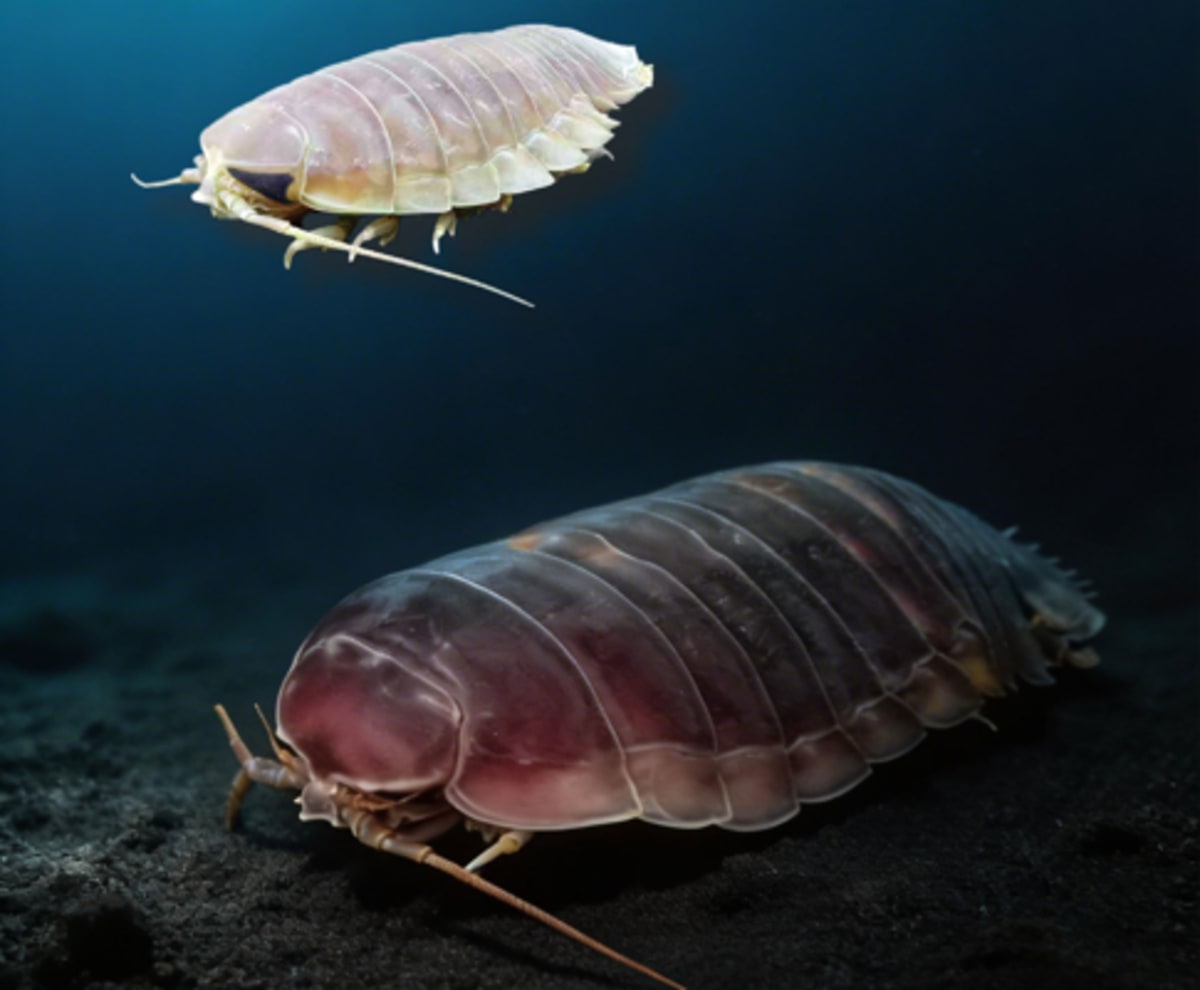
Deep-Sea Giant Survives 5 Years Without Food
Scientists have discovered how a tablet-sized deep-sea creature can survive over five years without eating. The secret is a gene it "stole" from bacteria millions of years ago.
Imagine not eating for five years and thriving. That's exactly what the supergiant isopod does in the deepest, darkest parts of the ocean.
Chinese scientists have finally cracked the code behind this remarkable survival skill. The answer lies in a gene the creature hijacked from bacteria and turned into its own energy-saving superpower.
The supergiant isopod is a distant cousin of the pill bugs you find in your garden, but supersized to about the length of a tablet computer. It lives thousands of feet below the ocean surface, where food is incredibly scarce and the water is freezing cold.
Researchers from the Institute of Oceanology of the Chinese Academy of Sciences worked with teams from Hong Kong and Xi'an to solve this biological puzzle. They published their findings in the journal Cell in June 2026.
Lead researcher Yuan Jianbo and his team discovered the isopod uses a two-part survival strategy. First, it has an enormous stomach that takes up two-thirds of its body, acting like a built-in deep freezer where it stores food for months or years.
Second, it runs on an ultra-low metabolism, essentially keeping itself in permanent power-saving mode. But the real breakthrough came when scientists found the gene responsible for this slowdown.
The gene, called ND1, didn't originally belong to the isopod at all. Through a process called horizontal gene transfer, the creature copied useful DNA directly from symbiotic bacteria, like hitting biological copy-paste.
To test their discovery, the team inserted the ND1 gene into zebrafish, nematodes, and human cells. At normal temperatures, the gene made organisms burn energy faster and become less tolerant of starvation.
But in cold conditions that mimic the deep sea, ND1 flipped like a switch. It slowed down energy metabolism and boosted starvation endurance in zebrafish by 37 percent.
This temperature-dependent switch solves what scientists call the "energy paradox." How can a large animal with high energy needs survive where almost no food exists? The ND1 gene acts like a smart thermostat, adjusting energy use based on the environment.
Why This Inspires
This discovery shows nature's incredible ability to innovate under pressure. The isopod didn't just evolve slowly over time. It borrowed genetic tools from completely different organisms and repurposed them for survival.
The research could inspire real-world applications too. Yuan suggests the findings might help advance longevity research, obesity treatment, and sustainable aquaculture by teaching us how to manage energy more efficiently.
Understanding how life thrives in Earth's most extreme environments reminds us that solutions to our biggest challenges might already exist in nature, just waiting to be discovered.
Based on reporting by Google News - Scientists Discover
This story was written by BrightWire based on verified news reports.
Spread the positivity!
Share this good news with someone who needs it


