Delhi Hospital Opens India's First Sensory Park for Kids
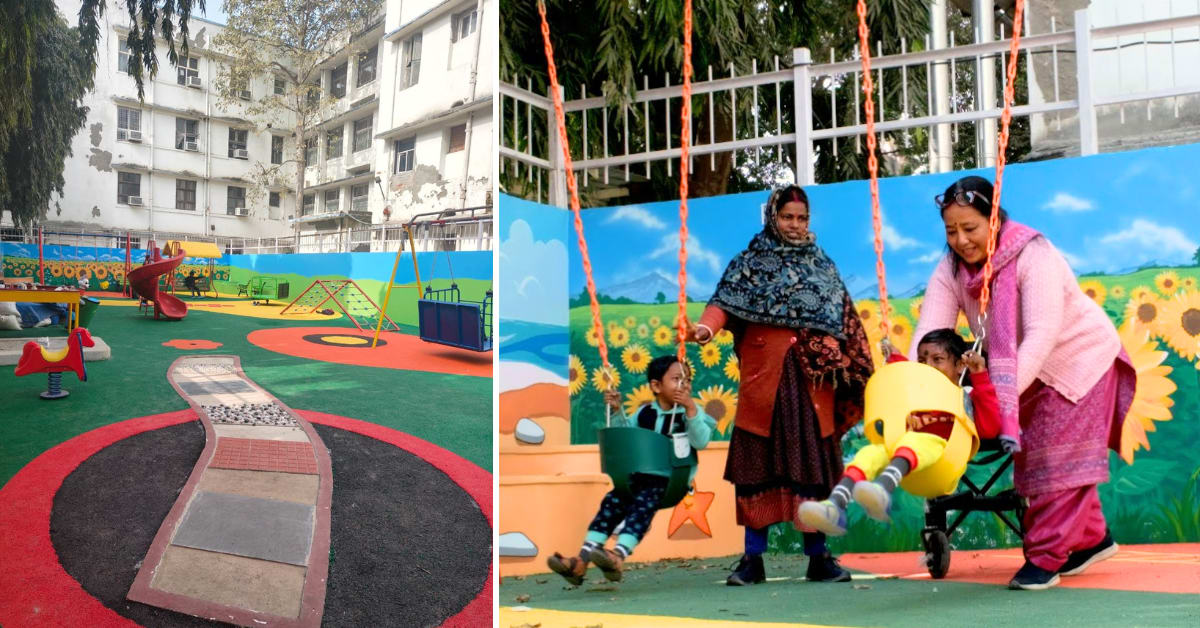
A new sensory park at Delhi's Safdarjung Hospital gives children with disabilities a place to play safely after years of exclusion from public playgrounds. Umang Vatika opened in January 2026, transforming what a hospital visit can feel like for thousands of families.
When a five-year-old girl with cerebral palsy was reportedly turned away from a Delhi playground swing in February 2026, the viral video sparked outrage. But for many parents of children with disabilities, the moment felt painfully familiar.
Public parks across India rarely welcome children with special needs. Narrow gates, uneven ground, and standard playground equipment quietly signal who belongs and who doesn't.
That's why Umang Vatika matters. Opening on January 9, 2026, at Safdarjung Hospital in Delhi, it's a sensory park designed specifically for children with neurodevelopmental needs like autism, cerebral palsy, and developmental delays.
The 2,500-square-foot space sits right next to the hospital's pediatric ward. Unlike typical playgrounds, it uses adaptive design with textured surfaces, specialized swings, and equipment that supports balance and coordination while letting kids explore safely alongside their peers.
The idea started five years ago with Pratik Aggarwal, executive director of ASTHA, an organization serving people with disabilities in Delhi's urban slums. In 2017, he spent his birthday accompanying a young girl with cerebral palsy and kidney failure through hospital corridors.
"I realized there was no real space for children with disabilities," Pratik says. "It made me question why hospital spaces had to feel so grave for our kids. Even if their condition may or may not improve, their lives should still be filled with dignity and joy."
That question became a mission. ASTHA partnered with Safdarjung Hospital's pediatric neurology division, Kilikili (an organization specializing in inclusive play spaces since 2006), and the R Squared Foundation, which sponsored the project.
The timing worked because ASTHA already ran monthly camps at Safdarjung helping families obtain disability ID cards. Hospital officials recognized the need immediately since their pediatric neurology department treats many children who could benefit from sensory play.
Getting approval took patience. After the hospital agreed in September 2024, officials spent months navigating permissions and green zone regulations. By December, the site was cleared. The Central Public Works Department reorganized sewage lines, electrical systems, and water pipelines to prepare the space safely.
The Ripple Effect
Umang Vatika represents more than one playground. It signals a shift in how India's medical institutions think about childhood, disability, and dignity.
For children who spend long stretches in hospitals, the park offers moments of lightness alongside treatment. For families navigating developmental challenges, it provides validation that their children deserve spaces designed with them in mind, not despite them.
The park also serves as a working model. Other hospitals and municipalities can see what inclusive play looks like in practice, how it can be built within existing infrastructure, and why it matters for communities often overlooked in urban planning.
Every child who swings, climbs, or explores in Umang Vatika sends a message louder than any viral video: play isn't a privilege, it's a right.
More Images
%2Fenglish-betterindia%2Fmedia%2Fmedia_files%2F2026%2F03%2F02%2Fsensory-park-safdarjung-2026-03-02-15-45-45.png)

%2Ffilters%3Aformat(webp)%2Fenglish-betterindia%2Fmedia%2Fmedia_files%2F2026%2F03%2F02%2Fumang-vatika-2026-03-02-16-13-05.png)
%2Ffilters%3Aformat(webp)%2Fenglish-betterindia%2Fmedia%2Fmedia_files%2F2026%2F03%2F02%2Fumang-vatika-2026-03-02-16-08-05.png)
Based on reporting by The Better India
This story was written by BrightWire based on verified news reports.
Spread the positivity!
Share this good news with someone who needs it