DeWalt's Robot Drills 90,000 Data Center Holes in Days
A new autonomous drilling robot is transforming data center construction, completing in days what used to take human workers two months. The technology cuts costs by two-thirds while achieving 99.97% accuracy.
Building the massive concrete facilities that power artificial intelligence used to mean workers spending weeks bent over hand drills, grinding thousands of precise holes into thick floors. Now a robot can do the entire job in days, working around the clock with almost perfect accuracy.
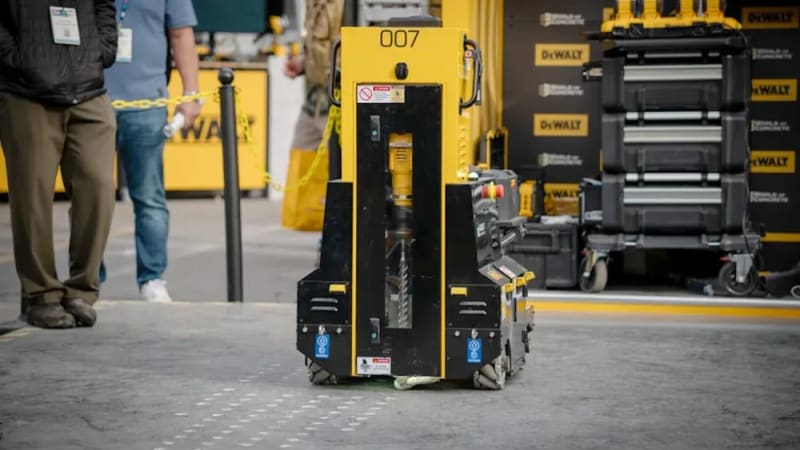
Tool maker DeWalt just unveiled an autonomous drilling robot that roams data center construction sites, drilling the thousands of anchor holes needed to secure server racks. Developed with August Robotics and tested on real projects, the robot has already drilled more than 90,000 holes without human help.
The speed difference is remarkable. What takes human crews up to two months in a large data center now takes a small fleet of three or four robots just days to complete. For smaller holes, the robot finishes one every 80 seconds. Larger holes take three minutes each.
The timing couldn't be better. Data centers are growing into sprawling campuses as tech companies race to build AI infrastructure, with each facility requiring up to 10,000 perfectly placed holes. But the construction industry faces a shortage of more than 500,000 skilled workers, making labor shortages the leading cause of project delays.
Bill Beck, president of tools for Stanley Black and Decker, says precision matters enormously in this work. "You can't have the hole be a quarter of an inch off," he explains. The robot achieves 99.97% accuracy while operating 24 hours a day.
The Ripple Effect
The innovation solves multiple problems at once. Workers avoid the physical strain of repetitive drilling work that demands hours of bending and precision. Construction companies can move forward with projects faster, since nothing else can happen until the drilling is complete.
The cost savings are substantial too. Human crews charge about $65 per hole, while the robotic fleet brings that down to $20 per hole. For projects requiring thousands of holes, those savings add up quickly.
DPR Construction, the largest data center contractor in America, plans to prioritize testing the technology in 2026. Tyler Williams, the company's field and robotic innovation leader, sees it as a way to "reduce ergonomic strain on craft teams, boost productivity, and generally make the onsite experience better for people."
The robot will be commercially available by mid-2026, just as demand for data centers reaches new heights. Tech giants like Meta, Google, and OpenAI are pushing to build capacity as quickly as possible to stay competitive in artificial intelligence development.
For an industry facing worker shortages and growing project demands, this robot offers a path forward that's faster, more affordable, and easier on human bodies.
Based on reporting by Google: robotics innovation
This story was written by BrightWire based on verified news reports.
Spread the positivity!
Share this good news with someone who needs it