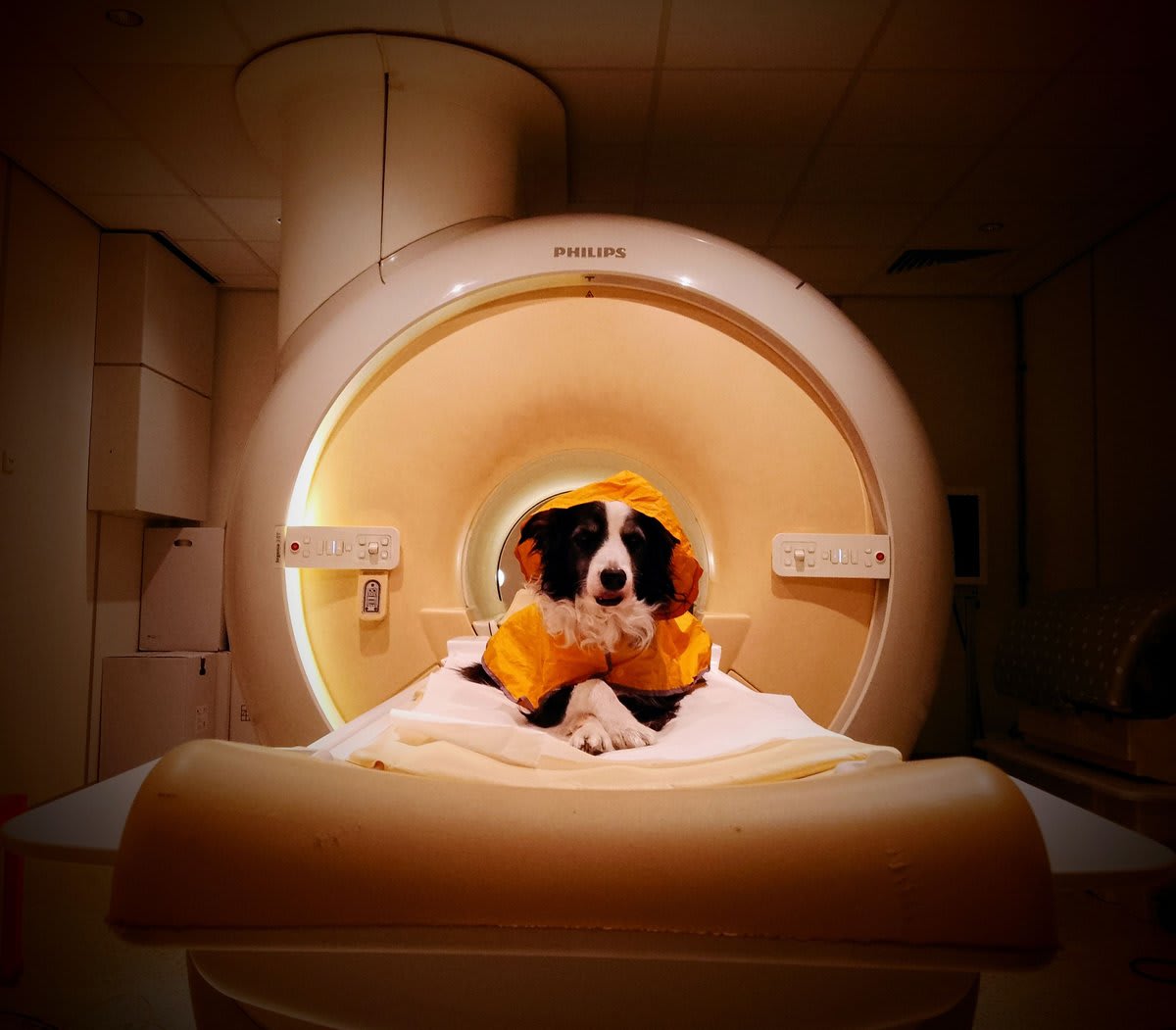
Dogs' Brains Light Up When They See You Smile
Your dog really does know when you're happy, and new brain scans prove their minds actually respond differently to human emotions. Scientists found that happy faces activate the reward center in dogs' brains, the same area that lights up when they smell their favorite person or anticipate a treat.
Your dog isn't just wagging their tail to be polite. New research shows that when you smile at your furry friend, you're literally lighting up the reward center of their brain.
Scientists at the University of Vienna trained dogs to sit perfectly still in an MRI machine while viewing human faces showing different emotions. What they discovered was remarkable: dogs don't just recognize our facial expressions, they process them in surprisingly sophisticated ways.
When the dogs looked at happy faces, their caudate nucleus became active. This is the same brain region that fires up when they smell someone they love or know a treat is coming. In other words, seeing you smile gives your dog an actual neurological reward.
The researchers didn't stop there. They showed 12 dogs faces expressing happiness, sadness, anger, and fear to see if the animals could tell negative emotions apart.
The dogs' brains showed the strongest response to happy faces. But here's what excited the scientists most: the dogs could distinguish between fear and anger at a neurological level, processing these two negative emotions differently.
"For the first time, we found this distinction in the dog brain between two negative emotions," says Laura Cuaya, the study's senior author and postdoctoral researcher. The finding suggests dogs process emotions much like humans do, not just as positive versus negative.
The research makes sense given our deep history together. Dogs and humans have lived side by side for tens of thousands of years, and understanding our signals has been essential to that relationship.
Why This Inspires
This study gives scientific proof to what millions of dog owners already suspected in their hearts. Our pets aren't just responding to commands or food, they're genuinely tuned into our emotional states at a biological level.
The researchers used strangers' faces in the study, which means dogs are likely even more sensitive to the emotions of their own families. Every smile you give your dog creates a small celebration in their brain.
Lead author Raúl Hernández-Pérez puts it beautifully: "Dogs do pay attention to you; they do pay attention to your face. Just by smiling at them, you are giving them something."
The study shows our bond with dogs runs deeper than we imagined, written not just in years of companionship but in the very structure of their brains.
More Images



Based on reporting by Scientific American
This story was written by BrightWire based on verified news reports.
Spread the positivity!
Share this good news with someone who needs it