Earth's Core Holds 9 to 45 Oceans' Worth of Hydrogen
Scientists discovered Earth's core may contain up to 45 oceans' worth of hydrogen, making it the planet's largest water reservoir. This finding rewrites our understanding of how Earth got its water during the earliest days of planetary formation.
Deep beneath your feet lies a secret ocean larger than all the water on Earth's surface combined, and scientists just figured out how to measure it.
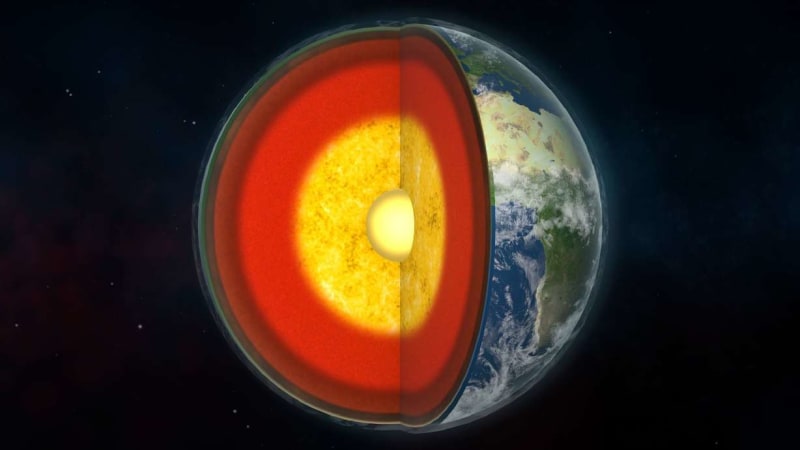
Researchers at Peking University estimate that Earth's molten metal core contains between 9 and 45 oceans' worth of hydrogen. That's not liquid water swirling around down there, but hydrogen atoms locked in iron and nickel under crushing pressure, thousands of miles below the surface.
The discovery changes how we think about Earth's origin story. Instead of comets delivering water to our planet's surface after it formed, Earth likely captured most of its hydrogen during those first chaotic million years when rocks and dust crashed together to build our world.
Lead researcher Dongyang Huang and his team faced a major challenge. The core sits too deep for anyone to visit, and its extreme conditions are nearly impossible to recreate in a lab. Hydrogen is also the tiniest, lightest element, making it incredibly tricky to measure.
Their solution was brilliantly simple. They melted iron with lasers in a diamond press, mimicking core conditions. Then they used atom probe tomography, a technique that literally counts atoms one by one, to see how hydrogen interacts with silicon and oxygen in the molten metal.
The results showed hydrogen makes up roughly 0.36% to 0.7% of the core's total weight. Previous estimates ranged wildly from 0.1 oceans to more than 120 oceans because older methods couldn't measure hydrogen directly at the atomic scale.
Why This Inspires
This discovery does more than solve an ancient puzzle about planetary formation. Understanding how hydrogen moved into Earth's core helps explain how our planet developed its protective magnetic field, the invisible shield that makes life possible by deflecting harmful solar radiation.
Without that churning, hydrogen-rich core releasing heat into the mantle billions of years ago, Earth might never have become the habitable oasis we call home. Every ocean we see, every raindrop that falls, connects to this vast hidden reservoir that's been there since the beginning.
Other scientists are already building on this work. Kei Hirose at the University of Tokyo thinks the hydrogen levels might be even higher than the new estimates suggest. Rajdeep Dasgupta at Rice University notes this research supports the idea that hydrogen was present throughout Earth's entire growth process, not added later.
The techniques developed for this study open doors to understanding other planets too. If scientists can count atoms in samples that mimic Earth's core, they can apply similar methods to investigate how rocky planets around distant stars might harbor the building blocks of life.
What started as a measurement challenge has become a window into Earth's deepest secret, one that's been hiding in plain sight for 4.6 billion years.
More Images




Based on reporting by Google News - Science
This story was written by BrightWire based on verified news reports.
Spread the positivity!
Share this good news with someone who needs it