Eight Automakers Join Forces to Fix EV Charging Problem
A Durham-based charging network just earned top marks from EV drivers by making public charging actually work. IONNA, backed by Toyota, BMW, GM, and five other major automakers, proves competitors can team up to solve problems too big for anyone to tackle alone.
Eight of the world's largest car companies are betting that better charging stations can reignite America's stalled electric vehicle revolution.
IONNA, the Durham-based charging network owned by Toyota, BMW, General Motors, Honda, Hyundai, Kia, Mercedes-Benz and Stellantis, just received a J.D. Power award for ranking highest among public fast-charging networks. The honor comes at a crucial moment, as EV sales dropped 20.5% in the second quarter compared to last year.
The companies gathered in Durham on Wednesday to celebrate their unusual partnership. In an industry built on fierce competition, these rivals decided some problems require cooperation.
"We felt if we pooled together to help the entire industry, that would benefit the customer and, of course, benefit the overall market," said Thibaut de Barros Conti, vice president of business development at Toyota North America.
Public charging remains the top reason Americans reject electric vehicles, according to J.D. Power. Drivers worry about finding chargers and whether they'll actually work when they arrive.
IONNA is changing that reality. The network now operates about 177 locations across 30 states with more than 1,400 charging bays. The company plans to reach 200 locations by year's end and build at least 30,000 bays across North America by 2030.
The numbers show real progress. The share of visits where drivers couldn't charge despite finding a station dropped to 12%, the lowest rate since researchers began tracking the problem. IONNA scored 807 points out of 1,000, beating both the Mercedes-Benz Charging Network and Rivian Adventure Network.
CEO Seth Cutler says reliability is just the starting point. "The question is, how do you build on top of that from an overall experience where I have something to do while I'm there, I feel safe, it's a place that's enjoyable?"
North Carolina has become central to the electric vehicle future. Toyota's $13.9 billion battery plant in Liberty began production in 2025 and expects to employ about 5,100 people when fully staffed. The facility makes batteries for hybrids, plug-in hybrids and fully electric vehicles.
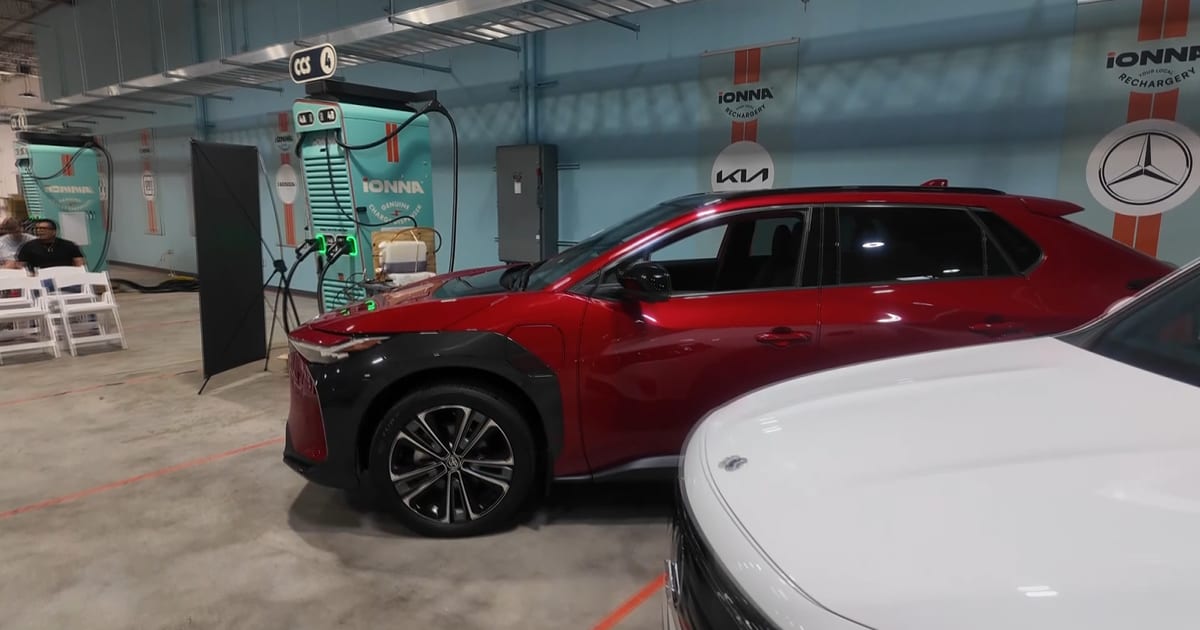
IONNA's first "Rechargery" transformed a roughly 100-year-old gas station in Apex into a charging destination with covered chargers, bathrooms, a 24-hour lounge and a bakery run by a local entrepreneur. The chargers work for any vehicle brand and support both major connector types.
The Ripple Effect
This partnership tackles more than car sales. Transportation generates 28% of America's greenhouse gas emissions, with most coming from gasoline and diesel. Making EVs more practical helps address climate change while creating thousands of manufacturing and service jobs.
The automakers are expanding despite current sales challenges because they see the bigger picture. Cutler predicts sales could rebound as early as next year, and the network needs to be ready.
Even as quarterly numbers fluctuate, the companies maintain their long-term vision. "There's been, of course, a slowdown for some time, but there's still a long-term trajectory for battery electric vehicles and all electrified vehicles," de Barros Conti said.
Sometimes the best competition means working together first.
Based on reporting by Google News - Electric Vehicle
This story was written by BrightWire based on verified news reports.
Spread the positivity!
Share this good news with someone who needs it