Einstein Tile Crystal Bends Light in Unexpected Ways
Scientists built a crystal from a never-repeating shape that mathematicians searched for decades to find. The crystal bends light differently than any ordinary crystal, opening doors for future optical technology.
A team at the University of Tokyo just turned a math puzzle into a breakthrough light-bending crystal that could change how we build optical computers.
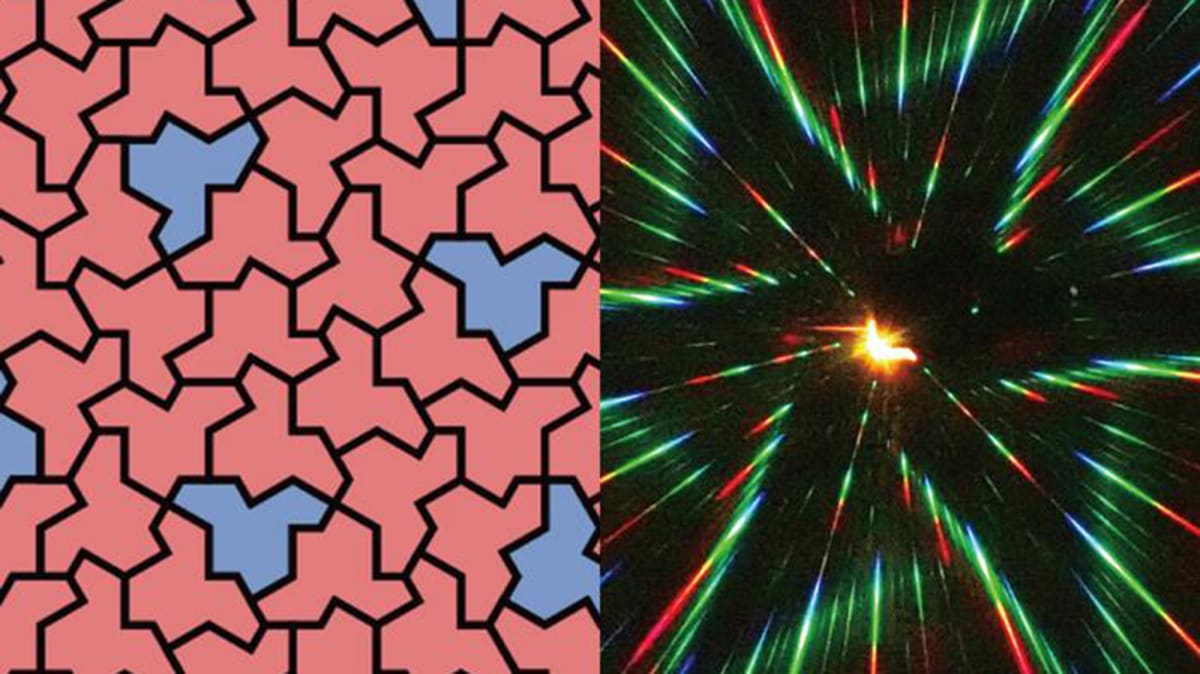
For decades, mathematicians searched for a single shape that could cover a surface forever without its pattern ever repeating. They called it the "einstein problem," a pun on the German words "ein stein" meaning "one stone." In 2023, geometry enthusiast David Smith finally cracked it with a quirky 13-sided shape nicknamed the "Smith hat."
Experimental physicist Yuto Moritake stumbled across the hat tile while reading a popular science book in 2024. He wondered what would happen if he used this never-repeating pattern to build a photonic crystal, a special material designed to control light for uses like lasers and optical sensors.
His team punched hundreds of thousands of tiny holes into a silicon nitride chip, each one 500 times thinner than a human hair. The holes followed the hat tile's unique pattern, creating something no one had built before.
When they shined a laser at the finished crystal, something remarkable happened. The light scattered into a beautiful pinwheel-shaped pattern with well-defined bright spots. Even more surprising, the crystal responded differently depending on which direction the light was spinning, clockwise or counterclockwise.
Ordinary crystals can't do this. The hat tile's lack of mirror symmetry gives it a special property called chirality, like how your left hand differs from your right. That asymmetry created an optical effect Moritake didn't initially expect to find.
Why This Inspires
This discovery shows how pure math puzzles can unlock real-world breakthroughs. A shape that existed only as an abstract curiosity less than two years ago is now bending light in ways that could revolutionize technology.
Moritake wants to use this never-repeating pattern to control light inside photonic chips for optical communications and computing. These technologies use light instead of electricity to transmit and process information, potentially making our devices faster and more efficient.
Sometimes the most unexpected connections lead to the brightest discoveries.
More Images

Based on reporting by Google News - Science
This story was written by BrightWire based on verified news reports.
Spread the positivity!
Share this good news with someone who needs it