Engineers Make Magnets Dance Like Graphene Electrons
Scientists at the University of Illinois have discovered that magnets can follow the same physics rules as graphene, opening doors to tiny wireless devices. The breakthrough connects two worlds that scientists always thought were separate.
A graduate student playing with magnetic materials just revealed a hidden connection in physics that could shrink your phone's wireless components to microscopic size.
Bobby Kaman at the University of Illinois was studying metamaterials when he noticed something strange. Both graphene's electrons and magnetic waves behave like ripples moving through water. That observation sparked a wild idea: what if he could design a magnetic system that acts exactly like graphene?
Graphene is a wonder material made of carbon atoms arranged in hexagons, and its electrons move in ways that break normal physics rules. Scientists have studied it intensely since its discovery. But nobody expected magnets to play by the same rulebook.
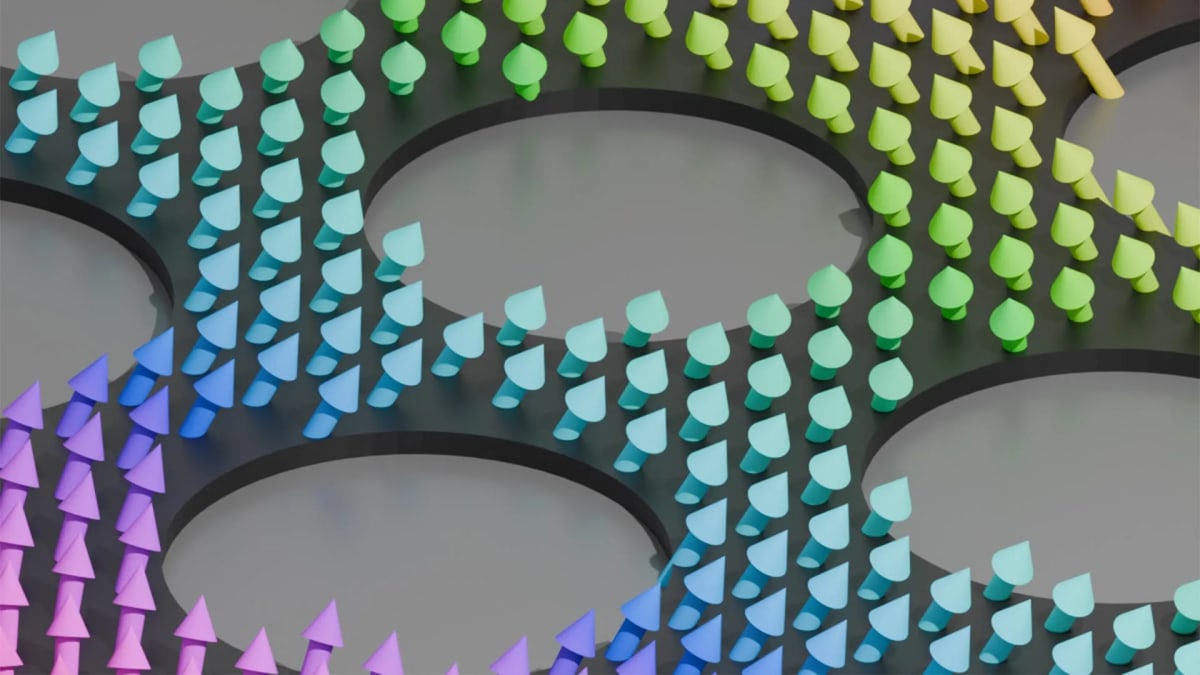
Kaman and his team created a thin magnetic film dotted with tiny holes arranged in the same hexagonal pattern as graphene. Inside this structure, magnetic waves called spin waves traveled through the material. When the researchers calculated how these waves moved, they were stunned.
The magnetic waves followed the exact same mathematical equations as graphene's electrons. The system was even richer than expected, showing nine different energy patterns at once. Some waves acted massless like graphene's electrons, while others created completely new behaviors.
"It's not at all obvious that there is an analogy between 2D electronics and 2D magnetic behaviors, and we're still amazed at how well this analogy works," Kaman said. His advisor, professor Axel Hoffmann, noted that magnetic crystals usually produce confusing behaviors that scientists catalog without understanding. This graphene connection finally explains what's happening.
The Ripple Effect
The discovery goes beyond elegant physics. These magnetic systems could revolutionize wireless technology by replacing bulky microwave components with devices smaller than a human hair.
Microwave circulators, which direct radio signals in cellular networks, currently take up significant space in phones and routers. The team's magnetic system could shrink these components to the micrometer scale. They've already filed a patent application for potential devices.
The breakthrough also gives scientists a powerful new toolkit. Graphene has been studied for decades, so researchers have developed sophisticated methods to analyze it. Now those same tools can unlock secrets in magnetic materials that were previously too complex to understand.
The National Science Foundation funded the work through the Illinois Materials Research Science and Engineering Center. The team published their findings in Physical Review X this month.
What started as one student's curiosity about wave patterns has bridged two distant islands of physics, proving that nature's deepest rules connect in surprising ways.
Based on reporting by Science Daily
This story was written by BrightWire based on verified news reports.
Spread the positivity!
Share this good news with someone who needs it