NASA's Roman Telescope Launches Early and Under Budget
NASA's newest space telescope is ready to launch eight months ahead of schedule and under budget, a rare feat in space exploration. The Roman Space Telescope will capture massive infrared images of the universe, revolutionizing how we study everything from distant galaxies to nearby asteroids.
NASA just proved that space projects can actually finish early and save money.
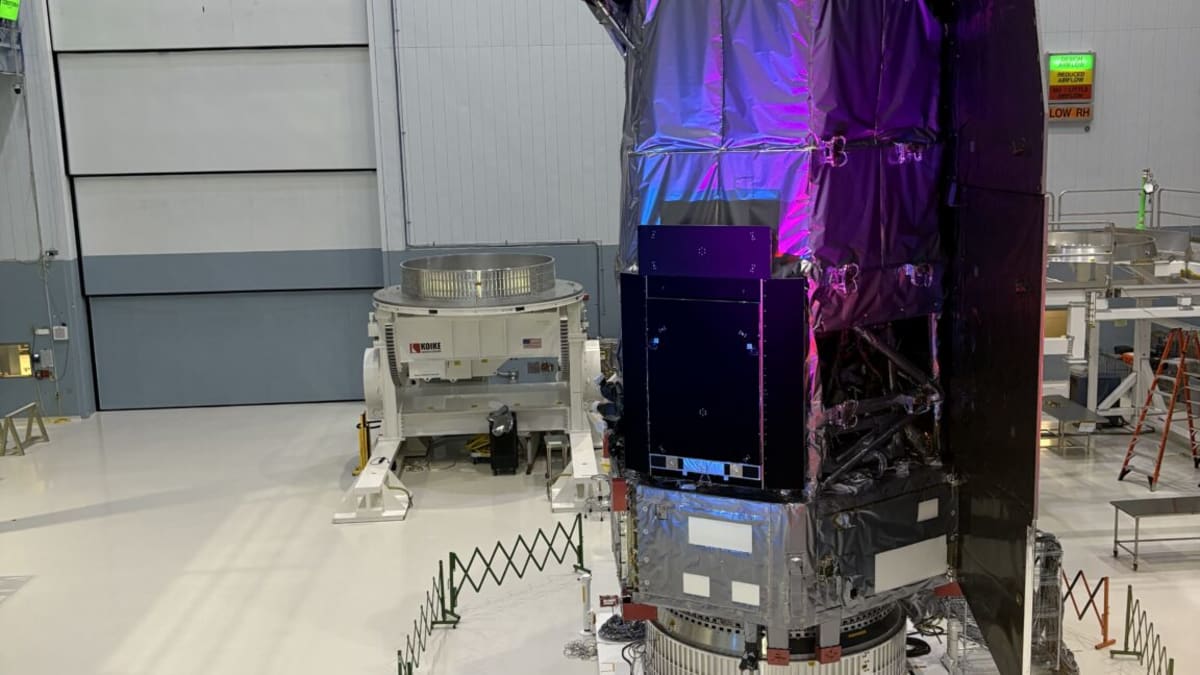
The Nancy Grace Roman Space Telescope is fully assembled and ready for its September launch, arriving eight months ahead of schedule and under budget. In an era when space missions often face delays and cost overruns, this achievement stands out as a model for future projects.
The telescope got an unexpected boost in 2012 when the National Reconnaissance Office donated two surplus spy satellites to NASA. The hardware was nearly twice the size of what NASA had originally planned, forcing engineers to scale up the entire project. Rather than causing delays, the larger telescope opened up new possibilities for higher resolution imaging and better instruments.
What makes Roman special is its ability to see the big picture. Unlike the Hubble and Webb telescopes, which focus on tiny slices of the sky in incredible detail, Roman captures an area roughly the size of a full Moon in a single image. That's 100 times wider than Hubble's largest images.
The telescope's 18 detectors will each capture 16 million pixels, creating images so massive that displaying one at full resolution would require enough 4K TVs to cover El Capitan in Yosemite. All that data adds up to 1.4 terabytes streaming back to Earth every day.
Roman will hunt for infrared light, which our atmosphere normally blocks but reveals some of the universe's most important secrets. The earliest galaxies, exoplanet atmospheres, and the large scale structure of the early universe all shine brightest in infrared wavelengths.
The telescope also carries a coronagraph, an instrument that blocks out stars to reveal orbiting planets. This marks the first time a coronagraph with active elements will fly in space, paving the way for the future Habitable Worlds Observatory that will search for Earth-like planets.
The Ripple Effect
The lessons learned from Roman's success could transform how NASA approaches future missions. Administrator Jared Isaacman highlighted the project as a potential template, showing that careful planning and creative problem solving can keep ambitious projects on track.
Engineers kept the design deliberately simple. Unlike Webb's complex origami of mirrors and sunshields, Roman has few moving parts. Solar arrays and the communication antenna simply spring into place once released, a process that starts just 20 minutes after separating from the launch vehicle.
The telescope could begin doing science before it even reaches its final orbit around the L2 Lagrange point. NASA astronomer Julie McEnery said commissioning will take only 90 days, remarkably fast for such a sophisticated instrument.
Roman carries enough fuel for at least 10 years of operations, though it will likely last longer. Once it starts observing in the fall, the telescope will survey vast regions of space, cataloging asteroids near Earth and mapping baryon acoustic oscillations from the early universe.
The project proves that when circumstances align and teams work efficiently, space exploration can exceed expectations while respecting taxpayer dollars.
More Images


Based on reporting by Google News - Science
This story was written by BrightWire based on verified news reports.
Spread the positivity!
Share this good news with someone who needs it