ENIAC Turns 80: The Computer That Started It All
Eighty years ago today, the world's first large-scale electronic computer was unveiled in Philadelphia, launching the digital revolution that powers our modern world. ENIAC's breakthrough design turned weeks of calculations into seconds and sparked eight decades of innovation.
On February 15, 1946, a room-sized machine in Philadelphia changed human history forever. The Electronic Numerical Integrator and Computer, better known as ENIAC, became the first programmable electronic digital computer, proving that high-speed computing wasn't just possible but practical.
The need was urgent. During World War II, military gunners needed artillery firing tables to hit their targets accurately, but human "computers" took days to calculate each table by hand. The U.S. Army commissioned engineers John Mauchly and J. Presper Eckert at the University of Pennsylvania to build something faster.
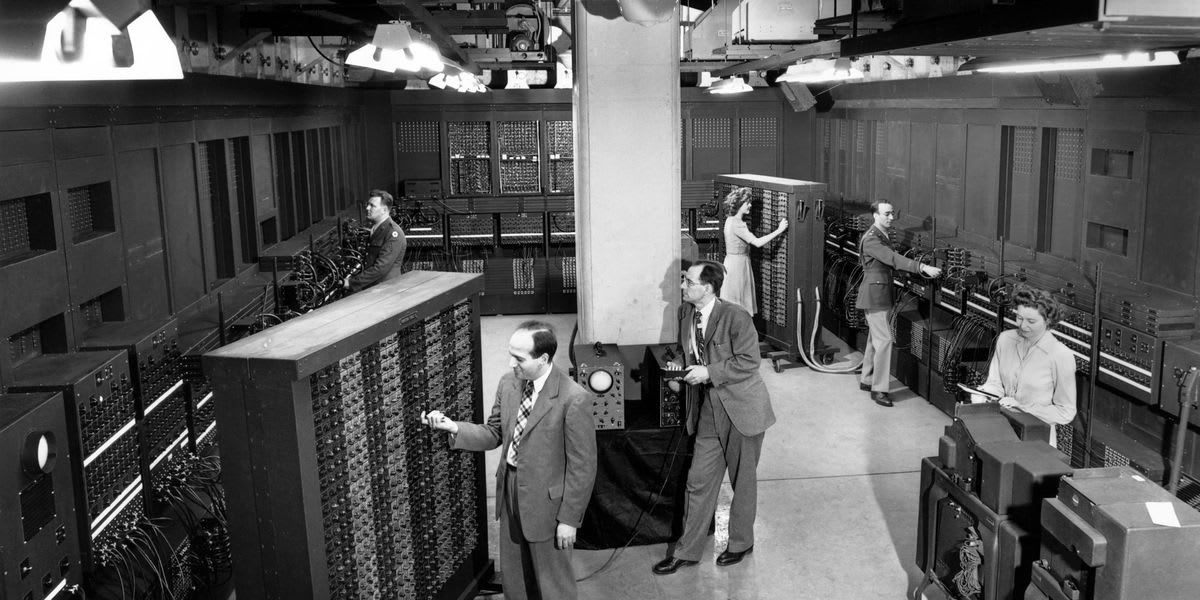
What they created was revolutionary. ENIAC filled a 9-meter by 15-meter room and contained 18,000 vacuum tubes kept cool by 80 air blowers. It weighed 30 kilograms and consumed enough electricity to power a small town, but it could perform calculations in seconds that took humans weeks to complete.
Programming ENIAC meant physically rewiring the machine with cables and switches, a process that took several days. Despite this limitation, it worked beautifully for nearly nine years before being decommissioned in 1955.
The Ripple Effect
ENIAC's success sparked a computing revolution that continues today. Within a decade, universities including Cambridge, MIT, and Princeton built their own machines. The innovations kept flowing: integrated circuits in 1958, microprocessors in 1971, personal computers in 1981, the World Wide Web in 1989, cloud computing in 2002, and generative AI in 2023.
Today's pocket smartphone has millions of times more computing power than ENIAC. The digital economy ENIAC helped create now drives global innovation and supports billions of lives worldwide.
In 1987, IEEE recognized ENIAC as a historic milestone, calling it "a major advance in the history of computing" that "established the practicality of large-scale electronic digital computers." The organization noted how strongly ENIAC influenced modern computer development.
The story has one more chapter worth celebrating. Among ENIAC's key contributors was Adele Katz Goldstine, one of the machine's original programmers who helped prove that electronic computing could work.
From calculating artillery tables in a Philadelphia basement to powering artificial intelligence across the globe, ENIAC's 80-year legacy reminds us that breakthrough innovations often start with solving one urgent problem and end up transforming everything.
More Images

Based on reporting by IEEE Spectrum
This story was written by BrightWire based on verified news reports.
Spread the positivity!
Share this good news with someone who needs it