Enzyme Discovery Could Extend Life of Weight Loss Drugs
Scientists at the University of Utah have discovered an enzyme that transforms peptide drugs like Ozempic into longer-lasting forms. The breakthrough could help medications stay effective in the body for hours instead of minutes.
The next generation of weight loss and diabetes medications might work longer and better, thanks to a tiny molecular machine discovered by Utah researchers.
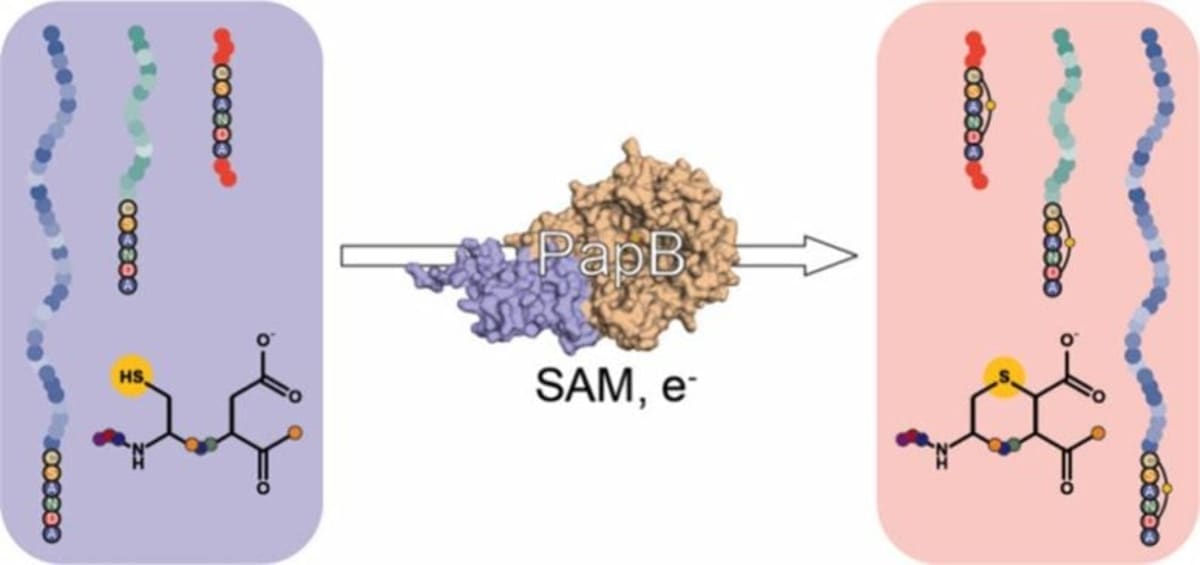
Chemistry scientists at the University of Utah have identified an enzyme called PapB that can reshape therapeutic peptides into compact ring structures. This process, called macrocyclization, could dramatically improve drugs like semaglutide, the active ingredient in Ozempic and Wegovy.
The discovery matters because peptide drugs face a critical challenge. The human body constantly breaks them down using proteases, enzymes that chop proteins into pieces. A medication that works beautifully might only last minutes before your body dismantles it.
PapB solves this problem by tying the peptide ends together into a ring, essentially hiding the drug from the enzymes that want to break it down. Think of it like tucking in the loose threads on a sweater so they don't unravel.
"You have these peptides that could have a great biological response, but if that biological response only lasts minutes, then all of a sudden you don't have a good therapeutic," said Karsten Eastman, study co-author and CEO of Sethera Therapeutics. "By using this enzymatic method to tie off the ends, we are essentially hiding the peptide from some of the most common proteases in the body."
What makes PapB special is its flexibility. Unlike other enzymes that need specific molecular signals to work, PapB successfully formed rings on three different GLP-1-like peptides without requiring extra sequences. It even worked when researchers swapped in unusual amino acids commonly used in modern diabetes drugs.
"We were surprised by how flexible the enzyme turned out to be," said Jake Pedigo, the study's lead author and graduate student. "It didn't need the usual leader sequence, and it still worked even when we swapped in unusual amino acids."
The method also offers practical advantages over traditional chemical approaches. Conventional techniques for closing peptide rings are often expensive and difficult to apply late in drug development. PapB provides a cleaner, more controlled option that could be integrated into existing production processes.
The Ripple Effect
This discovery extends beyond weight loss medications. The researchers founded Sethera Therapeutics to bring their enzyme technology to market, creating what they call the PolyMacrocyclic Peptide Discovery Platform. The University of Utah's Technology Licensing Office recognized their innovation by naming them 2025 Founders of the Year.
The platform could revolutionize how pharmaceutical companies develop all kinds of peptide drugs. By making medications more stable and longer-lasting, patients might need fewer doses, experience better results, and see fewer side effects.
The research team, supported by the National Institutes of Health, published their findings in ACS Bio & Med Chem Au. Their laboratory experiments confirmed that the enzyme successfully formed stable ring structures even with the complex building blocks used in current medications.
Eastman emphasizes they're not replacing existing drugs but enhancing them. "Big pharma's GLP-1 backbones are already excellent," he said. "What we're adding is a clean, late-stage enzymatic step that can make those molecules work even harder."
The discovery opens doors to peptide therapies that are more stable, more targeted, and easier to produce for millions of patients worldwide.
More Images

Based on reporting by Google News - Scientists Discover
This story was written by BrightWire based on verified news reports.
Spread the positivity!
Share this good news with someone who needs it