Eye Surgery Laser Could Remove Brain Tumors with Precision
Scottish scientists have proven that lasers similar to those used in routine eye surgery could one day remove brain tumors with 100 times more precision than current surgical tools. The breakthrough could transform neurosurgery in the coming decades.
Brain surgeons may soon wield a tool that cuts 100 times finer than a human hair, thanks to research that started with supermarket lamb liver and a laser originally designed for eye surgery.
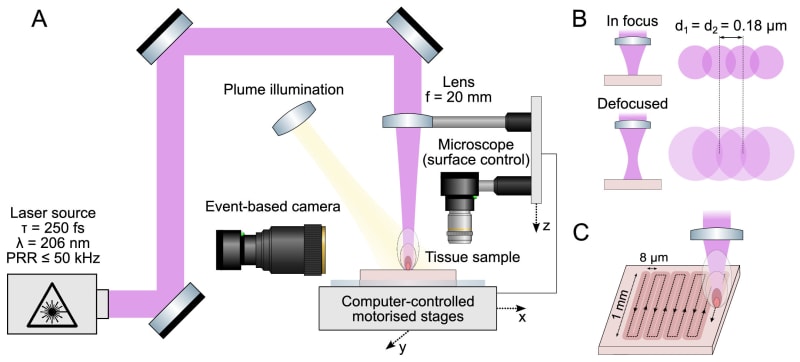
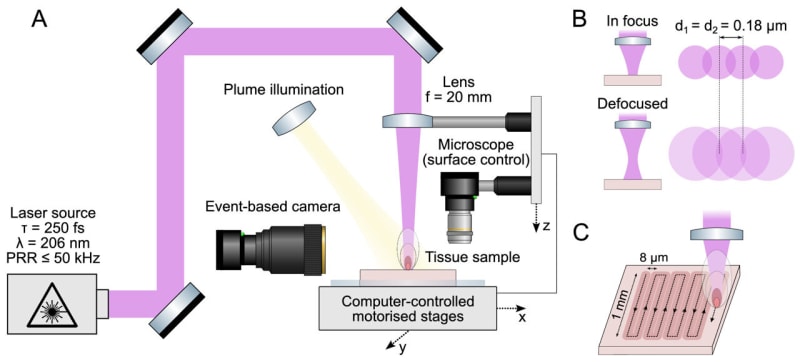
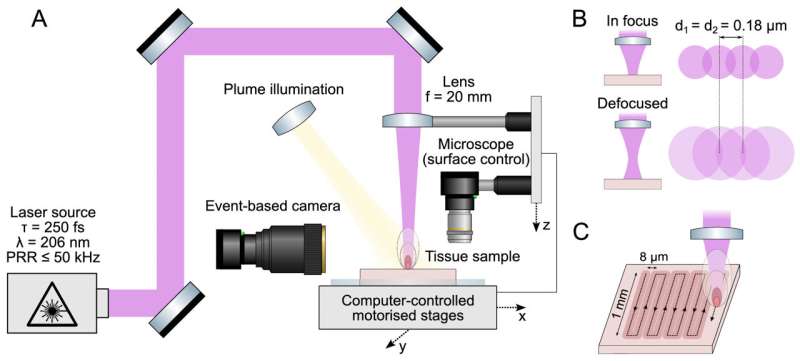
Scientists at Heriot-Watt University and the University of Edinburgh have cracked a puzzle that's stumped researchers for three decades. They've shown how deep-ultraviolet lasers can remove soft tissue in slices just 10 micrometers thick without damaging anything around it.
That's 100 times more precise than what neurosurgeons can currently achieve in the operating room.
Tatiana Malikova, the PhD student who led the study, used lamb liver from a local grocery store to stand in for brain tissue. She needed hundreds of samples to understand exactly how the laser behaves with soft, delicate tissue.
"Brain tissue samples are very hard to get, and we wanted to run a large and tightly controlled study," Malikova explained. The liver worked perfectly as a testing ground.
The technique itself isn't new. Eye surgeons have used similar ultraviolet lasers for LASIK procedures for 30 years, reshaping corneas with controlled light pulses. The top layer of cells absorbs the ultraviolet light and evaporates instantly, protecting everything beneath.
But eyes are easy compared to brains. The cornea is rigid and simple to reach with a laser beam. Soft tissues like brain matter present entirely different challenges.
The Ripple Effect
What makes this research groundbreaking is the microscopic detail Malikova's team captured. Thirty years ago, imaging technology couldn't show the effects clearly enough. Now, arrays of high-quality microscope images prove the laser leaves zero detectable damage to surrounding tissue.
Professor Paul Brennan, a consultant neurosurgeon at the University of Edinburgh, sees the immediate impact. "In neurosurgery, where a few millimeters can determine whether a patient recovers or suffers a lasting deficit, this advancement could be game-changing."
Current surgical tools work on a millimeter scale. This laser system operates at 10 micrometers, and Malikova believes they can go even finer.
The technology won't appear in operating rooms tomorrow. It needs to combine with advances in medical imaging and robotic guidance systems. But within decades, these technologies could converge into a surgical system that transforms how doctors treat brain tumors.
The research team is already looking beyond cancer surgery. Their u-Care project aims to create compact, robust deep ultraviolet light sources that could also fight drug-resistant superbugs, another growing medical threat.
For now, the most exciting part is simply knowing it's possible to operate with cellular-level precision without harming healthy tissue around it.
More Images
Based on reporting by Medical Xpress
This story was written by BrightWire based on verified news reports.
Spread the positivity!
Share this good news with someone who needs it