Farm Robot Company Cracks Outdoor Autonomy After 8 Years
Burro's agricultural robots now work reliably in rain, dust, and extreme heat after confronting real-world challenges most robotics companies avoid. Their breakthrough could unlock autonomous systems for ports, construction sites, and outdoor industries.
📺 Watch the full story above
A robotics company has solved one of the toughest challenges in automation by making machines that work in the real world, not just in controlled demonstrations.
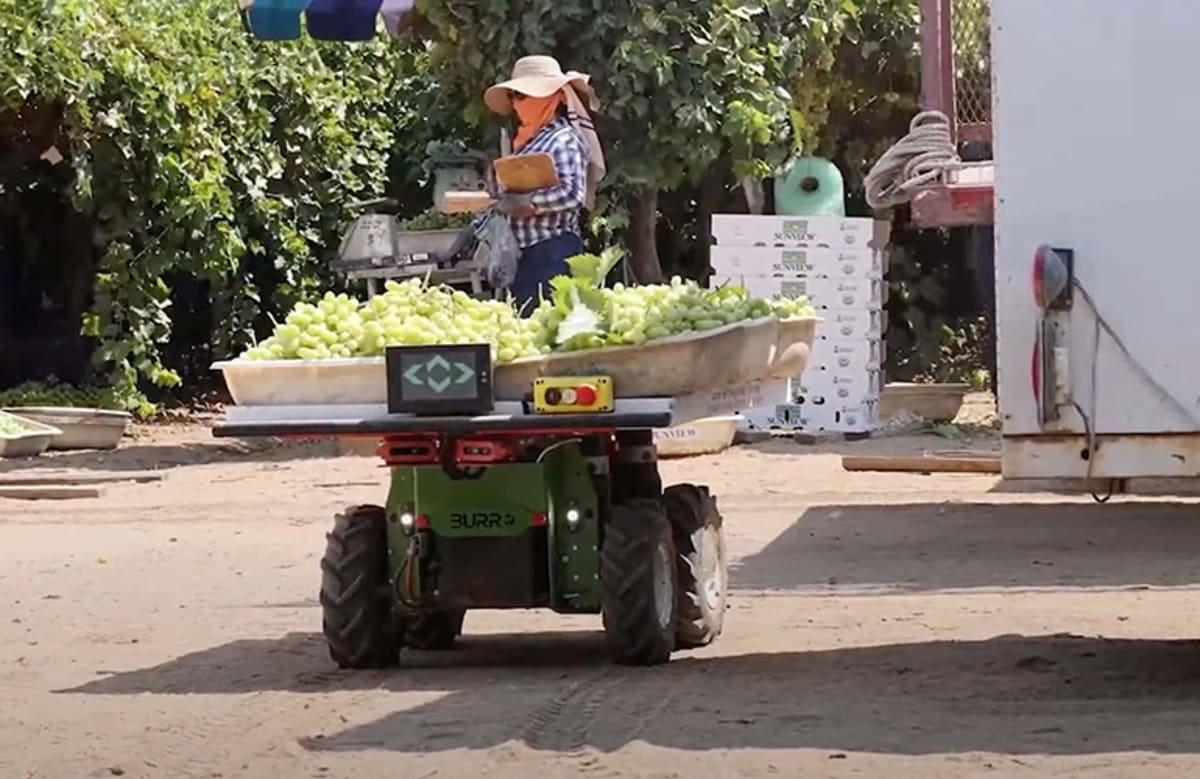
Burro started in 2018 building autonomous robots for farms. Their first demo looked perfect, but co-founder Vibhor Sood admits they didn't understand the real problem yet.
The team quickly learned that outdoor agriculture offers no second chances. Farms have no GPS signals under tree canopy, no controlled lighting, and workers who won't change their behavior to accommodate machines.
Within weeks of adopting Burro's robots, farmers shifted from seeing them as interesting tools to depending on them completely. They organized workflows around the machines and told teams to plan accordingly.
"When it fails, they are not mildly disappointed," Sood explains. "They are angry in the way you are angry when critical infrastructure fails, because that is what it has become."
The same farm row looks completely different at dawn versus midday, in summer versus winter, in rain versus dust. Temperatures swing from below freezing to 120 degrees Fahrenheit.
Making a robot work across all these conditions isn't just harder than making one work in a single condition. It's a fundamentally different engineering achievement that can only be built through years of exposure, not simulation.
The Ripple Effect
Burro's eight years of field data has created a breakthrough that extends far beyond farming. Every mistake made by one robot gets absorbed into the system and corrected across the entire fleet.
This matters because the next frontier for robotics is outdoors. Port yards need autonomous systems that handle heavy vehicle traffic and continuous operations. Construction sites change physically every day as work progresses.
These environments can't be solved from inside a lab. They require what Burro developed: infrastructure-free localization and perception that works reliably as sensors degrade and environments constantly change.
The industrial automation industry has done remarkable work indoors over the past decade. But the physical economy operates in yards, corridors, and open sites that current systems can't handle.
Burro's robots can now carry, tow, scout, patrol, and mow across unpredictable terrain. More importantly, they've proven that autonomous systems can become as reliable as critical infrastructure in the harshest conditions.
The company paid the full cost of learning the difference between a demo and a deployment, and their lessons are opening doors for outdoor autonomy across entire industries.
More Images


Based on reporting by The Robot Report
This story was written by BrightWire based on verified news reports.
Spread the positivity!
Share this good news with someone who needs it